


November 22, 2025
July 25, 2026
Click “Listen Now” to hear the audio version of Insights.
HERE'S MY TAKE
A guest column from Cardus Canada President Brian Dijkema
There were very few weeks of my childhood in which I couldn’t see the United States. That’s not a metaphor. I grew up on the St. Lawrence River, within swimming distance of America, and, because it was Upper Canada, the marks of old American hostilities were everywhere. People in my hometown of Brockville used to hang out—and cruise around in their Firebirds and Trans-Ams—on a place called Blockhouse Island, which was so named because it once held a type of fortification that was put in place after Brockville experienced a raid from the Americans during the War of 1812.
Just down the road from us, in a place called Prescott, was another fortification—Fort Wellington. It, too, was built as a defensive structure to provide protection for Canadians, mainly made up of Loyalists who fled the American revolution, from American aggression during the war. What is fascinating about Prescott is that, for the last 85 years or so, it has been the Canadian host of the Prescott-Ogdensburg bridge, which provides one of the more beautiful, and frictionless, means of transport between our two countries.
And, dear friends, this is a metaphor. The bridge represents not just a cessation of hostilities between us, but a physical, economic, and cultural connection—even friendship—between us. It is a binational ligament, joining trade, enabling cultural exchange, and hosting a flow of traffic reminiscent of the great waterway we’ve shared for centuries.
Think about a bridge for a minute. Actually, think about driving over a bridge that is hundreds of meters above a deep and powerful river. You start out on land, and, bit by bit, move out to a point where your very presence on it is a profound manifestation of trust. Trust in the engineers who designed it, trust in the skill and construction standards of its builders and the workers who put it together, trust in the makers of the steel and concrete used, trust in the hydrological surveyors that the base isn’t going to be swept away by the current, and, ultimately, trust that your journey to the other side isn’t going to be met with guns and fortifications, but a gruff, and at base, friendly face, who ensures that you’re a person of good will and says “Welcome.” Almost all of this, it’s important to note, is unseen, unnoticed. Unless something goes wrong. And then you really notice.
If you’ve read the news these last couple of weeks you’ll probably guess why bridges are on my mind. I’ve been following the Gordie Howe bridge schmozzle for a while now. My brief political take on it is that the Americans are acting in bad faith, typical of this administration; our government has been less than forthright, if not outright dishonest, to its citizens about negotiations; and that debates over revenues for a bridge are more indicative of medieval economic models than those based on modern trade.
On that last point, governments should look only for cost recovery on bridges. The value of a bridge is not in the cash it can generate for either Canada or the US, but for the amount of trade it can facilitate with the minimal amount of friction possible. If we’re debating over revenue as a means to “get a better deal” we’re not much better than brigands, and a hell of a lot less interesting than Little John with a stick on a log challenging Robin Hood to a fight.
But I’m less worried about what you can see—the bridge debate—than I am about the unseen, slow, deterioration of the thing that has made North America great for centuries. This bridge debacle, and the new slew of questionably legal tariffs imposed on Canada this week, combined with the elbows-up posturing, is a bit like road salt on a steel bridge. It’s corrosive. No single thing is going to kill our relationship with each other but, bit by bit, almost imperceptibly, we are trusting each other less. And that means more friction, and that the flow of goods (cultural and economic) between us will thicken and slow. This is not for the greater good.
A quick word on friction. This week, the Cardus executive team had the privilege of taking a retreat where we worked with Jeff Jans on our internal operations, our long-term goals, and planning to grow more effective at our mission. One of the things that Jeff brought to our attention is that conflict, a slightly sharper type of friction, is actually a good thing. In any relationship—business, think-tank, government, even a marriage—conflict is where we raise real issues, where we resolve and remove the things that prevent us from committing to, being accountable to, and achieving the ends to which we are striving.
I’ve seen the results of an institutional culture that is conflict-averse. Resentment grows, issues don’t get dealt with, and, like salt, it too corrodes your ability to get things done properly and well. I think for a long time Canada has been avoiding dealing with some of its own issues. And as much as I think the current American approach resembles nothing so much as a zero-sum, I win you when you lose mentality, it at least has the benefit of bringing to the surface things we should have been talking about years ago: our defence spending levels, the uncompetitive nature of some of our industries and sectors, and so on.
But, as Jeff noted in our discussion, conflict is only productive if it’s done in a context of trust. At the end of the day, trust is like the towers that act as anchors for a suspension bridge: if they give out, the whole thing collapses. The big, unanswered, question is: how are we going to build that up so the next generation can benefit from the bridges between us?
One way to build trust is to spend time together. Our executive retreat this week allowed us to share our lives with one another. And spending time allows you greater space to learn people’s strengths, their weaknesses, their hopes, and their fears. It prevents making decisions based on false impressions and allows you to see what will be to the good of the other, and thus, your organization.
An American magazine commissioned my Cardus colleague Jeff Reimer, an American, and me, a Canadian, to spend time in each other's worlds and report back on what we experienced: a type of Canada/America cultural exchange. They published that this week. The results were interesting, and I encourage you to read Jeff’s take on Canada and my take on America. I’d love to know what you think.
Spending time together comes with a cost. Jeff and I are both busy, and we don’t have a lot of margin. And time, these days, is harder and harder to find. I heard from someone I trust this week that “our elites are increasingly stupid and busy.” I think she is right, and I think the two are connected, perhaps causally.
We need time to think, to reflect. Summer time—where we all take off to live out the dream of wearing shorts forever—is a great time for that. We need time, margin, to think about what we care about, what is most important in life. To reflect on how we, as individuals, and as leaders of businesses, churches, organizations, and governments can spend time on that which matters most. To reflect, I hope, on God, and His great, great love for this world, and for what He is calling you to do in it. I hope that this guest missive is being read by you in a hammock with something cold to drink beside you.
Who knows? Perhaps vacations will save the world.
WHAT I’M READING
Harassment is becoming a threat to Canadian democracy
Hot on the heels of Nova Scotia Premier Tim Houston's windshield being broken and Alberta Premier Danielle Smith being harassed at the Calgary Stampede, a group of four UBC researchers have published a new op-ed in Policy Options examining the rise in harassment of politicians in Canada at all levels. This is not a uniquely Canadian phenomenon, as Brits continue to reckon with the recent murder of former MP Ann Widdecombe.
Young adults are poor despite every metric which suggests otherwise
Johann Kurtz, a financial advisor affiliated with the C.S. Lewis Institute, highlights some of the generational changes in social capital and cost of living which is impacting younger generations. "The goods that constitute a life—house, spouse, children, good school, good neighbors—have inflated so far beyond wages that the ordinary life path of 1965 now requires an extraordinary income. It turns out that we do actually need social capital."
Nuns suing New York over MAiD
A group of Catholic healthcare providers are suing New York state over the recent implementation of Medical Assistance in Dying laws. The nuns, who receive no government support, told The Free Press the bill would force them to proactively raise MAiD with their patients, contrary to their beliefs.
Wagner's Test
With a significant ruling coming soon on Bill 21 and the notwithstanding clause, the Globe & Mail has profiled Chief Justice Richard Wagner and his journey to the top legal role in the land.
MEANINGFUL METRICS
Trusting the Numbers
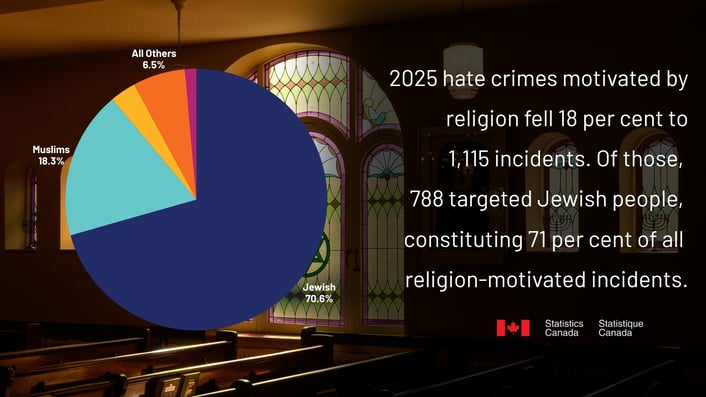
Statistics Canada recently released hate crime statistics for 2025. They found that religious hate crimes reported to police had decreased for the first time since 2018, though the overall number of incidents in 2025 was more than double 2018's count.
Jewish persons were the target of 71 percent of all religion-motivated hate crimes in Canada despite representing about one per cent of our overall population. Jews experienced more recorded hate crimes in 2025 than every other faith, more than those who reported a hate crime based on their sexual orientation, and more than all racial minorities except for black Canadians.
We remain proud of our work to combat antisemitism in Canada through The Simeon Initiative, and concerned about the overall problem of hate in Canada. Freedom of religion remains a Canadian right and a key part of our heritage, going back to our founding. As former prime minister Pierre Elliott Trudeau said, “The golden thread of faith is woven throughout the history of Canada from its earliest beginnings up to the present time.” Despite the year-over-year decline in incidents, that thread remains under significant strain and we must continue to reject hate motivated by faith reasons.
TAKE IT TO-GO

FIFA World Cup a GOOOOOAL for Canada
A final whistle for this week's Insights: Canadians went head over cleats for soccer over the past month. While the economic benefits were not as much of an assist as hoped, Numeris reports that over 30.5 million unique Canadian viewers tuned in to the games on Bell Media's platforms—a scoreline anyone would be happy with. This edition of the beautiful game's biggest tournament even saw the fewest yellow cards given out in World Cup history, though there were some red-card-worthy political stunts which momentarily distracted from the athleticism on display.
Canada's Round of 16 finish kicked our national expectations into a new league. Thanks to all who are stepping onto the pitch to coach and train our future footy superstars, and to those who helped ensure the tournament was a win for fans across the country.
With the August long weekend coming up, we'll skip next week's Insights and look foward to being back in your inbox on Saturday, August 8th.


Reply to Ray