

September 19, 2026
Click “Listen Now” to hear the audio version of Insights.
HERE'S MY TAKE
I was in meetings and missed the live coverage of the several ceremonies commemorating the twenty-fifth anniversary of the 9/11 terrorist attacks last Friday. This made the contrast between different conversations while I waited for my flight doubly interesting. The same speech by former Prime Minister Chrétien at the Gander, Newfoundland ceremony that one friend found inspiring and thoughtful, another saw as self-aggrandizing and hypocritical. “If Trump had said that, everyone would be critical” was his frame. Usually these friends see the world similarly, so it did pique my curiosity to watch the speech for myself.
For those who missed the coverage, Mr. Chrétien, Canada’s 20th Prime Minister who remains an actively engaged, spry 92-year-old, was in office in 2001 and took the occasion of his remarks to directly address the present tensions between Canada and the United States. “Never mistake our generosity for weakness. Never, never mistake our tolerance for lack of determination. And never, never mistake our kindness for softness. We know who we are and we are proud of it...I say that not in anger, but as one friend to another. Friends need to be honest with each other….Vive les États-Unis! Vive le Canada!”
The contrast in responses pointed to a prior question, “What is commemoration for?”, and prompted reflection that meaningful remembering is neither nostalgia nor forgetting, but bringing the past into conversation with the present.
I used my available weekend free time to watch both Chretien’s speech and several other 9/11 commemorative events. (As an aside, I found the conversation between former President George Bush and Secretary of State Condoleezza Rice especially cogent). But the question of “what’s the public purpose of commemoration?”, prompted by my friends' diverse responses, formed a subtext to my watching.
My undergraduate degree is in history. I suppose it’s a credit to my university professor that I can still vividly recall my very first university history lecture. With a bit of dramatic flair, the professor wrote on the chalkboard, “History is bunk. Henry Ford, Chicago Tribune Interview, May 25, 1916.” The quote served as his segue into a larger discussion about the discipline's importance. He engaged with arguments about who gets to define history, how it extends moral questions from one generation to the next, and how history shapes our identity and remains relevant to present issues. This was the mid-eighties, still a time when the “canon” of history was respected and before peak deconstructionism had fully arrived. But increasingly, social history and becoming conscious about the voices that weren’t being listened to were part of the discipline’s consciousness and how students were taught.
All of this was background as I watched 9/11 commemoration highlights. It wasn’t as geeky as it sounds; I knew the next time I engaged either of these friends, I was expected to have and defend my opinion on Prime Minister Chrétien’s speech. What is remembering for and how do we remember well? I toggled three themes in my mind.
-
Remember rather than forget. The binary alternative to remembering is forgetting. The event isn’t first and foremost about the Canada-United States relationship but (among other things) about freedom, security, and democracy; about living together with religious difference; and about a new global socio-political order in which the former “east-west” divide that fell with the Berlin Wall in 1989 was redefined. Figuring out the relationship between faith traditions and the extremists within them; between religious terrorist networks (like al-Qaeda and ISIS) that were different from but connected to the countries that provided them shelter, and what might be the limits of freedom within a democracy in which we all might stay safe were questions that required fresh contemplation and more careful answers. Not to remember or reference what 9/11 has done was not to take into account the context for debates that have continued for the past 25 years.
-
Remembering is intergenerational. Twenty-five years is a long time. In practical terms, one-third of the population does not have a living memory or deep emotional connection to events from 25 years ago. On this year’s anniversary, I spent the day in a meeting with eight people. Only I and one other were in the workforce in 2001 and could tell the stories of that day. Most of the room (mainly in their thirties/early forties, I would guess) told the story of that day in the context of how the adults around them reacted and how they tried to make sense of it. President George Bush compared 9/11 for the present generation to World War I for his: “just a date…(that) had no emotional attachment whatsoever.”
-
Remember honestly. While the Gander story of generosity (made famous by the Come From Away Broadway musical) is an inspiring story, and the heroism of first responders and others who dealt with their tragedy in selfless and remarkable ways (thinking especially of the Todd Beamer story) all deserve retelling and commemoration, remembering well requires more than nostalgia. In fact, it requires honesty. Secretary of State Rice’s honest admission that the government in which she served was not prepared for and did not understand the nature of the threat (something for which she said “I will always carry deep personal remorse”) is a valuable part of the remembering. It was striking that her candour added a credibility that I suspect gives her – now serving as a Stanford professor—an ability to engage in the context of trust that a one-sided propaganda sales job, that skips the difficult parts, simply cannot achieve. That trust is a key ingredient in applying the lessons of the past to meaningful contributions to our present challenges.
As my first university history lecture took pains to remind us, the bumper sticker headlines that history can produce can both be accurate (it was properly sourced, could be verified, and was actually part of Mr. Ford’s story) and misleading (read in context, his point was far more nuanced about the value of history and its application to present decision-making, which, in Ford’s context, was the present challenges of World War I).
September 11, 2026, and the 25th commemoration of 9/11 provided both bumper sticker bunk and nuanced learning opportunities. On reflection, I support Prime Minister Chrétien’s choice to segue from the truth of what took place 25 years ago to the trust and values it represented, and to apply its relevance to the political judgements required on present-day issues.
And he did it respectfully— “as a friend”—and civilly in a manner that I think added value to the moment.
Remembering well is not an easy assignment. What’s easier is to abuse history by conscripting it as a proof point for a present argument. Alternatively, it’s easy (although far more boring) to waste it by artificially preserving it in museums and behind glass, stripping it of its life and relevance. The test of remembering well isn’t just a requirement for the exams that comprise a history degree. It’s even more relevant for everyday life and citizenship, in which the hard-earned lessons—and prices—paid by one generation are kept alive in a way that informs the identity and choices of the next.
WHAT I’M READING
EU. Eww, or an X on the Ballot?
Last weekend’s Wall Street Journal piece first floated the idea of Canada being considered for a special sort of relationship with the European Union, with the term “associate membership” used to describe it. It’s impossible to know exactly where this might lead (besides towards a Canada-EU summit in Montreal on October 29-30th, guaranteeing it will remain a current topic) and in the context of global trade confusion (President Trump views this very discussion as a “hostile act” that would warrant the U.S. breaking its trade agreement with the EU and further punishing Canada with further tariffs), a subject of conversation. My own sense (pure speculation) is that the Canada-EU discussion has the greatest value for the Canadian government as a talking point, unlikely to have significant policy implications, but potentially useful as a political (and maybe even an election) frame.
Remember the UK, Australia and New Zealand?
While most of the media focus has been on Canada’s relationship with the EU and the US, Daniel Hannan published an article in the Telegraph that posited that the deepest relationship Canada has actually remains with the UK and the Commonwealth countries. In the midst of a Western world redefining relationships (as internal dynamics shift within each political entity, as best I can tell), it is important to keep an eye on the entire horizon.
Taxing Questions
Trade policy matters; domestic economic policy matters even more. The Productivity Mega Deduction allowing the immediate expensing of some new capital investments announced this week has potentially significant consequences. But as economist Glen Hodgson argued in a Policy Options essay, what would be more consequential is overall tax reform impacting the basic architecture of how Canada taxes, a discussion that has been ongoing but only minimally acted on since the Carter Commission on Taxation, now six decades old.
Everyday AntiSemitism
An interview with Deborah Lipstadt, a leading expert on Jewish history and Holocaust studies published this week at thehub.ca, is well worth the read and does a good job of translating some of the ideas regarding antisemitism, too often clinically discussed as policy and social issues, into real-life everyday terms. On the same theme, Cardus Senior Fellow Andrew Bennett was published in the National Post calling out Canadian government inaction (and implicit tolerance) of antisemitism, represented among other data by “96 per cent of Jewish post-secondary students surveyed said they had experienced or witnessed at least one antisemitic incident in the preceding 12 months, with 18 per cent of cases involving faculty members.”
MEANINGFUL METRICS
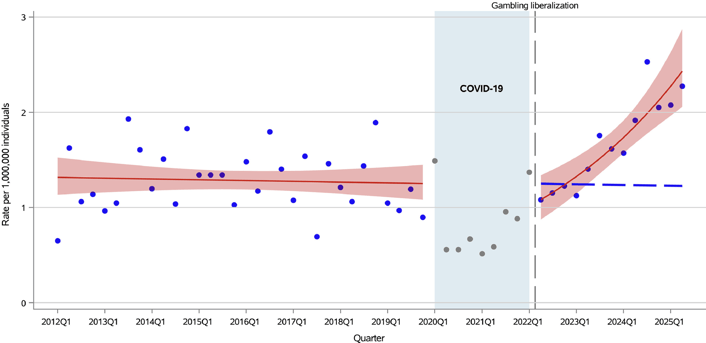
Are we Gambling to a Public Health Crisis?
A study published this week in the American Journal of Preventive Medicine reports that emergency room visits on account of gambling issues have almost doubled in Ontario since 2022, when Ontario opened the gambling market to private operators for online gambling. Mostly impacting males between ages 10 and 44, most of the emergency room visits also involve another mental-health condition or substance-related harm (e.g. depression, alcohol use or self-harm), but researchers suggest emergency room visits only represent “the tip of the iceberg” when it comes to the range of negative impacts of online gambling.
TAKE IT TO-GO
The Last Word
Words are an assemblage of letters that communicate meaning. The dictionary meaning doesn’t change whether the referenced word is written or spoken. What it doesn’t account for, however, are the games that sound plays with words, sometimes adding a different dimension to its meaning, and often tempting us to a menu of wordplay fun that the straight-laced seriousness of the dictionary has difficulty handling.
That all seems a bit heavy for a good-bye paragraph and so we’ll skip the details and just let the ear take precedence, celebrating the double life words get to live when they don’t stay in their lane. It’s the drum to which Take It To Go usually marches. I know marching music is also an acquired taste, and anything out of sync produces confusion rather than symmetry. Maybe we need to think of meaning and sound like lanes and borrow a car analogy (take comfort—it’s covered by CUSMA, assembled with parts from both sides of the border, and appropriately tariff-free). That’s not without its risks either—bad wordplay does cause the occasional fender-bender, but more often, it’s more like the skillful change of lanes that gets us through the traffic jam with spirits not only intact but lifted, patterns of movement accomplished that are lyrical enough to sing about.
But before we come to the toll road, we’ll just take this as the destination. I hope that wherever next week’s journeys take you, your trails are safe and successful. I look forward to safely navigating the insights vehicle into your inbox again next Saturday. We’ll use the HOV lanes if we need to, but whatever words we end up using will carry meaning, with a few pun ones joining us for the ride.
Until then.
Reply to Ray