


January 17, 2026
June 13, 2026
Click “Listen Now” to hear the audio version of Insights.
HERE'S MY TAKE
Prime Minister Carney’s statement at his June 1 speech at Holy Blossom Temple in Toronto has caused some online stir. His statement “Canada was not founded on a single creed, race, language or faith” has been critiqued as “revisionist,” “chilling,” and “unmoored” among other less flattering labels.
In fairness to Mr. Carney—delivering as he was on the rise of antisemitism in Canada and announcing an initiative intended to make Jewish Canadians feel less unsafe in a country that has long welcomed diversity, I don’t think he intended his speech to define his view of constitutional history or moral identity. In context, his point was that Jewish Canadians face hostility that is “un-Canadian.” From Canada’s earliest days, we were a country about accommodating and living with differences. French and English, Protestant and Catholic, Indigenous and successive waves of immigrants—the public square in Canada has been one in which all should be able to participate. It’s never been perfectly achieved—and sometimes even grossly violated—yet it’s always been a national aspiration. But if we have learned anything in the four centuries since Champlain planted the first permanent settlement on the St. Lawrence, it is that pluralism is not self-sustaining. It depends on the moral traditions and institutions that formed it—and when those foundations erode, pluralism becomes an ideology that can no longer explain itself or defend the dignity it claims to protect.
The reason that Mr. Carney’s statement has attracted attention, however, is that his language seemed to redefine what makes such pluralism possible. It implied that pluralism is self-generating, an end, and a foundational principle. It overlooked the contradiction that when pluralism becomes detached from any account of truth or the common good, it becomes its own dogma. Diversity becomes the one value that cannot be questioned. What begins as a framework for living with difference gradually becomes an ideology in its own right. That ideology is challenged in practice, such as the present one involving our Jewish neighbours, when those critical of their Jewish neighbours for whatever reason exercise their right to express their opinions in a manner that diminishes the dignity and security of Jewish Canadians, so that the rights become totally one-sided (denying the very diversity that they champion).
It is true that Canada’s “peace, order, and good government” ambition, reflected in our founding documents, is a way to live with difference. French Catholics and English Protestants (and Indigenous Canadians, although in a very different way)—each of whom would have identified themselves as part of different nations, although living alongside each other within common national boundaries—decided that they preferred to continue their arrangements with each other over accepting the annexationist overtures that were coming from south of the border.
That accommodation of difference, however, did not emerge from a vacuum. Christian traditions informed the frameworks, institutions and moral vocabulary of both French Catholics and English Protestants. Carney described Canadian secularism as “open” and inclusive, arguing that no concept of the good is privileged by state power. In so far as this is a confirmation not just of an American style non-establishment of the church (distinct from the UK where the monarch remains the head of the church to this day) but also a consciousness and protection of differing religious communities to participate in public life, even when they are in a minority (as Section 93 of the Canadian constitution explicitly grants French Catholics and English Protestants), the statement is historically valid. But that technical truth buries a substantial problem.
Historian Janet Ajzenstat notes that George-Étienne Cartier envisioned a political nationality in which diverse ethnic and religious communities could unite for the general welfare. Yet this diversity existed within a shared moral world. Confederation's architects differed on many things, but she notes, “Few, if any, however, would have denied the right of the community to impose consensual standards of right conduct on its members, standards that extend to the private conduct of consenting adults.”
Ironically, this brings us back to the very problem Carney was addressing. Antisemitism is not merely a failure of inclusion. It is a failure of moral formation. The hostility some are now expressing on our streets—requiring increased security and preventing Jewish neighbours from enjoying a stable community life—reflects a diminished respect for human dignity, equality, responsibility, and neighbour-love. Without these virtues, pluralism isn’t possible.
We do not become tolerant by celebrating tolerance. We become tolerant through the institutions, practices, and beliefs that teach us how to live with those we disagree with. Respectful pluralism doesn’t just happen. It depends on learned habits of restraint, charity, responsibility, and mutual obligation. Each of those, clearly, requires some shared conception of “the good.”
There is a lot of confusion between pluralism and relativism. Relativism says that there is no shared truth—meaning that those whose truth suggests that some are better than others (and implicitly that others can be demeaned and treated badly because they are worse than some)—is an inevitable consequence. A healthy pluralism recognizes the place of different perspectives and seeks to deal with them.
A proper understanding of the role of government is essential here. The task of government is to protect citizens from threats from outside and inside its boundaries—ultimately backing its word with coercive power—and seeking justice for those within. Justice contains core beliefs about what is worth protecting, what it means to be a fellow human being, a neighbour, or an enemy. It can allow for differing treatments—it’s appropriate to treat a neighbour differently from an enemy—but in both there are rules of justice that bind our behaviours (which is why we have just war theory and accountability for how our soldiers and police exercise their coercive power).
The Canadian settlement did not ask citizens to abandon their deepest convictions when entering public life. It asked them to bring those convictions into a constitutional order that recognized the legitimacy of other communities doing the same. The result was not neutrality in the modern sense. It was a negotiated coexistence among communities possessing strong identities and substantive beliefs.
This is why Canada's pluralism has traditionally been institutional rather than merely individual. Churches, synagogues, schools, charities, businesses, and voluntary associations all contributed to the common good while remaining distinct from the state and from one another. Diversity was sustained not by the absence of convictions but by their presence.
In that respect, the challenge facing Canada today may be deeper than rising antisemitism, troubling as that phenomenon is. The Prime Minister’s speech accompanied the announcement of a series of measures, including the creation of a new advisory council on rights, equality and inclusion, increased coordination to combat hate crimes and extremism, and a commitment to strengthen efforts to protect Jewish communities and other vulnerable groups. Whatever the merits of the specific steps being taken, they really don’t get at the deeper challenge—the ideological drivers of the current surge in antisemitism.
The challenge is whether we still possess the cultural and moral foundations necessary to sustain a genuinely pluralistic society. When we have a citizenry that increasingly has not learned the moral vocabulary in which we communicate what it is to live together, we end up challenged. When pluralism becomes detached from the traditions that formed it, it risks becoming increasingly thin and fragile. Citizens may continue to invoke inclusion and diversity, but they may lose the habits and virtues that make meaningful coexistence possible. A society united only by procedural commitments eventually struggles to explain why those commitments matter.
This brings us back to Carney's speech.
He is right to insist that antisemitism violates something fundamental about Canada. He is right to defend a society in which people of different faiths can live together in freedom and security. He is right to celebrate Canada's long experience of accommodating difference.
Where I would part company with him is in how that experience is understood.
Canada's pluralism emerged because generations of Canadians inherited and cultivated a moral framework. The institutions that taught responsibility, the communities that formed character, and the traditions that gave meaning to concepts such as dignity, equality, and justice were not obstacles to pluralism. They were the preconditions for it. What is required today is a much deeper conversation about how to renew the civic education of those born here and those we welcome, so that the moral vocabulary on which our peaceful coexistence depends is replenished and passed on.
If we forget that, we risk treating pluralism as though it can sustain itself. Canada's pluralism is not an alternative to tradition. It is one of the traditions' achievements. It is the fruit of a moral framework that enabled people with significant differences to live together in peace, order, and freedom. If we hope to renew our civic compact in the years ahead, we will need more than an appeal to diversity itself. We will need to recover the sources of the dignity, responsibility, and mutual respect that made that diversity possible in the first place.
Pluralism is worth defending. But it is strongest when it remembers the traditions that taught us why it matters.
WHAT I’M READING
CUSMA Term Sheet
I previously referenced last summer’s The Grand Bargain framework proposed by the Macdonald-Laurier Institute, which suggests that renewing the Canada-U.S.-Mexico agreement lies in expanding it to include security and energy as well as trade. On June 4th, they published a follow-up “term sheet” that includes a relatively detailed list of possible items that could together form the basis for a settlement.
Technology Isn’t Neutral
Peter Copeland’s essay on the necessity for a conservatism that goes beyond economics and choice to account for the impact of our choices, including those of technology that encroaches on our social fabric, makes a familiar point but includes important current contextual applications. While noting that the growing talk of banning social media for kids, including by Liberal cabinet ministers, raises significant questions about the government’s role, Copeland advocates an approach that starts with a robust anthropology. “The right response is to shape technology according to human nature, rather than pursue it as a vehicle of unlimited transformation for its own sake. This means ceasing to judge its products only by their convenience and looking instead at the kinds of persons, habits, and social relations they produce. We can then see that the product design and business models of key goods and services are part of the problem.” He advocates a broader-than-government approach, suggesting that “We need to exert pressure on the firms and business models that are in play, and provide clear signals from law and policy that show the public that these ideas, products, and practices are harmful. This can be done while respecting and preserving the sphere of liberty and personal responsibility that are crucial to a healthy society. None of this requires hostility to tech as such, which also clearly holds great promise.”
Is There a Conservative Case for Childcare?
My colleague Andrea Mrozek’s "A Conservative Case for Childcare" was published by the Institute for Family Studies. Making the distinction between childcare and daycare, she notes that almost all parents need some help, whether that help comes formally through paid assistance or informally through the extended social networks of family, church, or community. She argues that we need to strengthen the full range of institutions rather than obsess over publicly provided daycare, noting, in particular, the literature confirming that maintaining emotional attachment between parents and children is essential to effective parenting. “Some of the best research available suggests that the quantity of time spent in whatever form of child care and particularly at young ages (below three) is as important as the quality of child care. Which takes us back to the conservative case for child care. Keep it local, keep it relational.”
Grievance Politics
Father Raymond de Souza frames the Alberta separation debate through the history of grievance politics, noting that “in this age of upset,” the next months in Alberta will provide a case study to “emulate or avoid” much more broadly. His Alberta-specific framing is instructive of what is happening on the ground, but the application of his framing to the broader setting struck me as apt and worthy of further reflection. “The political issue is whether grievances can be guided toward something good, a constructive politics, or come to grief in a politics of destruction.”
Being Reliable is More Important than Being First
Peter Menzies credits the Prime Minister’s office for skillful public relations while excoriating contemporary journalistic practices for allowing themselves to be manipulated in a Substack essay. Noting from his career of experience how modern reporter methods “would have been laughed out of every newsroom I ever worked in,” Menzies regrets that what we are left with are “editors and publishers who allow their reporters to be manipulated by unnamed sources [and] make their newsrooms look like, at worst, mere water carriers for government propaganda or, at best, useful idiots.”
MEANINGFUL METRICS
The Positive Power of Religion
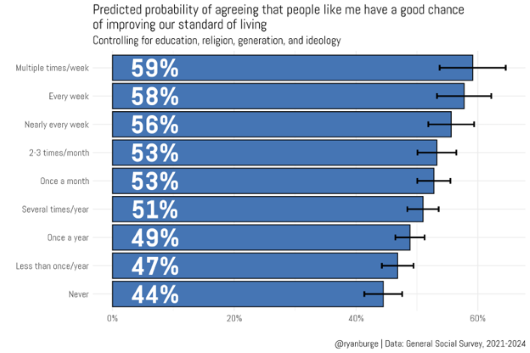
I spent my week on an official work vacation, but working, wearing my church elder’s hat, attending my denomination’s synod. Many denominations are having their official meetings in these weeks, and given that churches are comprised of sinful people just like secular institutions, it should not be a surprise that the meetings of religious organizations end up having an agenda filled with problems to solve that, at first glance, aren’t something that would necessarily inspire or create a sense of holiness. And so as I scanned my newsfeed after hours to compile links for this weekly newsletter, American sociologist Ryan Burge’s post caught my eye. The theme was “Can Americans Still Get Ahead?” and he analyzed data seeking to answer which institutions were impacting people’s optimism (or lack thereof, often labelled “despair”). While “getting ahead” as understood economically in this survey question isn’t the first priority of religion (it has a more eternal standard of living outcomes in view), religion is not without its short-term consequences either and as the data shows, “frequency of religious attendance does have a pretty clear impact on this question of one’s likelihood of raising their standard of living.” Burge muses about the impacts of belonging to a religious community, and there is certainly something to it. Thinking about this with a week’s worth of internal church-related themes providing context, I am reminded how the “belief-behaviour-belonging” triad with which religion is often analyzed remains valid and that trying to separate any one from the other two has inevitable consequences that impact not just our spiritual, but also our emotional, social, economic and political realities.
TAKE IT TO-GO

Speaking of Insights, Hear We Go…
This Insights farewell paragraph is committed to wordplay as a signature sign-off, intended to have you close this newsletter with at least a groan, if not a smile. After using words to hopefully share meaningful content and helpful frameworks, we say goodbye by appreciating words as words and the surprising ways words can shape our spirits—even when the content just shared may not always be encouraging.
The workplace banter that inspires much of what I share here is often better suited to conversation than to a written monologue, so I'm excited to share that, starting this fall, my colleague and Cardus’s Director of Policy and Stakeholder Relations, Andreae Sennyah, and I will launch a new podcast that explores many of the same themes as Insights. As coworkers, Andreae and I have spent years trading observations, stories, and the occasional questionable joke. Being old enough to be her father, I regard it as my responsibility to intersperse arguments with wordplay. She regards it as her responsibility to groan, roll her eyes, and fire back with her distinctly millennial style of humour (with a healthy literacy and appreciation for themes that have been discussed for more than two millennia). The podcast will build on that good-natured banter, bringing some of the themes, curiosities, and verbal mischief that appear in this newsletter into a conversational format. We hope the conversation will strike a chord, resonate with listeners, and perhaps prove that intergenerational exchange still has its appeal.
For those unfamiliar with Cardus's growing family of podcasts—an extension of the work of Comment magazine—this new venture will join an already lively lineup. This week's episode of Conversing features a conversation among the five podcast hosts reflecting on the recent Understory Festival sponsored by Comment, and offering a preview of the various podcasts we host. It also includes a brief introduction to the new podcast Andreae and I will be launching this fall.
Until then, this newsletter will continue arriving in your inbox on Saturday mornings.
Stay tuned.


Reply to Ray