


September 27, 2025
October 25, 2025
Click “Listen Now” to hear the audio version of Insights.
HERE'S MY TAKE
Numbers are at the heart of budgets, and this week, we’ve received plenty of hints about the kind of counting we should expect in the federal budget on November 4. But all of it becomes moot if the minority government can’t manage the arithmetic of votes in the House of Commons so that the “yeas” outnumber the “nays.” With 343 MPs in the House, 172 would need to vote in favour of the budget (although, if not all members vote, the budget can pass with fewer votes).
The drama and intrigue of political deal-making is what makes headlines, while the shape of the government’s economic agenda and the potential of another election hang in the balance. Less discussed, but at the moral core of the debate, is how democratic legitimacy expresses itself through these processes. The concept of confidence is at the heart of what gives a government democratic legitimacy in the Westminster model.
The government will inevitably follow one of three broad paths. The most obvious first path is the one that minority governments have most frequently used in recent Canadian history: striking a deal with an opposition party. In 2005, the minority government of Prime Minister Paul Martin amended its budget to incorporate specific NDP policies, including daycare. The minority governments of Prime Minister Stephen Harper did not make formal deals publicly. However, tactically they were able to get budgets passed by ensuring there was enough in them to secure opposition support, or at least to prevent the opposition from voting at all. The 2006 budget technically passed unanimously when no opposition MPs stood to oppose it. The Bloc Québécois supported the 2007 budget, while Liberal MPs supported the 2009 budget. Interestingly, the Liberals abstained from voting in 2008 and 2010, allowing minority Conservative governments to pass budgets in those years. Justin Trudeau’s minority government entered a formal supply and confidence agreement with the NDP, however, which allowed it to pass multiple budgets and effectively function as a majority government.
The second route is to use the budget to cause an election. In 2011, the Harper government presented a budget it knew the opposition parties would not support, so that it could then argue that the “dysfunction of Parliament” meant Canada needed “a strong, stable, national, majority Conservative government.” It’s most likely that this week’s musings by the government house leader about a possible election were more about negotiating for political leverage rather than making a genuine prediction. It would seem there is considerable risk for all parties in being seen as the cause of Canadians returning to the polls so quickly. Their present rhetoric notwithstanding, the risks of causing an election (and then losing it) are potentially career-ending for Prime Minister Mark Carney and Leader of the Opposition Pierre Poilievre.
There is a third path. The Liberal government could entice three opposition MPs to cross the floor, giving it a functioning majority. Peter Mansbridge’s podcast with reporters Rob Russo and Athia Raj created a buzz in Ottawa as they mused about Liberal efforts to recruit some dissatisfied Conservative MPs. Some consider this a realistic option, while others dismiss it as Liberal mischief-making to make life uncomfortable for the Conservatives. It’s been two decades since Belinda Stronach famously crossed from the Conservative opposition caucus to the Liberal minority government to facilitate the passage of a federal budget, immediately joining the cabinet.
Recruiting opposition MPs to join the government caucus would not only allow the government to see this budget pass, but also give it a longer runway for the other inevitable confidence votes it will face. Crossing the floor, however, is controversial. Floor-crossing MPs always have to deal with the perception that they’re seeking personal political advantage rather than the good of the country and that they’re betraying the voters who elected them under a different party banner. Conflict of interest rules prohibit private interest inducements for the votes of MPs. An inquiry into the appointment of David Emerson to the Harper cabinet (which involved a floor crossing immediately following the 2006 election) concluded that offering an opposition MP a cabinet position is a political matter, not an illegal personal inducement.
I don’t know whether the possibilities of opposition MPs joining the government are real or just mischievous gossip. While it makes obvious sense for the prime minister to seek to recruit such support, the realities for MPs involved are much more complicated. While Ms. Stronach won re-election in 2006 (with a larger majority as a Liberal than she had in the previous election as a Conservative), the evidence suggests that MPs who cross the floor are half as likely to win under their new party label in the next election. Crossing from opposition to government historically offers slightly better odds. Still, exceptions to the rule suggest it requires a unique set of circumstances for it to be in the MP's personal political interests. Specifically, floor-crossing MPs must have enough personal charisma and brand in their riding while also “selling” their crossing as ideological consistency.
But the question of the political consequences for either the government or individual MPs should also take into account the more principled question of confidence and the integrity of government. Canadians do not directly elect a government. They elect representatives to form a Parliament. It is Parliament which chooses the government by expressing its confidence in a prime minister invited by the Crown to form a government. The Crown chooses an individual who leads a recognized political party in the House of Commons—usually the party with the most MPs. The prime minister can only continue governing by maintaining the confidence of the House of Commons.
We tend to think of politics in terms of political party affiliations and the role of the leaders as potential prime ministers, and with good reason. However, the heart of our system of accountability rests with individual MPs and their judgment. A floor crossing in the present context would be sure to prompt instantaneous outrage. (However, given that we are dealing entirely with a hypothetical situation, the details matter, so the actual circumstances of the move may make such a critique altogether justifiable.)
But let’s not lose sight of the essence of an MP's judgment that is at the heart of our democratic system. In 1774, speaking as an MP, Edmund Burke addressed the electors of Bristol, providing a lasting reminder that accurate representation is not about simply echoing local opinion but about exercising informed judgment. He famously warned that a representative “owes you, not his industry only, but his judgment; and he betrays, instead of serving you, if he sacrifices it to your opinion.” Parliament, he reminded his constituents, “is not a congress of ambassadors from different and hostile interests, but a deliberative assembly of one nation, with one interest—that of the whole.”
I have no inside knowledge, but if I were asked for a prediction, I would expect the government and at least one opposition party to strike a deal to pass the budget. As we learned in 1979 with the Joe Clark minority government, sometimes governments stumble into an election they did not plan. The odds of that happening today are slim. And floor crossings, while dramatic and making sense from the government’s perspective, seem a long shot given the mix of conditions needed for them to make sense for at least three opposition MPs simultaneously. But stranger things have happened. And if it does happen, it is worth reminding ourselves, in light of the almost certain outrage that would follow, that this may even be an affirmation of democratic legitimacy in which the judgment of elected representatives supersedes the control of party leadership and political gamesmanship that has become commonplace in Canadian politics. To the extent that such circumstances reinforce the essential lubricant of our democracy—the legitimacy expressed through legislative confidence—it might even prove to have value beyond passing a budget.
WHAT I’M READING
Charlie Kirk, Abraham Kuyper, and the New York Times
David Brooks’ column on Charlie Kirk’s funeral and the mixing of religion and politics is important reading, regardless of whether you agree with him. He pivots from the premise that “a naked public square is a morally ignorant public square,” pointing out that religion in general and Christianity in particular are “load-bearing walls” in American democracy. He proceeds, however, to warn against the “higglegy-piggledy” mixing of the spheres, appealing to Dutch statesman Abraham Kuyper’s theory of the spheres—that there are intermediate institutions, like the family, schools, and faith, between the government and the individual. Brooks reflects on various aspects of the Kirk funeral and the subsequent public reaction, noting the dangers of operating “without any coherent theory of how religion should relate to politics.” I am partial to Kuyper’s theory, but whether you choose that or a different theory, Brooks’ warning that without a coherent theory “sin roams free” and expresses itself in the dangers of “unrestrained faith and unrestrained partisanship (which are) an incredibly combustible mixture.”
Eugenics 2025 Edition
My colleague Brian Dijkema has an important essay at commonplace.org responding to the promotions coming from Silicon Valley that pre-screening embryos for genetic defaults can enable parents to choose a “superbaby” over an “average baby.” Dijkema points out that the horror of these practices, once properly labelled eugenics, are “hidden within the cordon sanitaire of medical and scientific labs.” He also notes Silicon Valley isn’t accounting for “the deeper things—happiness, virtue, joy—that constitute what it means to be a successful or thriving human being.”
Gambling, Investing, Gaming. Is There a Difference?
The New York Times ran an interesting essay reflecting on the cultural changes that have accompanied legalized betting. The essay outlines a recent partnership that allows sports betting from retirement accounts and the “gutting of oversight of prediction markets and online gambling.” It recounts the resignations of four of five oversight body commissioners after US President Trump cut their staff by 15 percent, leading them to drop one-third of their investigations. The essay argues that “(t)he solution is not necessarily to outlaw speculation. But at the very least, financial companies should be transparent with users about risks, and platforms.
Alberta’s New Mayors
New mayors in Calgary and Edmonton don’t define Alberta. Still, with over 70 percent of the province’s population living in the two major cities, they certainly do have a significant tone-setting impact. Falice Chin suggests that Edmonton’s choice of Andrew Knack, an experienced councillor known for his methodical approach, is likely to deepen the city’s bureaucratic and administrative instincts. Meanwhile, Chin expects that Jeromy Farkas, leading a Calgary council with ten rookies, marks a rejection of the status quo in a path that seems quite unpredictable.
MEANINGFUL METRICS
We’re Getting Old
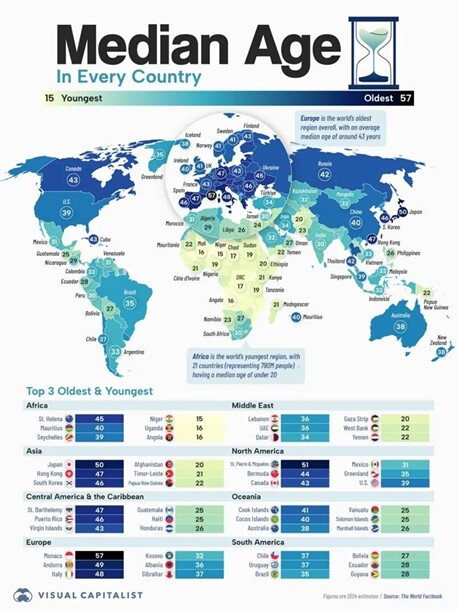
It was striking to see this week’s Visual Capitalist infographic providing a map labelled with median ages. At 43, Canada ranks alongside the European average, which is the oldest region in the world. Africa is the world’s youngest continent, while Asia has a mix, from Japan, with a median age of 50, to Afghanistan, with a median age of 20. While fertility rates, life expectancy, and immigration patterns are the major factors contributing to differences between countries, median age often correlates with economic growth rates. Older countries are more likely to have labour shortages and significant health, pension, and social service costs, while very young countries often face unemployment challenges and political instability. The “sweet spot” is often considered slightly younger than the median, offering room for ambition and opportunity.
.
TAKE IT TO-GO

Better Than Hollywood
Last Monday, the Rogers Centre vibrated with enthusiasm as the Blue Jays earned their way to the World Series. The aftershocks of the tremors caused by Blue Jay fever are still being felt throughout Canada.
By the time you read this, the first game of the Dodgers-Blue Jays series will be history. Confession time. I like the Dodgers and rooted for them in last year’s World Series. The Dodgers roster may resemble the Walk of Fame, and they may be used to Hollywood lights but this year they are being relegated to extras in the World Series show. Look for a delightful blockbuster box score with the boys with the Maple Leaf on their caps going on a roll. The dome in Toronto means there is snow reason for game delays—October Canadian weather notwithstanding—and the script LA intends will be interrupted by a few curve balls.
The cross-border banter will only add to the drama as we skirmish with bats instead of tariffs. I’m looking for Toronto to start with a flurry and leave the Dodgers adrift. The Springer Dinger was just batting practice. We are now looking for the northern lights, with a focus on the 2025 World Series championship trophy, to be rightly housed in Canada. Insights will be back in your inbox next Saturday, which will also be the day Toronto hosts Game 7, if the series gets that far. Until then, let’s go, Blue Jays.


Reply to Ray