

August 22, 2026
Click “Listen Now” to hear the audio version of Insights.
HERE'S MY TAKE
Since Tuesday evening’s announcement of a tentative trade deal between Canada and the United States that would stop the imposition of a new round of significant tariffs scheduled to take effect on Wednesday, August 19, there has been lots of commentary and analysis. It’s mostly meaningless, given that negotiators are still hammering out the fine details of the agreements, the full facts aren't public, and assessing this deal will vary by sector and region, with any overall evaluation inevitably taking time to sort through.
Listening to some of the back and forth of this week’s punditry, I found myself comparing this Canadian moment to the angst of Hamlet.
To deal or not to deal—that is the question in a nasty world. Whether to trust the covenants of allies, or to conclude with Hobbes that beneath every friendship lies the old calculation of fear, interest, and power.
That question—whether a deal rests on durable institutions or on the shifting sands of a personal relationship between leaders—is, I'd argue, the real story behind this week's trade news, and behind a separate story out of the Korean peninsula this week too. Relationships between leaders can grease the wheels of diplomacy. But when relationships replace institutions rather than support them, an agreement becomes only as durable as the goodwill between the people who signed it.
It was President Trump who, over the past seventeen months, has repeatedly invoked “Canadian nastiness” as a barrier to an agreement. The most recent was in an August 5 speech to a business audience, in which Trump described Canada as “nasty.” “People think Canada—they’re nasty people. I love the people but they’re nasty. Nasty leadership.”
I don’t want to read too much into the rhetoric—not every line is carefully scripted with philosophical intent. Caricaturing his opponents, whether in politics or across a negotiating table, is part of President Trump’s style. Still, the repeated use of “nasty” evokes a famous line from Thomas Hobbes’ Leviathan, written in 1651, a required reading in any quality introduction to political science. Hobbes argues that without some sort of coercive force (typically the state), human nature is “solitary, poor, nasty, brutish and short.” Nastiness, in Hobbes’ world, is part of the natural condition that occurs when we can only rely on other individuals (who inevitably have self-interests different from ours and hence abandon us) and points to the need for high authority. Much of what Hobbes points to is institutional power that is essential to an ordered life, but he also grapples with the higher moral authority that comes with such institutional powers.
I doubt Trump has read Hobbes, nor am I suggesting that current events provide a perfect case study for the validity of Hobbes' observations now almost four centuries ago. However, the metaphor does provide insight into our times and how nations arrive at international deals these days. And how a deal comes together has significant consequences for what it means—regardless of what the fine print of the final text might say—and how long it might last.
An unrelated but very current international news story might help illustrate the point.
On August 16, President Trump ordered the Pentagon to “substantially reduce” the joint US–South Korean military exercises that had just commenced. His stated reasoning is striking. He called the exercises an “inappropriate and hostile” signal toward North Korea, described North Korea as “unthreatening and respectful,” and emphasized his “very good relationship” with Kim Jong Un. He simultaneously pointed out that South Korea had declined his request to assist the United States over Iran. Quite apart from the somewhat surprising decision and the potential global security implications, what was striking was how Trump’s language reduced treaties between nations from institutional commitments to personal relationships between leaders.
Now of course, relationships between leaders matter and leaders can accomplish much more on an international front—whether the conversations are about trade, security, or any other global topic—than when leaders dislike each other. But there is a difference between effective relationships serving as a lubricant to allow the institutional machinery of government to run smoothly and a view of relationships that replaces the institutions of government.
Which brings us back to Hobbes’s insights. Nasty is part of the way he describes the state of nature—a condition in which everyone must ultimately provide for their own security. No one can safely rely on promises, goodwill, and cooperation when no common power can ensure that others will reciprocate.
Early in Leviathan, Hobbes commends a particular kind of political wisdom: “Read thy self.” He warns against the confidence that we can simply “read” particular people from their actions, since the same behaviour can arise from very different passions and purposes. Hobbes was hardly an institutionalist in the modern sense—the seventeenth-century context was very different from ours—but applying his insights points to the value of institutions precisely because they make political order less dependent on one leader’s ability to read another correctly in the moment.
In the case of the Koreas, President Trump is redefining adversary and ally through a short-term lens, stripping history and institutions down to present-day feelings and relationships. Time will tell as to how durable the new trade deal with Canada is, but his willingness to redefine previous deals based on the whims of the moment reflects a similar move.
President Trump prides himself (and perhaps with some justification) on being able to read people well and has a track record of securing deals with individuals. Some of these would seem unlikely partners. But leadership requires us to read not just individuals but humankind.
My own theory of social change makes room for the role of significant leaders—good and bad—but I am convinced that it is the intersection of institutional change in different spheres that creates change that lasts. Only time will tell us the extent to which whatever significance the changes this week’s international news takes on will have, but I am quite convinced that, given how leaders arrive at these agreements, it will not be that long before new circumstances will challenge their stability and negotiators will have to hammer out new agreements to take their place.
WHAT I’M READING
Let the Courts Decide Legal Matters
The Ontario Court of Appeal has unanimously overturned a judge’s decision that declared bike lanes in Toronto a matter of cyclists’ Charter rights to life and security of the person as provided in Section 7. The multi-year political battle pitted Ontario’s Ford government (which wanted to remove bike lanes on certain major Toronto streets, arguing they caused congestion) against Toronto’s municipal government and the cyclist lobby. Ben Woodfinden’s National Post analysis describes the decision as a “smack-down” and eloquently gets to the heart of the issue.
The Right Way to Write?
The prevalence of AI in the education system is undeniable. What is most concerning is the frequency with which students are using the technology to assist with their writing and research assignments, combined with the rarity of teachers being able to recognize it and feeling trained in using it for good. Teachers in Ontario are feeling unprepared for another school year, lacking training and school-wide policy on how to use AI in the classroom. The New York Times says teachers are recognizing that the art of learning to write without AI assistance is becoming a lost skill in their students. While a tool can and should be used to assist learning, replacing the skill with an automated (and often incorrect and biased) technology defeats the purpose and does a disservice to the student in the long term.
Betting on Community
Betting ads come with a side of regulation these days. Alberta’s government is seeking applications for programs that help people overcome mental health issues related to gambling addiction (which private casino and gambling operators would fund with a cut of their profits). The UK is recognizing the cultural cost of gambling to community vibrancy due to the prevalence of “betting shops” on popular retail streets. This kind of regulation is at least an effort to mitigate the harmful effects of gambling, without banning it outright . But as Hannah Rich writes in Theos, “Real regeneration means creating places of belonging that do not depend on people losing money in order for others to survive.”
MEANINGFUL METRICS
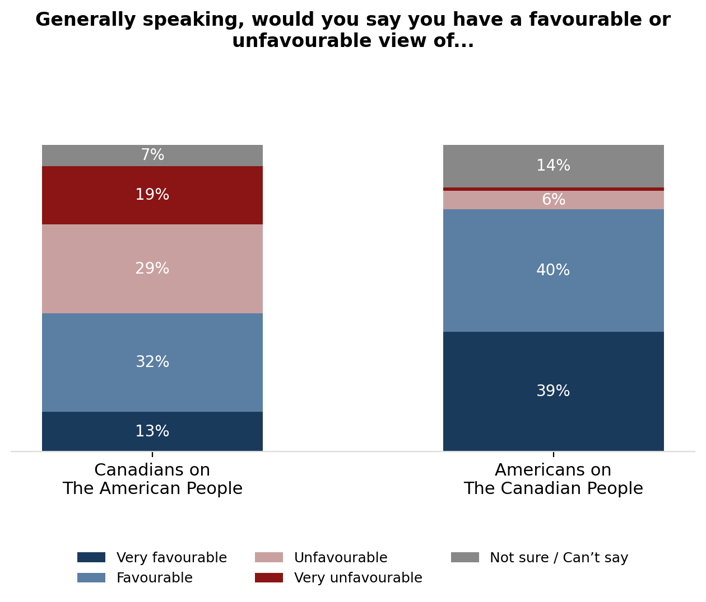
Somewhat-Requited Love
With tantalizing hints of an impending Canada-US trade deal in the news, it is easy to focus on cross-border trade tensions and the drama of political personalities at odds. Yet data from the Angus Reid Institute, released in early August, suggests that underneath intensifying political rhetoric from American leaders, Americans themselves retain an overwhelmingly positive view of their Canadian neighbours— nearly eight in ten, according to ARI's report. But that neighbourly affection is not entirely reciprocated: Canadians are roughly evenly split between favourable and unfavourable impressions of Americans in turn. This is partially due to Canadians' greater attention to ongoing trade disputes. Interestingly, though, a majority of Americans do not support further tariffs on Canadian trade—a sign that neighbourly affection could also be having a political effect.
TAKE IT TO-GO

No Otter Way to Put It
Wordplay comes pretty naturally to me, and rare is the week when it's Friday and the Take-It-To-Go paragraph remains empty. But no worries—it's 2026, and when in need, we can turn to our friendly ChatGPT companion and ask it if there were any oddball stories I'd missed that are well suited to a few words of farewell wordplay. While its claim to providing something otterly remarkable may be a stretch, it did bring to life a Canadian Press story that I hadn't originally seen. The story involves Gordon Mellish giving chest compressions and mouth-to-mouth resuscitation to revive one of three otter pups caught in a fishing net. It also involves sibling protection, nasty bites, and a moving gesture of gratitude on the part of the otter that ultimately swam away and rejoined its siblings in the wild. Chat claims it all to be otterly remarkable—I think breathtaking is the better descriptor, but either way, the animal was rescued and has lived to see an otter day.
That's all for this week—looking forward to being back in your inbox next Saturday morning. I trust the late summer weather is as gorgeous where you are as it was in Ottawa this week. Enjoy.
Reply to Ray