


September 21, 2024
April 25, 2026
Click “Listen Now” to hear the audio version of Insights.
HERE'S MY TAKE
When Hungarian Prime Minister Viktor Orbán lost power last week, the reaction was immediate and expansive. Many commentators across Europe and North America interpreted the result as part of a turning point in the global tide of populism. For me, though, Hungary’s election results (and the reaction to it) offered a powerful reminder that lasting change is not simply won at the ballot box, but is built in families, schools, businesses and communities—and that such transformation is slow, relational, and generational.
Orbán’s sixteen years in power were perceived by many to be a global symbol. His government represented a particular style of politics: nationalist, skeptical of liberal institutions, and willing to use state power assertively in reshaping civil society. Steve Bannon once called him “Trump before Trump.” The global attention paid to an election campaign in a 10-million-person Central European country remained disproportionate to its economic, diplomatic, or military influence. Vice President Vance made the trip just days before the election (and publicly called President Trump on his cell phone to endorse Orbán at a campaign rally), while reports also emerged that the Kremlin was seeking to influence the outcome in Orbán’s favour.
I won’t pretend to understand Hungary well enough to parse the mix of reasons for Orbán’s defeat. Was it an expression of liberal cultural dominance? Resistance to Orbán’s social conservative, pro-family agenda? The challenging economic conditions? Orbán’s reshaping of institutions, the silencing of opposition, and allegations of cronyism and corruption? Commentators have made much of Orbán’s ‘race-mixing’ speech, but what to make of the fact that his successor campaigned on a platform that would continue some of Hungary’s most controversial policy planks? Given the coverage of Orbán’s autocratic impulses, his concession of defeat and peaceful transfer of power without questioning the legitimacy of the election process isn’t quite what we had been led to expect. I've read enough to be concerned about Orbán, and enough not to accept the caricature as the whole story.
But more significantly for North Americans is the question of the extent to which Orbán’s rise heralded a populist era and the extent to which his defeat marks its decline. Our answer to that question will at least in part depend on the theory of social change to which we subscribe.
Elections are dramatic. They are visible, decisive, and easy to interpret (not always correctly). But they are also episodic. They can redirect a country’s trajectory, but they rarely reshape a society’s underlying convictions. While political change is often an immediate expression of cultural change, they are not the same thing.
Broadly speaking, most social change theories fit into four categories.
The first is a bottom-up view: majorities matter. Culture shifts when enough people are persuaded, elections are won, and power is secured. This is the logic of populism in its simplest form. It is appealing because it is democratic and direct: “You want something to change, and all you have to do is get the majority of people to agree with you.” But we all know that this doesn’t always work. Campaign promises don’t always translate into the promised change. Go back one step further. How do minority ideas become majority convictions? And why do so many populist waves prove temporary? Again and again, a movement rises, wins, governs boldly, and a decade later much of the change is undone. Political victories are rarely self-sustaining. What does that say about the role and limits of the political sphere for lasting social change?
The second view is that ideas win. If truth is clearly articulated, it will prevail. It’s rooted in a view of history as one of constant progress: “Sometimes it’s two steps forward and one step back, but stick with it, make the right arguments, and eventually we will get there.” But is that really accurate? It presumes humans are driven by reason, but the evidence is quite overwhelming that many other factors shape our behaviour. Besides, even when we are dealing with arguments, history is filled with examples of bad ideas succeeding. Winning influence involves more than argument. As James Davison Hunter puts it in his book To Change the World, it is not simply that ideas win, but that “[u]nder specific conditions and circumstances ideas can have consequences.”The conditions matter as much as the content. Ideas themselves are not determinative.
A third perspective emphasizes power. Liberal democratic processes are seen as too weak; authority must be used to impose a vision of the good and suppress alternatives: “Skip the meetings and debate. Make decisions and get things done.” It’s an elite top-down view of social change. “It’s not what but who you know.” It most frequently translates into a “celebrity leader” form of government, which focuses on powerful individuals more than teams. Once you have power, use and protect it. Versions of this now appear across the political spectrum.
But power has limits. It is effective at dismantling institutions. It’s easier to say “No” than “Yes.” It can disrupt and coerce. But building something better is another matter. Power struggles to build trust, cultivate virtue, or sustain a shared moral vision. If Orbán’s legacy depended primarily on control of the levers of power, it will be revealing to see what endures.
My own theory of social change fits into a fourth category—an adaptation of what James Davison Hunter has called “faithful presence.” It sees social change as multi-sphere and relational. It recognizes that joining a symphony orchestra, serving in a refugee support group, or the local historical society are as significant as joining a political party. Change takes root when individuals and institutions together embody a richer vision of the good—truth, goodness, and beauty. It focuses on the long term, using measurements that span decades and generations. It’s not without its challenges. As the pace of technological change accelerates and the space for reflection diminishes, how will this play out in the decade to come compared with the one we’ve just completed? And when the information that influences our behaviour comes at us faster than we can process, will there be a different set of interactions that shape the society we are about to live in?
I don’t have easy answers, but I'm convinced the primary focus should be on something more fundamental than the day's surface issues. Culture precedes politics. Humans are relational creatures. Institutions exist to facilitate cooperation—structured ways of working together toward shared purposes. We flourish not simply as individuals, but in community. Our freedom is most fully realized not in autonomy, but in living out our vocation: to love God above all and our neighbour as ourselves.
That has implications far beyond religious worship attendance. I would not be a faithful Christian if I were not encouraged by the increase in church attendance, but that is not a proxy for positive social change. History offers too many examples in which outward religious participation coexisted with deep social brokenness and sometimes even contributed to it.
Lasting change—the kind that can be passed on to the next generation—comes when individuals live out a vision of truth, goodness, and beauty in every sphere of life, not just in worship. It is when the impulse that drives us to worship, and the overflow that comes from meaningful worship, translates into transformed behaviour in all of life.
It translates to good stewardship of our businesses and finances. It is seen when we promote justice not only in private conviction but in public life. It is seen when we show mercy—not only in individual acts, but in supporting institutions that serve the poor and marginalized.
It is seen, too, in how we order our loves: in the art we create, the communities we build, and the priorities we set. A society shaped by a Christian vision will not measure success solely by efficiency or comfort. It will recognize that human flourishing is richer than that.
This kind of change cannot be imposed. It grows within institutions such as families, schools, businesses, churches, and civic organizations that shape people over time. It is sustained through relationships and endures when different spheres reinforce one another. This will involve not just participation in these structures but also the active shaping of them to be the best they can be. Politics matters, but at its best, it creates space for these other spheres to flourish. Government cannot build healthy families or thriving communities. The best it can do—and this is no small thing—is contribute to conditions in which building healthy families and thriving communities is possible and more likely.
To be clear, it is not just Christian belief that translates into behaviour. All belief does. And we are all believers. The question is not whether our culture informs our public square, but rather which beliefs inform our behaviour and, as a consequence, the public square.
This lens invites a different reading of Hungary’s election. I am not close enough to determine whether the changes over the past sixteen years were primarily the result of coercive power (top-down) or enabled Hungarians to live out their convictions across multiple institutions (bottom-up). Either scenario will result in short-term political change, and few doubt that it has occurred in Hungary, lasting even sixteen years. But political change is not cultural change. What are the passions, beliefs, and desires that live within the Hungarian people, and how will they be expressed not just in politics (which, for the moment, sees a change in government) but across all of society’s institutions?
Lasting change does not arrive through a single election. It comes when multiple parts of a society move in the same direction—when political, economic, cultural, and spiritual institutions align around a shared vision of human flourishing. That kind of change is slower. It is harder to see. And it does not lend itself to easy headlines.
But it is the kind that lasts.
WHAT I’M READING
A Boring Roller-Coaster?
Abacus’s data pollster David Colletto argues in Maclean’s that Canadian voters have shifted from a populist, grievance-based political frame to a “boring” stability-based frame. His take on Hungary is a bit different from the one I offered above, although not entirely incompatible. Given the volatility of the polls between the December 2024 and the April 2025 election in Canada, I am not so certain whether this amounts to a change of frame or simply a response to the perceived threats of the moment. To quote Coletto: “I don’t think Carney’s current popularity is a permanent repudiation of populism. It’s more of a temporary reordering of threat perception. Our own polling points in the same direction. When we ask Canadians to rank threats, Trump now sits above most domestic concerns, which is especially true among older voters. Younger voters are more fragmented, and Conservatives will likely continue blaming government overspending, immigration and domestic elites. The threat voters fear most may now be one of the clearest predictors of how they vote.” Sean Speer provides helpful nuance to these arguments in a recent essay in The Hub.
Happy Charter-versary
April 17th marked the 44th anniversary of the Charter of Rights and Freedoms being signed into law and the annual variety of takes on its impact were on offer in both mainstream and social media. There is a long-standing debate (and not necessarily Charter-specific, as similar debates occur in other jurisdictions) that really amounts to which judicial philosophy (original intent vs. living tree adaptation) dominates. Among the takes that caught my eye this year were Canadian Geographic’s contention that the Charter has failed to deliver substantive equality for marginalized and Indigenous people. Thomas Axworthy (who was an advisor to Prime Minister Pierre Trudeau and in the room during some of the crucial meetings) and his 2022 piece came to my attention through links, and I found his first-person account of the compromises that went into the shaping of the Charter, especially relevant in the current debates about the appropriate use of Section 33 (“the notwithstanding clause”).
Tucker Carlson / Donald Trump Dispute
Most people have strong opinions regarding both President Donald Trump and media personality Tucker Carlson. So when Carlson, who had long been a promoter and ally of Trump, apologized this week for “misleading” people regarding Trump, indicating that he was “tormented” by this and calling it a moment to “wrestle with our own consciences,” the responses were predictably varied. Michael Wolff, a biographer of Trump who has been critical and hostile, analyzes the significance of this as a narrative of the fracturing of the Trump coalition. President Trump and his allies have been harshly criticizing Carlson for not supporting the president’s Iran invasion, calling him a “deranged” back-stabber.
Cardus Not-To-Be-Missed
You’d expect the co-founder of Cardus to recommend everything Cardus does, so I generally try to avoid linking our own stuff here. Still, there were two especially thought-provoking pieces published this week that fit this section well, and so I’ll draw your attention to them in case you missed them. Comment published L.M. Sacasas’s “AI as Christian Heresy,” which I found particularly helpful in analyzing the reactions to AI—from utopian expectations to apocalyptic fear—and helpfully frames the importance of developing a more disciplined and theologically grounded posture to AI. We also posted on YouTube a presentation by Baylor Professor Matthew T. Lee at a faith and health symposium that I was privileged to chair back in February. Entitled “Faith and Human Flourishing: Insights from the Global Flourishing Study,” it’s well worth 45 minutes to hear how data outcomes combine to make a compelling case for what constitutes health and flourishing and point to the importance of faith in public life.
MEANINGFUL METRICS
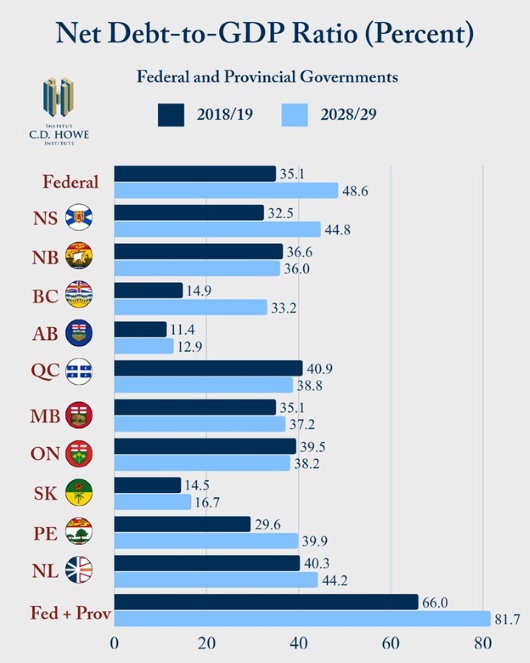
Hi Ho, Hi Ho, Further Into Debt We Go
Our think tank compatriots at the C.D. Howe Institute released a fiscal analysis this week that suggests our official reports are understating the risks associated with Canada’s fiscal crisis. Government expenses are rising—driven by the healthcare needs of an aging population, growing defence commitments, and mounting infrastructure investment—while revenue is being squeezed by weak productivity, low investment, and a shrinking workforce. On Tuesday, the Finance Minister will be presenting the Spring Economic Update, which I am certain will include numbers to support their claim of “the strongest economy in the G7.” We will watch carefully and not prejudge, but I’ll keep the C.D. Howe’s report’s caution in mind, namely that “government projections understate the risks” and that, in the context of all federal and provincial governments having loosened the grips of their fiscal discipline, it will take “a real change in direction” for Canadians to realize the benefits of economic growth and improved living standards.
TAKE IT TO-GO

From Sens Mile to Stanley’s Smile
Last week, a “Sens Mile” street sign appeared 85 strides from my Ottawa front door—data point verified, think tank credentials intact. It’s prompted a reconsideration of my playoff posture. As a lifelong Leafs investor, I’m used to managing emotional volatility, and this year, the market closed early. But a sign—literally—suggests an opportunity.
Located in a patio-dense policy environment, each Ottawa Senators win promises audible returns: hoots, hollers, and possibly street-level exuberance. Admittedly, early results have been disrupted by a hurricane-type storm, but the outlook remains… aspirational.
Critics (both on social media and in family circles) have questioned my diversification strategy. Fair enough—“fan” is short for fanatic. But good investing avoids emotional decision-making. My core holding may be the Maple Leaf, but a Canadian Stanley Cup is a clear net public good. And that’s as pro-maple leaf as you can get. That leaves Ottawa, Edmonton, and—digging deep—Montreal.
Call it a disciplined shift from fandom to fundamentals: less fanaticism, more rational patriotism. From Sens Mile to Stanley’s Smile, the eight-week experiment is underway.
This week I’m off to Alberta and will be filing the next edition of Insights from Edmonton. Hoping that whatever team has your rooting interests, you have a good week, and I look forward to connecting next Saturday morning.

Reply to Ray