


March 7, 2026
June 20, 2026
Click “Listen Now” to hear the audio version of Insights.
HERE'S MY TAKE
The headlines surrounding Thursday’s adjournment of the House of Commons until September appropriately assessed what was accomplished during the spring session. Government representatives pointed to 23 pieces of legislation passed—nine of them in the final week—as evidence of productivity. The Opposition focused on outcomes rather than activity, arguing that laws enabling things to be built do not build them, and that few of the approved pieces of legislation have translated into impact on the day-to-day lives of ordinary Canadians.
The issues Canadians most want their politicians to address remain familiar: the economy, whether framed as affordability, jobs, or broader economic performance; safety and security, whether from crime at home or threats abroad; and identity, which shapes debates over expression, conscience, and decisions surrounding life and death.
The details and headlines produced by the House over the past few months reflect this: the government’s budget, the Groceries and Essentials Benefit Act, major infrastructure announcements, and new frameworks designed to accelerate projects deemed in the national interest. These include discussions of a potential pipeline, carbon capture and storage in Alberta, and critical mineral and aluminum supply chains in Quebec.
On security, Bill C-12 sought to strengthen border management and immigration controls. More controversial was Bill C-9, passed just before adjournment. The legislation creates new offences related to intimidating people accessing places of worship and expressing hatred against identifiable groups. Yet even some who support its objectives worry that its redefinition of hate could threaten good-faith religious expression that falls outside of cultural orthodoxies.
Increased military spending and procurement commitments also belong in this category, though, given Canada’s clunky procurement process and the nature of the military, it seems that change here, on the best of days, is but a small step in a very long journey.
Security and identity issues dominated the session, though not always coherently. Separatist sentiment in Alberta and Quebec may technically be provincial matters, but their significance meant even routine federal actions were evaluated, and often redefined, through that lens. On life-and-death questions, the parliamentary committee studying the planned 2027 expansion of euthanasia for those with mental illness held extensive hearings and reported this week that Parliament should indefinitely abandon those plans. From my perspective, that can rightly be celebrated as good news, but I temper that with the caution that a Parliamentary report is not a change of law, and we still await the details of the promised legislation in the fall to know how this translates into practice.
With 94 days until the House next sits, some may conclude that politics is largely on hold and we can focus on other things in the meantime. That would be a mistake.
In fact, it could be argued that much of what ultimately shapes our politics happens when Parliament is not sitting. That is not to diminish Parliament's importance. The institution has value far beyond the legal formalities it performs, and its current form falls short of its potential. But that is a different column for a different day.
Question Period and media scrums in front of the familiar House of Commons backdrop are only a small part of politics. For our purposes, politics can be understood as the process by which people sort through their differences in order to live together peacefully. In that sense, politics occurs in communities, workplaces, associations, congregations, and governments alike every day.
Whenever people must act together, different perspectives emerge. Some prevail while others do not. When those differences are resolved without coercion, we call the process politics.
Without getting too theoretical, three elements are usually present.
The first is voice.
Different perspectives need to be heard. The root of the word Parliament comes from the French verb parler—to speak. We reserve seats in the House of Commons for elected representatives whose role is to speak on behalf of its citizens. A member of Parliament cannot hire someone else to rise and speak in their place, no matter how qualified that person might be. Politics begins with citizens expressing their views and representatives giving voice to those views.
The second element is sphere.
We often associate politics exclusively with government, and this column uses Parliament's adjournment as its starting point. Yet politics is equally present in workplaces, neighbourhoods, families, businesses, unions, and community organizations. The rules differ from one setting to another, but the underlying reality is the same: people must negotiate differences and arrive at decisions they can live with.
This matters because much of what elected officials do involves engaging with other institutions. Canada is not simply 41 million individuals living within a set of borders. It is also a network of institutions: governments, courts, businesses, unions, charities, schools, families, and community organizations. These institutions develop voices of their own and participate in shaping our common life.
The House of Commons is an important institution, but it is only one among many. Focusing on it to the exclusion of the others risks misunderstanding how society actually functions. Parliament may be adjourned for three months, but politics is not on pause. Indeed, we would probably benefit from paying closer attention to how the agenda established through legislation works its way through the many institutions responsible for implementing it. In practical terms, that often has a greater impact on our flourishing than anything said during Question Period.
The third element is identity.
Many disagreements arise not simply from different strategies but from different understandings of who we are. We often describe these differences through ideological labels such as left and right, progressive and conservative. But identity is broader than ideology. It includes generational, religious, regional, economic, and cultural differences. We understand what someone means when they refer to Prairie politics versus Quebec politics, even if the distinction is difficult to define precisely.
Each of us carries multiple identities. We constantly rank them, deciding which differences are important enough to spend social capital defending and which we are prepared to set aside.
This is partly ideological and partly practical. Few of us resign from an organization every time a decision goes against us. "That's just politics" is often the explanation. We recognize that some disagreements are secondary to larger commitments. We accept that sometimes we win and sometimes we lose, and we continue working together.
That dynamic shapes political life at every level, including government. Every few years, Canadians are asked to compress dozens of identities, priorities, and concerns into a single mark on a ballot. We select someone to be our voice, trusting them to navigate the inevitable tensions among competing interests and institutions.
Politics is much more than Parliament. It may be stating the obvious, but given the implicit suggestion of so much coverage these past few days that things are now on hold and there’s a “See you in September” attitude, it seems necessary to point it out.
A newsletter written by a think tank analyst with an office a short walk from the House of Commons is expected to report on what elected representatives are doing. The media will continue grading the spring session and debating whether enough was accomplished. The government will defend it; the opposition will say it wasn’t enough. And all of that is good and proper—everyone doing their job in our Westminster system. Over the summer, attention will likely shift to polling numbers, leadership dynamics, and the horse-race aspects of our politics.
But this is neither as all-encompassing nor as determinative as it often appears.
If recent years have taught us anything, it is how quickly legislative politics can change. In December 2024, almost everyone expected that a column written in the summer of 2026 would be evaluating the accomplishments of a Prime Minister Poilievre and assessing Liberal rebuilding efforts. Events unfolded differently. Who’s to say whether events over the next 18 months may not change the narrative as much as it has over the past 18 months?
Yet even if that scenario had materialized, many of the same questions would remain. How effectively were promises implemented? How quickly were projects built? What practical difference did new policies make in the lives of Canadians? Legislative victories are only the beginning. Government-driven change usually takes years to work its way through institutions and into everyday life.
Parliament may be quiet this summer, but the voices, institutions, and identities that shape Canadian politics remain active.
Leadership matters. A decade of Stephen Harper produced very different outcomes than a decade of Justin Trudeau, and partisans on both sides readily acknowledge that political choices have long-term consequences.
But those consequences weren’t just about them, and neither will what happens in the next 18 months be totally defined by what Prime Minister Mark Carney decides or what he and 343 MPs determine. They matter–a lot–but politics does not belong to politicians.
It belongs to all of us.
This speaks to the fact that summer recess is a time for citizens, community groups, and institutions to make themselves heard. The importance of meeting with MPs in their constituencies is often undervalued, but it is a place where all three dimensions of our politics—voice, sphere, and identity–can be expressed. As someone who regularly interacts with politicos of all stripes, my experience is that engagement (especially?) with those who hold perspectives different than mine is usually a good investment of time. It’s not just building relationships for leverage and influence; it is also doing politics yourself, expressing and engaging in a way that stewards the freedoms we enjoy in Canada today. Whatever our challenges, Canadians in 2026 remain among the most blessed and most free people, not just compared to others who are alive today but throughout millennia of history. It’s a blessing and an opportunity we need to steward.
Whether or not the House of Commons is sitting, the work of sorting through our differences and pursuing the common good continues. It deserves our attention in all its dimensions. Happy Canada Day.
WHAT I’M READING
Keeping Catholic Education Catholic
A recent summit of Catholics concerned about education produced an insightful 14-page manifesto that is well worth reading. It argues schools should be explicitly ordered toward the supernatural formation of the whole child—mind, body, and soul—rather than primarily toward academic outcomes, workforce preparation, or other secular educational goals. It outlines seven foundational principles covering human dignity, parental rights, curriculum, teacher formation, ecclesial responsibility, and the cultivation of a distinctly Catholic culture, presenting these as a framework for rebuilding Catholic education in fidelity to the Church’s educational tradition. Framed by its authors as a response to contemporary educational and cultural challenges, the statement seeks to unite bishops, educators, and institutions around a shared vision of Catholic school renewal grounded in faith, wisdom, virtue, and the integration of faith and reason.
Excellence in Education
While on the theme of education, the Manitoba Premier's Excellence Award being awarded to Gonzaga Middle School recently caught my attention. To the surprise of some, this small independent Catholic school was recognized for its excellence in supporting students and graduates through academic, social, and cultural programming. It was acknowledged alongside Manitoba’s largest and best-resourced public-school divisions for an approach built on long-term relationships, mentorship, and community support extending well beyond graduation. For many observers, the recognition will seem counterintuitive, challenging assumptions that leadership in Indigenous education and reconciliation is found primarily in government-led or secular institutions rather than in a Catholic school rooted in a distinct educational and religious tradition.
Is Christian Humanism an Option?
Regular readers will know that Cardus, through Comment magazine, of which I serve as publisher, recently hosted a 1,000+ person Understory Festival at Washington’s National Cathedral. Peter Wehner’s Atlantic essay uses that event as a starting point to contrast American evangelical engagement with the public square, as reflected in recent political developments, with a more foundational and historical approach that shaped American democracy and rooted human rights and liberty in the dignity of the person. Wehner scrambles conventional categories and familiar political categories by presenting Christian humanism—not secular progressivism—as a defence of pluralism, constitutional government, and civic restraint, while casting parts of the religious right as challengers to those same ideals.
Euthanasia Delay
Wednesday’s tabling of the Parliamentary special study regarding extending MAID for mental illness in March 2027 recommended that this implementation be suspended indefinitely. My colleague Dr. Rebecca Vachon pointed out in her National Post article that public opinion polling argues that Canadians support a "fantasy version" of MAiD. As noted above, the report is a significant but not definitive step, and the matter will be on Parliament’s fall legislative agenda, with the details of that legislation having significant consequences.
Happy Father’s Day
The celebration of Father’s Day seems an appropriate context to pass along “America’s Great Dad Divide,” an essay on parenting by Brad Wilcox. He observes that fatherhood in America is increasingly split along class lines, with college-educated and married men far more likely to be actively involved in their children’s lives than less-educated and unmarried men. The result is a growing inequality in family stability and child well-being, as the benefits of engaged fatherhood become concentrated among those already enjoying greater social and economic advantages. Family decline is neither a universal cultural problem nor merely an economic one, but is best understood through the lens of the health of the institutions and norms required to sustain committed fatherhood.
MEANINGFUL METRICS
A Score for Patriotism
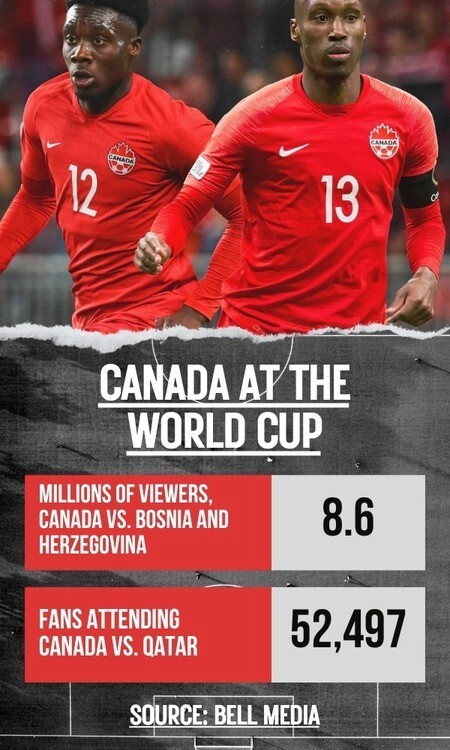
While we may be known as a hockey nation, there are great expectations for Canada at the World Cup this year. We started off the tournament with a 1-1 draw against Bosnia and Herzegovina, and followed that up with a 6-0 smackdown of Qatar on Thursday.
It’s easy to get caught up in the scoreboard and miss the bigger story. As we await the annual Canada Day publication of fresh insights, we have some hints that the rise in patriotism observed in 2025 may be continuing. Some 8.6 million unique viewers tuned into that opening match for Canada across Bell Media’s platforms, while there were 52,497 fans in the stands for Canada’s match against Qatar.
The World Cup continues until July 19, with Canadian games being played in Vancouver and Toronto.
TAKE IT TO-GO

Here's Howe to Bridge Trade Inefficiency
With the Stanley Cup awarded and hockey fans turning their attention to the off-season, another Canada–U.S. contest has unexpectedly gone into overtime. This week's postponement of the Gordie Howe International Bridge ribbon-cutting has delayed what was supposed to be a celebration of a project designed to improve the flow of trade through one of North America's most important economic corridors. The delay has prompted some comparisons to a bullying hockey enforcer, with the current delay essentially a post-fight interruption of play while the officials figure out the appropriate penalties to be served before the game can continue, and some trade goals realized after the puck passes the Detroit–Windsor corner, through which a remarkable share of bilateral trade passes.
Named after "Mr. Hockey" himself, the newly constructed bridge was meant to symbolize determination, connectivity, and the ability to get things done. The flow of the game has been interrupted by repeated delays, with the project spending more time in the penalty box than carrying the puck up ice. One wonders: if a bridge named after Gordie Howe can't fight its way out of the penalty box, what does that say about our ability to complete the nation-building projects Canada needs? The Stanley Cup may have found a winner, but the Canada–U.S. prize for trade efficiency is still a game that is not being well-played.
Next week’s Insights will be a “best of” edition, republishing some of the items you have missed. I am participating in two conferences in Europe while my colleagues will be rightly enjoying Canada Day-related activities. We hope to be back in your inbox with fresh content on July 4th. Happy July 1st to our Canadian readers and July 4th to our American readers. While this newsletter certainly shares the many concerns about how each of our countries is faring these days, let us never lose perspective on the tremendous prosperity and freedom we enjoy as citizens, privileged above most of the rest of the world’s population and certainly among the most blessed in history.


Reply to Ray