


August 10, 2024
January 10, 2026
Click “Listen Now” to hear the audio version of Insights.
HERE'S MY TAKE
Does geopolitics matter for Canada? Self-evidently, the answer is “Yes,” but the thornier question for 2026 might be “How?” Answering that question is difficult, given that the undercurrents shaping Canadian public life in 2026 are occurring outside the country and beyond our control. Canadian decisions in response to geopolitical issues matter more to us than they do to any other country or people. That’s just sober realism. Our almost 10 million square kilometres of land is second in the world (behind Russia’s almost 17 million), but we’re not even in the top 30 in terms of population or in the top 20 in terms of military power. Canada ranks around tenth in global economic power. On their own, Canada’s opinions and actions don’t set the global agenda.
So, when it comes to influencing issues in Venezuela, Ukraine, or Greenland, Canada can’t throw around much weight. We have slightly more influence over Ukraine due to our international alliances and our status as home to one of the largest Ukrainian diaspora communities outside Russia.
While Canada’s influence doesn’t determine outcomes, we are not passive recipients of a changing world order. These changes affect our domestic priorities—that is, what we need to do for our country’s benefit—even if the global impact of our decisions is relatively trivial.
Domestic debates about how to respond to global events expose national identity and values. Part of US President Trump’s election pitch to Americans was that they were paying a disproportionate cost of global leadership while other countries, including NATO allies such as Canada, were taking advantage of the United States. “Make America Great Again” was, in part, a pitch to reframe American foreign policy from global moral leadership to cost-benefit nationalism. He won the election, meaning that whatever caveats some want to put regarding his policies, they need to be regarded at least in part as a reflection of American values and beliefs.
The working assumption since World War II has been that global affairs occur within a rules-based international order. Russia and China—alongside regional powers, particularly in the Middle East, Africa, and South America—often contested aspects of that order in pursuit of their own ambitions. However, the balance of power, exercised through international alignments and informally underwritten by American military, economic, and diplomatic dominance, largely preserved global order. The on-the-ground application of these rules was always uneven and shaped by self-interest, but there remained a general expectation that sovereignty, territorial integrity, non-aggression, and, more unevenly, human rights constituted shared global norms.
If we weren’t convinced before that this framework is no longer valid, American actions over the past few weeks have confirmed that it’s no longer just Russia and China with expansionist agendas. The US National Security Strategy released in December indicates that American security requires that the US “will assert and enforce a ‘Trump Corollary’ to the Munroe doctrine” in the Western Hemisphere. Secretary of State Marco Rubio is heading to Greenland this week in the context of one American official openly saying, “Nobody is going to fight the United States militarily over the future of Greenland.” In fairness, this comment needs to be considered alongside other American officials who resist the implications of this rhetoric. Also, as with everything he says, we should bear in mind President Trump’s willingness to overstate his position to gain negotiating leverage. Still, the literal meaning of President Trump’s words can’t be disregarded. Consider that his press secretary presented Venezuela as an object lesson for Greenland, noting that “(President Trump) tried ardently to strike a good deal with Nicolás Maduro and he told him, ‘I will use the United States military, and you will not like it, if you don’t take such a deal,’ and look what happened.” The removal of Venezuelan President Maduro is almost universally acknowledged to be a good thing in that he was an illegitimate president by refusing to give up power after losing an election and by brutalizing his own citizens. Even so, President Trump justifies his actions mainly as a defence of American interests and an assertion of American control over Venezuelan oil. He barely mentions democracy or respect for Venezuelans.
While these matters affect every country, Canada feels the effects especially acutely. We can’t change geography. So, as long as Canada exists, the United States will be our largest neighbour, our most natural trading partner, and a defining influence on what is possible for us as a country. The challenge for Canadians is to address matters beyond our control in ways that shape what is within our control.
So, let me offer a few observations on what this might mean for our domestic priorities in 2026.
- As the Globe and Mail reminded us in Thursday’s editorial, since the American Revolution in 1775, Canadians have had to assert their independence and resist American annexation ambitions on multiple occasions. But that hasn’t prevented the development of a positive relationship. “For much of our country’s history, relations between Canada and the United States have been less than intimate, and yet our country grew and prospered,” the editorial board wrote. (A Cardus paper I co-authored in November made a similar point and expanded on how this reflects in the different religious cultures in our respective countries.)
- While Canadians are less than articulate about our positive values and identity, defaulting too quickly to “we are not American,” our demographic realities and everyday experience point to a different identity. More than 40 per cent of us are born outside Canada or have at least one parent born outside Canada. Historically, Canada has had an open stance toward refugees, ranking among the top countries globally in receiving displaced persons. Our humanitarian concern and policy of encouraging settlement emerge from a different mindset than that of a gate-keeping republic. Policy misjudgements in the past decade have challenged the Canadian immigration consensus, but the mindset of “what is a Canadian” vs. “what is an American” as it relates to citizens of other countries reveals a different value system at work, an important and prized ingredient of our Canadian identity.
- The recognition that the United States is prioritizing its identity over its values can be alarming, but it doesn’t change certain historical and current realities. In a world of imperfect choices, with the great powers being China, Russia, or the United States, my choice is to align with the United States 11 times out of 10. I’ve got lots of quibbles with US behaviour past and present but I celebrate with them 250 years of being a mostly positive force in the world. Whatever Canada-US problems emerge and regardless of how we need to prudently adjust to new realities, Canada needs to continue to recognize the essential differences among Washington DC, Moscow, and Beijing. Our national interest, as well as our values, requires a continued constructive relationship with the Americans.
Adjusting to a changing Canada-US relationship requires us to focus on what we can control. In the context of tariffs and the last Canadian election, I used this space to urge “being willing to pay the economic consequences for the privilege of preserving an independent Canada.” I hope the present trade crisis will strengthen Canada’s resolve to build major projects, break down our internal trade and political barriers, and take the steps to improve productivity we have long discussed but have not yet meaningfully implemented. There is much we can do to strengthen our negotiating hand. Let’s also recognize that the United States’ hemispheric focus implicitly elevates Canada’s importance. In Arctic security and natural resource development, for example, Canada has an advantage over many others in terms of supply-chain resilience, near-shoring, and workforce stability. There are plenty of voices within the United States as well that aren’t enthused about the economic implications of the tariff policy. American politics will evolve in 2026 just as Canadian politics will. So, Canada’s position isn’t as weak as some make it out to be, especially in the longer term. However, this comes with the expectation that Canada will do more, especially on defence spending and infrastructure, without necessarily gaining greater policy autonomy in return.
None of this requires us to cheerlead current American foreign policy. Canada can’t do much directly about Greenland and Venezuela. However, insofar as these are the front lines of a changing world order and set of relationships, the resolution of geopolitical matters will shape Canada in more ways than most realize. The answer is not avoidance nor a self-righteous critique of the United States. Instead, we can focus on what Canada can do to be a responsible player, living out our own identity and values. You don’t have to beat a bully in order to survive. But you do have to stand up to him. And that requires self-respect and a confident identity. In all likelihood, we’ll bear some short-term costs as we live out our ideals of peace, order, and good government. We’ll do so confident that this is the best way to guard freedom for individuals and institutions to live alongside each other, despite our differences, and to provide the opportunity for flourishing and prosperity.
WHAT I’M READING
Will New York Learn from Canada?
The promise of newly elected Mayor Zohran Mamdani to bring “the warmth of collectivism” to New York’s city hall has prompted widespread commentary on the contemporary relevance and practicality of socialist ambition. The rubber hits the road with promises of free transit, rent freezes, and free childcare, all intended to address the affordability crisis facing citizens. On the childcare file, my colleague Andrea Mrozek helpfully used the occasion to note how similar promises implemented in Canada have failed to deliver. Viewing childcare as an economic policy rather than caring for children, politicizing and regulating the mode of childcare delivery by removing the agency of parental choice, and sidelining the private sector are among the reasons Mrozek identifies for the Canadian system's failure to deliver on its promise.
Yearning for Justice
The anti-semitic violence on Sydney’s Bondi Beach prompted former Canadian International Trade Minister Ed Fast to publicly muse about the validity of the proverb, “The arc of the moral universe is long, but it bends towards justice.” He thoughtfully raises significant dimensions that challenge the experience of justice in the face of tragedy, leading to the conclusion that the difference between justice and moral optimism only comes from an “anchored hope—hope grounded in a sober understanding of the human condition and sustained by a moral order that transcends it.”
Taking Religion Seriously
Charles Murray is a leading American public intellectual whose 2025 book, Taking Religion Seriously, chronicles his journey from a secular, rationalist social scientist to a Christian believer. I picked up Murray’s book over the holidays after reading Patrick Luicani’s review. I found his summary accurate. “Murray’s book thus becomes more than an autobiography; it is part of a larger conversation about the role of religion in sustaining civilization. He does not preach or claim certainty. Instead, he writes as a man persuaded that the modern world has overestimated reason’s powers. Secular humanism, for all its virtues, cannot explain why anything—truth, beauty, or goodness—should matter in a universe of blind forces. The search for transcendence, Murray insists, is not escapism but realism.”
Ten Good News Data Points
A colleague forwarded Noah Smith’s end-of-year Substack entry documenting 10 positive trends in American society, intended to provide some optimism amid challenging times. There are details I’d quibble with and context I would provide, but I'm linking it in the spirit in which Noah wrote it and in which it was forwarded to me: to highlight encouraging data points that are not as well known as they should be.
MEANINGFUL METRICS
Provincial Angst
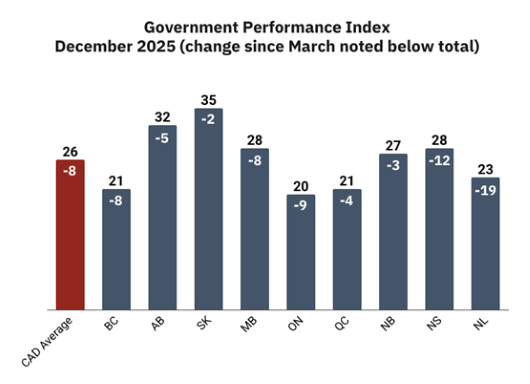
Every provincial government in Canada finished 2025 with a lower approval rating than it started with, according to a year-end Angus Reid survey. The Alberta and Saskatchewan governments fared best—both in raw scores as well as in the lowest level of decline—while the BC, Ontario, and Quebec governments scored lowest on comparative measures. The analysis suggests that provincial governments are scoring poorly in part because many issues of primary concern to most Canadians, such as affordability, housing, and health care, are primarily provincial responsibilities.
TAKE IT TO-GO

Found Missing
I hope I am not clearly misunderstood as I pass this along. I mean no offence whatsoever—none at all—but since every phrase I’m highlighting here comes straight from social media, the habit of pairing unlikely words in English is really an open secret. You could draw a small crowd if you rounded up all the original copies of wordplay that accidentally on purpose wander into our everyday conversations, often hiding in plain sight.
I’m not sure this rises to the level of tragic comedy—I find it more seriously funny than the pretty ugly assessment grammatical purists might offer. Still, these definitely maybe expressions manage to communicate meaning in a loosely precise way, even when the dictionary is of limited help—or perhaps almost useless—if you don’t catch the obvious ambiguity right away.
And that’s it for week one of 2026. As regular readers are aware, I try to adopt a casually formal tone in Insights. I certainly welcome your feedback (and even your pushback.) Iron sharpens iron. And while you’re at it, feel free to forward insights you find worthwhile to friends and colleagues who might not know about this newsletter.
Looking forward to travelling this 2026 journey with you and being back in your inbox next Saturday morning. Happy New Year to all Insights readers!


Reply to Ray