


May 3, 2025
January 31, 2026
Click “Listen Now” to hear the audio version of Insights.
HERE'S MY TAKE
January 31, 2026
Prime Minister Mark Carney’s recent Davos speech is well known for its analysis of the shifting global order and the role for middle powers like Canada to play within it. But there has been comparatively little attention to a secondary point he made: that the world should look to Canada as a model of educational excellence. If we are to heed his call for sober-minded realism—seeing the world as it is and not as we wish it to be—then we also need to apply the same standard to Canadian education. While the Canadian education system is better than what we see in some other countries, it is certainly not the global model of excellence. Education is a complicated story, so it’s easy to overlook it, but it is probably a more important conversation than most realize.
Although Canadian students still rank in the top ten countries on the OECD’s Programme for International Student Assessment (PISA), average scores in key subjects have been declining over several years. Math performance in particular has raised alarms. Recent analysis from the C.D. Howe Institute suggests that Canadian students’ math performance has been sliding steadily, both in absolute terms and relative to leading jurisdictions. This worrying erosion in numeracy has very negative implications for productivity, innovation, and social mobility. Seven provinces have declined more than 40 points on PISA since 2003, which translates into about two years of lost learning. Meanwhile, the share of students performing at the lowest levels in math has more than doubled in most provinces.
Part of our problem is that we often discuss education in purely technocratic terms, without addressing the basic questions of education's purpose, the role of parents, and the fact that people learn in different ways, making one-size-fits-all solutions rarely ideal. International comparisons show that high-performing systems are not monolithic; they reflect different institutional arrangements, cultural assumptions, and core beliefs. Treating education primarily as a centralized public service to be optimized can crowd out serious discussion about institutional diversity, innovation, and accountability. So, when we go abroad crowing about Canadian educational excellence, our claims come across as self-congratulatory slogans rather than serious evaluations.
International experience suggests that high-performing education systems are not uniform. They vary widely in structure, governance, and philosophy. Some rely on centralized national curricula; others allow significant local or institutional autonomy. Many incorporate publicly supported non-state schools as a normal part of the system rather than as exceptions. A recent Cardus study of education systems in 17 OECD countries concluded that what matters is not conformity, but coherence. Availability, accessibility, and accountability are the metrics we need to consider in building robust education systems. Canada scores a 66.7/100 on an index incorporating these measures. While the Cardus study I referenced didn’t do the analysis to definitively associate educational pluralism (which welcomes diverse schools, including independent schools, into the education system) with academic performance, a correlation can be observed.
The timing of this conversation is not accidental. An Alberta citizen initiative is underway to collect the required 177,000 signatures by February 11 to force a referendum on whether to defund the province’s independent schools. My colleague Catharine Kavanagh told the Calgary Herald the petition is based on some misconceptions. “Data shows that parents who send their kids to independent schools are not wealthy families at all, and in fact, they’re much more likely than your average Albertan to have a below average household income,” she said. “They’re more blue-collar, so they’re far more likely to be nurses, farmers, or even teachers themselves, and we know that almost 90% of independent school families are making significant financial sacrifices in order to send their children to those schools.”
The next few weeks will tell an interesting tale about whether Albertans will want to stick with their current system of educational options, which aligns with global norms rather than the very closed systems of Ontario and the Atlantic provinces, or instead try to force the change process. The province faces a proposal premised on scarcity (reallocating funds rather than leveraging resources), uniformity (one system fits all better than diverse options), and top-down organization, where government choices trump parental ones. Without getting into Alberta’s particulars and nuances, the mindset that motivates the referendum is similar to that which informs Mr. Carney’s overblown education rhetoric—ignore the data and the models that the rest of the world is using to produce better results and double down on the existing centralized government-delivered model.
Contrary to this rhetoric, I don’t believe Canadians are settled on how educational excellence should look or how to deliver it. Business people I talk to aren’t thrilled with the readiness of graduates who are entering the workforce. They mention the need for remedial programs. Many Canadians are paying out of pocket to make up for the failings of the education system. This is why the Canadian private tutoring market (with players like Oxford Learning, Sylvan, and Kumon) is worth more than $7.2 billion a year, with forecasts suggesting 10 percent growth over the next five years.
This situation should invite discussion, experimentation, and humility—not premature declarations of victory on the world stage. I don’t mean to denigrate the good things that Canadian education achieves. Compared to many, we are good. But we are not excellent by any meaningful measure and we are only denying reality if we pretend otherwise.
So, the rhetoric surrounding Mr. Carney’s Davos speech matters. When Canadian leaders present the country as an educational model without qualification, they risk overpromising abroad while underdelivering at home. Global credibility ultimately rests on domestic performance, not applause lines. Canada’s education system does not need international marketing; it needs sustained, honest debate about outcomes, governance, and the role of pluralism in a diverse society. We need to review the marks on our educational report cards before making claims of educational excellence. Excellence should be our aspiration. However, it is an aspiration we must earn. We cannot claim the degree until the coursework is completed.
WHAT I’M READING
Fix Policing, not the Law
Diving into the debate over Bill C-9 and its attempts to curb hateful expressions, lawyer Joanna Baron notes in thehub.ca that more consistent policing is much more urgent than legal reform. Statistics, she argues, show the rise of anti-semitism and the failure of the police to enforce existing laws consistently in Canada. “This crisis is a stress test that Canadian pluralism is failing,” she writes. “The implicit bargain of Canadian postmodern multiculturalism promised that you can bring your differences to Canada in exchange for submitting to common civic rules. When institutions refuse to enforce those rules, the bargain collapses.”
Missing in Davos
As analysis of Mr. Carney’s Davos speech continues, two in particular caught my attention, both using the lens of Christian social thought. Comment published Dr. Rob Joustra’s “Mr. Carney Goes to Davos,” which suggests the prime minister’s “emphasis on values and contracts and legalisms may be badly incomplete.” Dr. Janet Epp Buckingham reflects on how human rights seemed to be an important missing factor in Mr. Carney’s proposed strategic role for middle powers in this revised world order. I used this space last week to share my reflections on the speech, which prompted several reader responses. They were all helpful (keep the feedback coming!), but one in particular was particularly cogent. “I think the PM’s proposal for a new age marked by middle power collaboration and alliances is naïve, impractical, and counter to our principal interest in maintaining a positive relationship with the largest economy in the world immediately along our large border,” my correspondent wrote. “But certainly the sense we are in a hinge moment in history with the Ukraine War, the Middle East paroxysms and now the Venezuelan rupture coupled with all the radical social and economic changes that are sweeping away at the contours of our culture and economy seems broadly shared…the debate seems to be how rather than whether we are in an age of large-scale transformation.”
What Toronto Can Learn from Melbourne
While we are on the theme of learning from others, Marcus Gee’s Globe and Mail article compares Toronto and Melbourne across several factors, including public transit, parks, and museums. He notes that these otherwise comparable cities have significant cultural and leadership differences. “The lessons for Toronto are obvious,” he writes. “Treasure your history. Build up your cultural institutions. Invest in better transit. Be far-sighted. Be bold. Be more like Melbourne.” I’ve not been to Melbourne so can’t verify his claims but the advice seems timely and sound.
Alberta Firewall
This week marked the 25th anniversary of the famous “Alberta firewall letter,” in which six Albertans wrote to Ralph Klein, who was Alberta’s premier at the time, suggesting ways to increase Alberta’s autonomy. In the context of the current separation talk, the letter seems doubly poignant. There were several analyses of the anniversary. I found letter co-author Ted Morton’s analysis of “how the Alberta Agenda went from fringe to mainstream in 25 years” insightful, not just for the perspective it provided (which one need not agree with), but especially for the process of changing political norms it describes.
Gambling Our Future
I’ve raised the alarm on gambling before, but I’m doing so again following the release of an American study that more than one-third of adolescent American boys gamble online before they turn 18. The study suggests that online gaming is the most common context for recruiting young boys to gambling and that, once started, algorithms do the work in getting them increasingly hooked. “While most boys deny significant harm from gambling, 27% of those who gamble report negative effects, such as stress or conflict, with frequent gamblers and those in gambling peer networks most affected,” according to the report.
The US Courts and Trump
In the volatile situation that exists on some American streets of late, I found it interesting to read about more than 1,600 judicial decisions ruling against the administration’s mandatory detention policy.
MEANINGFUL METRICS
The Fate of Mr. Poilievre
I am writing this before Friday night’s Conservative Party of Canada convention vote on Pierre Poilievre’s leadership; by the time you read this, the result will be known. While anything short of roughly 80 percent support will likely embolden his internal critics, even a successful confidence vote should be understood as a necessary but insufficient condition for long-term leadership stability. In parliamentary politics, party cohesion ultimately rests on a leader’s perceived electoral viability. In other words, Conservatives not only need to convince Canadians that Mr. Pollievre is the best alternative but also that his election is a realistic prospect. To the extent that Canadians or Conservatives question the likelihood of success (in their deep-down, usually private convictions), the hill becomes steeper to climb.
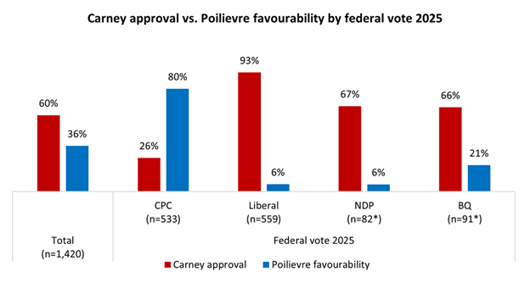
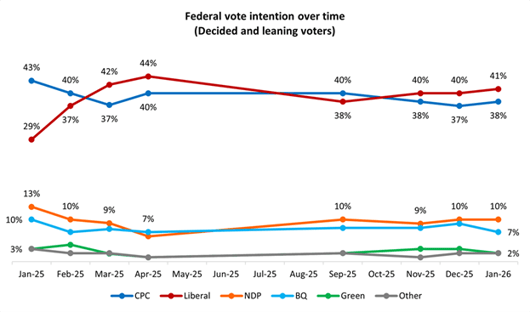
On that measure, recent Angus Reid polling—consistent with trends reported by other firms—suggests a significant vulnerability: Mr. Poilievre trails Mr. Carney by a wide margin on leader favourability, even as the two parties remain statistically tied when leaders are removed from the comparison. This divergence helps explain the Liberals’ strategic incentive to weaken Mr. Poilievre’s public standing without precipitating his removal. From a Conservative perspective, initiating an election under these conditions would carry substantial risk, absent a clear trigger that could plausibly be framed as Liberal opportunism. In such a scenario, voter backlash against perceived political cynicism might partially offset Mr. Poilievre’s personal liabilities. If Mr. Poilievre contests and loses an election, his ambitions to become prime minister are finished. Hence, the current dynamics point toward a prolonged standoff, with no election likely before 2027. In the interim, political actors can be expected to test the margins of parliamentary arithmetic through efforts to entice opposition MPs to cross the floor or accept appointments, potentially forcing by-elections that could alter the balance of power.
TAKE IT TO-GO

Never Short-Changed
Tomorrow is February 1. I grew up with my farmer father’s one-liner: “What month do farmers complain the least? February—it’s the shortest.” Still, February feels like a typo that somehow made it past proofreading—short, uncertain, and faintly unnecessary. February can’t decide how many days it deserves, or which letters it expects us to pronounce. We tolerate it but are uneasy as it’s not really winter, absolutely not spring, just a scheduling limbo we’re expected to respect.
To its credit, February makes a half-hearted effort at charm. It brings us Valentine’s Day and Family Day—mandatory warmth and cuddles in the middle of optional misery—even as the temperature reminds us who’s really in charge. And still, we push through, sustained by the promise of the Winter Olympics, Blue Jays spring training, and the comforting knowledge that somewhere in the southern hemisphere, their summer is ending, which means ours is coming.
Enjoy your first week of February. We’ll disappear before a groundhog decides how long winter will stick around—and reappear from our burrow to show up in your inbox next Saturday morning.


Reply to Ray