


March 29, 2025
March 21, 2026
Click “Listen Now” to hear the audio version of Insights.
HERE'S MY TAKE
On March 29th, roughly 100,000 New Democratic Party members are eligible to vote to select a new federal leader—though precedents suggest just over half will cast a ballot. And just as the decisions of a few Members of Parliament can shape whether Prime Minister Carney can govern with a minority or a majority, so the decisions of comparatively few Canadians who select their party leaders have an outsized impact on how we are governed. To put that into perspective, Mark Carney became Liberal Party leader with 131,000 votes; Pierre Poilievre won the Conservative Party leadership with the support of 295,000 voters. There’s nothing special about March 29th except that the results of this NDP leadership race may have an outsized impact not only on that party, but on the strategic landscape for every other party in Canada, federal and provincial alike. It’s a consequence of a political system in which only just over 2% of Canadian voters formally join a political party, and the outsized influence they have on Canadian political life.
It’s not that paying attention to the alternatives offered by Mark Carney and Pierre Poilievre is irrelevant. However, ignoring the NDP leadership race—as most Canadians, including the media, have done—may be a mistake. It’s less about knowing the names of the five NDP candidates (which even political junkies would be hard-pressed to name) but rather the different directions they represent that is at the heart of the choice. During last year’s election (when the Conservatives were leading in the polls and expected to form government), I used this space to argue that the NDP mattered not because of its strength but because of its weakness. The 2025 election was more than a defeat for the NDP. Its vote collapsed, its caucus shrank, and its relevance in Ottawa appeared to fade. But weak parties can still be consequential ones. The NDP recovered from similar challenges in the nineties and emerged with a focus and drive that led to becoming the official opposition under leader Jack Layton in 2011.
But recovery requires direction, and the choice of direction facing the NDP now–between deepening its urban progressive identity and rebuilding a working-class coalition–will have consequences that extend well beyond the party itself. Next week's decision is not mainly about who succeeds Jagmeet Singh. It is about whether the federal NDP’s priorities in the next decade are contending for power or settling for influence. That answer has impacts well beyond Ottawa.
The NDP is not simply a loose collection of federal and provincial brands. It operates as a political family spread across jurisdictions with integrated structures, unlike the Liberals and Conservatives. It governs in British Columbia and Manitoba, is the official opposition in Alberta, Ontario, and Saskatchewan, and shares not just a name but a common identity and set of expectations.
It is true that federal and provincial NDP fortunes do not move in lockstep. Canadian voters often distinguish between them. But that does not mean the parties are fully independent. Federal leadership decisions shape how the NDP is understood—by members, activists, and voters alike. Provincial parties adapt that identity to local conditions, but they do not define it entirely on their own.
That makes this leadership race unusually consequential. It will shape not only the NDP’s federal prospects, but how its provincial counterparts balance principle and pragmatism.
Historically, the NDP developed with three distinct strands: trade unionists, academic progressives, and social gospel populists. Today’s NDP has morphed into two distinct coalitions.
One is increasingly urban, younger, and more ideologically progressive. Climate policy, equity concerns, and a broader language of systemic change animate them. It is comfortable with politics as a vehicle for transformation, even at the cost of compromise. It is home to culture warriors. The other is more economically focused and less ideological. It is rooted in smaller cities, resource regions, and working-class communities. Its priorities are more immediate: affordability, jobs, and economic security. It’s about populist pocketbook issues and standing up for the little guy. Both parts of the coalition retain faint traces of the party’s social gospel roots, though they are barely discernible.
These two coalitions are not simply different policy preferences. They are different instincts. Observers suggest that Avi Lewis represents the urban progressives, Rob Ashton the economic populists, and the only MP in the race, Heather MacPherson, a political pragmatist seeking to draw from both camps. The anticipation is that whoever wins will not have an easy time bringing both coalitions into cohesion.
There is a broader symmetry here, but not a perfect one. The NDP’s urban progressive base plays a role on the left somewhat analogous to that of the rural conservative base on the right: both are geographically concentrated, culturally coherent, and highly engaged. But the similarities end there. The conservative coalition is more electorally efficient, translating its support into seats. The progressive coalition is more fragmented—divided among New Democrats, Liberals, and others—and less electorally efficient. It shapes the political agenda more than it determines outcomes.
For most of its history, the NDP has tried to hold these tensions together. Its provincial successes have often depended on combining the language of social justice with the practice of economic pragmatism.
But that balance is becoming harder to sustain.
The party’s current federal base leans heavily toward the first coalition: urban, younger, more educated, and more ideologically progressive. That is where its remaining strength lies. But it is not where governing coalitions are typically built.
Recent polling makes the problem clearer. Roughly four in ten Canadians say they would never consider voting NDP. That number is not unusual—every party has its detractors. The Conservatives face even higher levels of outright rejection. The Liberals are not far behind.
But the distribution of those “never” voters matters more than the total.
For the Conservatives, rejection is concentrated in urban and progressive demographics that the party has largely written off. For the Liberals, it is broad but often shallow. For the NDP, it is different. Its “never” voters are disproportionately found among non-urban and working-class Canadians—the very voters the party once relied on to build governing coalitions.
The problem is not simply that the NDP is rejected. It is where it is rejected.
That creates an asymmetry that the party cannot ignore. The voters most open to the NDP are not the same voters it needs to grow. Urban progressive voters remain broadly available to the party. But they are not exclusive to it. Many move fluidly between the NDP and the Liberals or disengage from party politics altogether. Working-class and non-urban voters are less so. When they leave, they tend to move to the Conservatives—or to exit the political system entirely. They are harder to win back, and once lost, often lost for longer.
This is the strategic dilemma at the heart of the leadership race. A party that leans further into its urban progressive base may become more coherent. But it risks narrowing its reach. A party that seeks to rebuild a broader working-class coalition may regain ground—but only by moderating or reframing positions in ways that unsettle parts of its base. There is no obvious synthesis available. Only trade-offs. And it would appear that the NDP caucus–soon to diminish to five when their only Quebec MP moves to the provincial scene as expected–is as divided on these questions as is the party, providing the newly elected leader with a significant challenge from day one.
These trade-offs will not be confined to federal politics. In British Columbia and Manitoba, where New Democrats govern, a shift in federal tone will raise immediate questions about alignment—particularly on economic and resource issues. In Alberta and Saskatchewan, where the party seeks to present itself as a government-in-waiting, the federal signal will shape whether it leans toward pragmatism or ideology. In Ontario, it will influence an ongoing contest with the Liberals for the same pool of centre-left voters.
The significance of this race is not lost on the NDP’s competitors, which is why strategists from all parties will pay attention even if the public doesn’t. Liberals benefit from an NDP that pulls the conversation left but cannot compete for power—an outcome most likely if the party leans further into its urban progressive base. Conservatives need an NDP to be politically competitive and secure at least 10% of the popular vote. The existing Conservative voting coalition is unlikely to win government without a viable NDP, which may mean that the Conservative Party itself will rethink its approach depending on the outcome of the NDP race.
Smaller parties matter at the margins. The Greens offer an outlet for disaffected activists but not a governing alternative. The Bloc, in Quebec, occupies space the NDP has struggled to reclaim. Both shape the terrain. Neither is likely to be excited by the outcome.
Party systems do not change overnight. They shift gradually until voters find themselves looking at a different menu of choices. A weakened NDP could mean a more consolidated two-party system at the federal level. A redefined NDP could instead force a broader realignment on the left. That development will also impact the Liberal Party, which under Justin Trudeau moved to be much more ideological, although the Liberal historic impulse to do whatever it takes to win does mean this gets applied differently there than elsewhere.
Those outcomes will not be decided by the results of March 29th. But they will be shaped by it. It is when a party is weakest that its internal choices matter most. Strength allows ambiguity. Weakness forces definition. The NDP is choosing a leader. But the results of that choice have implications for all of us and the options we will be provided over the decade to come.
WHAT I’M READING
Humanity of Refugees
As debates rage on about immigration numbers and the criteria by which newcomers are welcomed into Canada, it is easy to overlook the significant humanitarian component that has long been a signature part of Canada’s immigration scheme. For the past several decades, between 30,000 and 50,000 refugees have been welcomed annually, reflecting a longstanding commitment to humanitarian resettlement. As noted in last week’s newsletter, research shows that many (especially those privately sponsored) become contributing members of society very quickly. This week’s Globe and Mail opinion piece by former Senator Ratna Omidvar, who came to Canada as a refugee from Iran in 1981, powerfully narrates the very human dimensions of the issue.
We All Can Be Burdens
This Plough essay, reflecting on the need that we all have at some point in our lives to receive care from others, offers a thoughtful and necessary perspective, even amidst the current euthanasia discussions in Canada. While understanding the politeness that prompts the “it’s no problem” response to requests for help, Matthew Burdette argues that “the first step is overcoming the polite dishonesty that denies people are burdens at all.” His recommendation is to begin with parenting. “Christians who hope to raise children whose bodies and souls can survive this culture must teach their children that there is nothing wrong with being a burden; we must prepare our children to expect to care for us as we once cared for them; we must model what it looks like to bear the burdens of others and to be truthful about how difficult and demanding this kind of Christian love can be.”
Federalism at Work
Euthanasia is typically considered a federal issue, since amendments to the Criminal Code paved the way for the practice after the 2015 Supreme Court decision. But it’s not only about rights and liberty; it also involves the delivery of health care, which falls under provincial jurisdiction. To date, Quebec has led the way in a pro-euthanasia direction. This week, Alberta introduced legislation that would restrict the application of “MAID for mental illness” and prevent doctors from initiating or promoting MAID.
The Legal File
There’s been a lot of debate surrounding Bill C-9, especially the amendment during committee hearings that would remove the good-faith citation of religious texts as a defence against hate. This iPolitics analysis, published in December, reminds us that there is more at stake in the bill than just that clause. To be clear, while this clause is a concern, it is perhaps not as alarming as some rhetoric suggests—it does not criminalize scripture but instead removes a specific defence where citing scripture is the basis for a hate charge; other defences remain available. The Canadian Council for Christian Charities has a blog series that rightly raises concerns about the bill and the way it is being managed, updating readers at each stage. It should be noted that this bill has garnered critical attention not only from religious groups but also from a wide range of parties, including the Canadian Civil Liberties Association.
Potash Futures
I can't say I'm well-versed in potash trade and its significance, but this Walrus article helped me understand a few key points. It explained that Canada is one of three countries (alongside Russia and Belarus) that supply 80% of the world’s potash. It also highlighted the importance of potash as a critical mineral for agricultural productivity and its role in global supply chains. The article was prompted by President Trump’s recent deal with Belarus, which seems aimed at strengthening America's position in trade negotiations with Canada (which currently supplies almost all of America's potash)—a deal with Belarus that is as much about CUSMA as it is about global trade.
MEANINGFUL METRICS
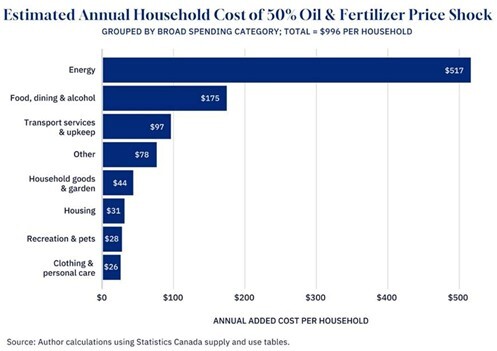
Inflation Beyond the Gas Pump
Trevor Tombe effectively explains the rise in fuel prices that many of us are experiencing at the pumps within a larger context. He describes how there is almost equivalent inflationary pressure, as increased fuel costs are embedded in the prices of nearly everything we buy. Although Canada’s overall economic impact is somewhat lessened—since, as an energy supplier, the economy also benefits from these higher costs—the distribution of costs and benefits is unequal. For the average Canadian, this only worsens the affordability challenges many are already facing. Current oil prices could add about 1% to inflation if maintained, with the real risk that ongoing Middle East conflicts will push oil prices and, with it, inflation even higher, which directly affects every Canadian household.
TAKE IT TO-GO
Dishing Advice Columns
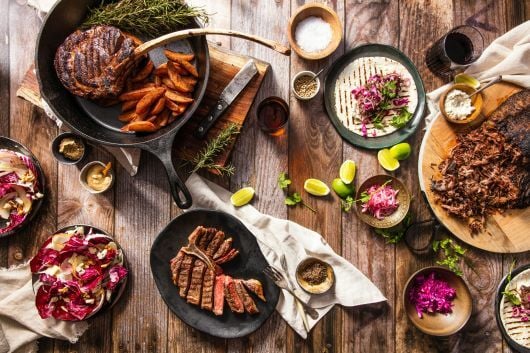
Remember Ask Ann Landers? In my childhood, her column occasionally resulted in a serving of other people’s dilemmas to our dinner table conversation menu—proof that advice could be both well-addressed and well-received. Occasionally, her offerings were spicy and sometimes rare, but digesting them in our family discussions often yielded some meat-and-potatoes advice. What made me recall this was this Globe and Mail reflection on the advice columns of yesteryear. I’ll admit to being surprised that “the genre continues to thrive today.” “Dear Prudence” on Slate and “Ask Polly” on Substack are not on my regular reading list, nor am I inclined to add them. But that doesn’t diminish the fact that day-to-day troubles are part of being human, and when life writes us questions, the answers are sometimes served up in surprising places.


Reply to Ray