


February 8, 2025
November 1, 2025
Click “Listen Now” to hear the audio version of Insights.
HERE'S MY TAKE
The Ontario government’s $75 million advertising campaign, reminding Americans that Ronald Reagan was a free trader and a skeptic on tariffs, landed Canadian trade negotiators in the penalty box as US President Trump called a timeout on the negotiations. It prompted significant debate about the wisdom (or, in the mind of many, foolishness) of this tactic, which seemed to threaten progress towards a Canada-United States trade deal, while possibly resulting in an additional 10 percent tariff.
While Ontario Premier Doug Ford made the headlines, the united Team Canada front on trade disintegrated. Manitoba Premier Wab Kinew publicly backed the Ontario campaign while BC Premier David Eby announced that his province would launch a similar campaign. Prime Minister Mark Carney has downplayed the tiff, urging caution and indicating a desire to continue talks. Alberta Premier Danielle Smith, meanwhile, said she was happy that Mr. Ford had pulled the ads.
Internal finger-pointing abounds as the Conservatives blame the prime minister for making “concession after concession” and getting nothing in return, suggesting that if they were in charge, a deal would have already been achieved. Polls over the last year suggest Canadians are divided as to whether they prefer an aggressive “elbows up” approach (which the Liberals campaigned on) or a more cautious, diplomatic approach to get a deal. No matter which side of that question you find yourself on, there are federal and provincial politicians loudly taking your side and condemning their opponents for being politically foolish.
Most of this is noise. It’s understandable that in the absence of information about events that affect our lives, the noise inevitably fills the void. If there is a critique to make about the federal government's approach, it is that it has included numerous closed-door meetings with many words about process, but very little substance regarding what’s on or off the table. That is understandable from a business perspective—negotiating in public only weakens your position. But trade deals are not just business; they also involve politics. The public are shareholders who expect and deserve to know what is going on. Failing to inform them will make whatever deal emerges more difficult to sell and risks undermining the government’s mandate to resolve the issue.
The connection between the politics and the business of the deal is complex and intertwined. It’s also important to remember that each party’s rational self-interest will not solely define the outcome of all this. Still, it remains useful to remind ourselves of what that self-interest is. Perspectives vary, but I remain convinced that Mr. Trump’s genuine belief in tariffs is rational, as I outlined in this space in the week he was inaugurated.
- Slap stiff tariffs on imports.
- Use tariff revenues to fund tax cuts and soften the inflationary impact.
- Within a couple of years, manufacturing will move to the United States in order to access the American market. Tariffs will recover the jobs that globalization and trade lost.
When negotiating any agreement, it is a mistake to assume that the other side will evaluate your offer based on the counteroffer they have made. Instead, the standard of evaluation is this: what are the consequences of not reaching an agreement? The question that informs the negotiating teams on both sides is what the implications would be if the Canada-United States-Mexico Agreement (CUSMA) were revoked or allowed to expire without a replacement deal in place.
In the United States, experts anticipate significant supply chain disruptions in numerous sectors from a CUSMA failure. The costs of many consumer goods would increase, which is inflationary. Meanwhile, there will be some localized sectoral layoffs, most likely in the automotive and agricultural industries, as jobs are relocated to other countries. The estimated immediate impact could be close to one percent of GDP. The impact would be felt very unequally, with many smaller border states bearing the brunt of the pain. Obviously, these impacts would be bigger or smaller depending on whether the expiry of the agreement was accompanied by escalating retaliatory tariffs from both sides and whether that trade is replaced by trade with other countries. China and the EU would be best positioned to increase their American presence as the Canadian presence declines.
The effects in Canada would be starker, especially in the short term. The GDP hit would probably be close to double what it is in the United States. Ontario’s manufacturing sector and Alberta’s energy sector would likely be hit hardest. Given that three-quarters of Canadian exports go to the United States (compared with just 15 percent coming the other way), the math suggests the proportional, immediate hit in Canada would be far deeper.
I have no way of understanding the reaction of Mr. Trump’s cancellation of the trade talks and imposition of the extra tariff. Was it a petulant tantrum because the US president was offended by an ad that came as most polls show his disapproval rating increasing, especially among independents and swing voters? The US Senate voted 51-47 this week to end the emergency declaration Mr. Trump used to impose his tariffs on Canada and Brazil. Given that Republicans hold 53 of the 100 seats in the Senate, the vote was a public and bipartisan rebuke to the president. This coming week, the US Supreme Court will hold an expedited hearing to consider whether the president has the unilateral authority to impose tariffs, as Mr. Trump has done in the past year. So, the court will resolve this internal American dispute about the division of powers between the White House and Congress.
On the Canadian side of the border, a different, significant event will take place next week: the introduction of the long-awaited federal budget in the House of Commons on Tuesday, November 4. The finance minister has promised “generational investments that empower Canadians by building Canada's economic strength.” The federal government plans to change its accounting methods to separate what it calls “investments” from operational spending. Whatever legitimacy there may be in making such distinctions, Canada will be borrowing eye-watering sums of money. However, in the context of Canada-US trade, it is useful to remember that the US debt challenge is also troubling. While Canada’s government debt was 11 percent larger than its national economy in 2024, American government debt was almost 21 percent larger than its economy in the same year. President Trump’s fiscal record isn’t that much different in this regard than Prime Minister Trudeau’s.
Significant next chapters in this story will be written in the coming week. There are many questions in the meantime. Is a Canadian elbows-up strategy of provocative advertising and retaliatory tariffs likely to get better results? Or does Canada flex whatever negotiating muscles are available and wait out the processes unfolding in the United States that may yet force Mr. Trump’s hand? And if the Canadian government has an articulate strategy, to what extent should it share it publicly? Whatever tactic the government chooses, the strongest negotiating position will come from strengthening Canada’s economic productivity independent of US trade considerations. So, evaluating what the budget achieves on that front seems most critical.
Canada doesn’t have unlimited time, mind you. Sean Speer capably articulated in the wake of last fall’s economic statement that “the arithmetic is going to eventually catch up to us” and force the country to choose between competing with Americans on their tax levels or providing European-style government services. Our attempt to do both is not sustainable. The trade dispute complicates things, as does the geographic reality that makes Canada-US trade inescapable. Mr. Trump seems to believe that economic self-interests define people and that if he wages economic warfare on Canada, Canadians will ultimately choose economic benefits over Canadian identity and sovereignty. He certainly has the clout to make that possible, but, as American overtures to absorb Canada were most prominently resisted in the 1760s, 1810s, and 1860s for non-economic reasons, there is reason to believe that most Canadians will continue to value their sovereignty and identity.
The path forward remains uncharted. This week, the Canadian federal budget and the US legal processes may bring us to a couple of significant forks in the road. I will pay less attention to the noisy debates about tactics with their flying elbows and penalty boxes than I will to how each country prepares for possible life without CUSMA. The context matters. If we rank Canadian provinces and territories, along with American states, by GDP per capita as a rough indicator of productivity, all Canadian jurisdictions (save Nunavut, the Northwest Territories, and Alberta) are in the bottom half. Seven provinces bring up the rear along with Mississippi. Ironically, it is as trade disruption consequences become clearer and Canadians better deal with economic weakness that the likelihood of a renewed deal grows.
WHAT I’M READING
Loyalty and Party Discipline
Alex Marland has distinguished himself as a thoughtful commentator on the day-to-day disciplines of politics. His latest book, No I in Team: Party Loyalty in Canadian Politics, came out this week. Other deadlines prevented me from picking it up immediately but I did enjoy Paul Wells’ interview with Marland. It explores the widespread desire for our elected officials to be independent and free-thinking, providing voice to diverse perspectives and communities, as opposed to a political system that is based on discipline and partisan unity. Marland highlights various systemic pressures within our system that encourage centralization and loyalty. He suggests that if change is to come, it will be from “a group of backbenchers in particular who say that we need change.”
Theological Tribes
Mark Tooley has an interesting essay that puts recent coverage of Douglas Wilson and Christian nationalism into perspective in the US press. Tooley notes the dominant narratives of Calvinism and post-liberalism have framed that discussion, but suggests that the historic contributions of Methodism and Wesleyanism are underrepresented in it. My own experience is that theoreticians work in clearer categories than do practitioners, but Tooley’s essay is valuable in bringing to light important nuances that many overlook.
Budget Optimism
The federal Liberals have changed their tone about next week’s budget. Defence Minister David McGuinty told reporters recently he has "every confidence" the November 4 budget will pass. Last week, the government house leader wasn’t sounding very confident at all that the minority government would survive a budget vote. No opposition party has publicly stated it would vote in favour of the budget—or abstain—but we won’t have to wait long to find out.
Trade Peace For Now
China and the United States have a trade deal of sorts in place. As The Economist has put it, the deal is “mostly a holstering of weapons, in which China agreed to postpone restrictions on exports of crucial rare earths for a year, while America will stay its tariff of 100 percent on Chinese goods and its threat of export controls on subsidiaries of blacklisted Chinese firms.” I suppose you could say it’s a trade war ceasefire. Most analysts consider this to be good news for the global economy, which is likely to lead to less disruption, at least in the short term.
MEANINGFUL METRICS
Good As Gold
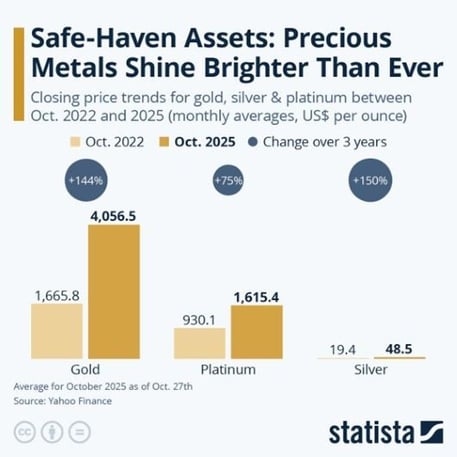
Anyone who has been watching the markets will have heard about the sky-high price of gold these days. Its price has jumped 144 percent in the last three years, according to this chart from Statista. Silver and platinum have also risen remarkably, though they started at a much lower price than gold. Why does this matter? Well, these precious metals have “reaffirmed their status as safe-haven assets, with their price trends reflecting global economic uncertainty, geopolitical tensions and shifting monetary policies,” writes Statista’s Tristan Gaudiaut. In other words, if you want to know whether bright financial minds are confident in or concerned about the future, look at the price trends of precious metals.
.
TAKE IT TO-GO

Cabochon Ineluctables
Both of the words in the title of this section were new to me when I read Jane Macdougall’s Globe and Mail essay asking, “Does using big words make you a snob?” Frankly, it’s the sort of article that I find ineluctable. Yes, I remember reading George Orwell’s “Politics and the English Language” and being reminded, along with every other North American of my vintage, that grandiloquence masks muddled thought. As a self-proclaimed wordsmith who shamelessly peddles my craft in this weekly paragraph, I bear the slings and arrows that the world understandably inflicts on those for whom polysyllabic words are swords. So, you might ask, is this all pomp without a point? Macdougall would respond negatively. Orwell would prefer the previous sentence to be just one word, “No,” but that would deprive Jane of the credit she deserves. “But there’s more to a grand vocabulary than just showing off,” Macdougall writes. “You see, the ‘big’ word is purpose-built for the occasion. Surgically, it does the job of conveying an idea. Economically, it nails down intention. Poetically, it adds lustre to text and dialogue. I could go on and on describing an impractical, starry-eyed idealist, or I could just say quixotic.” Couldn’t have said it better myself, although that doesn’t mean I won’t occasionally try.
Check your inbox next Saturday morning for your weekly dose of dot-connections sprinkled with a flavour of quixotic extravagance. If I am on my game, I might even deliver an ineluctable cabochon.


Reply to Ray