

September 26, 2026
Click “Listen Now” to hear the audio version of Insights.
HERE'S MY TAKE
China came knocking this week. America didn’t just answer—they rolled out the red carpet. “A truly great friendship” is how President Trump described his relationship with Chinese President Xi Jinping. The Chinese responded in kind: “Achieving the great rejuvenation of the Chinese nation and making America great again can go hand in hand.”
We need to take care not to read too much into the diplomatic niceties that accompany such visits. Statecraft requires open communication, even between strategic foes, and engagement itself can be a sign of maturity. It’s entirely possible to compete with, protect sensitive sectors, trade and negotiate with, and ceremonially embrace China. But balancing all these is a tall order, especially amid shifts in global security and significant strains occurring between the United States and her allies, Canada in particular.
I readily acknowledge less expertise on foreign than domestic files. I understand there is plenty of nuance to qualify my take, but political decision-making requires clear-minded thinking not only about your own priorities but also about those you are dealing with. At least the language, and I fear the substance, of the Chinese visit to Washington this week provide cause for concern.
I readily admit that when it comes to China, I remain suspicious. The China of my youth were “the bad communists” who persecuted Christians, provided little space for freedom, and showed little respect for the dignity of human life, including that of their own citizens. History justified the warning: after Mao’s Communist revolution triumphed in 1949, political purges, the Cultural Revolution, and especially the catastrophic Great Leap Forward contributed to tens of millions of Chinese deaths.
Recent history has done little to change that basic perception. The degree of injustice may have changed, but the underlying ethos has not. The detention of the two Michaels, the intimidation of Chinese Canadians—including the activities associated with so-called overseas police stations—and interference in Canadian elections are not ideological speculation. These are publicly documented findings of Canadian security agencies and a federal public inquiry. At home, the Communist Party continues to tightly constrain religious, political, and civic freedoms. Its foreign policy shows an increasingly powerful China willing to use diplomatic, technological, and economic leverage to advance its interests and pressure countries that resist it.
All of which means that when, earlier this year, the present Liberal government was criticized for cozying up to China—including by President Trump, who threatened severe trade consequences to Canada—I impulsively shared the suspicion, even if there was much to quibble about in the details. My default is that when China comes knocking, be clear-minded about who is at the door before opening it.
Let’s be clear. Opening the door to China is not a new conversation. Western governments have, for the past few decades, been increasing our trade with China, many defending it with the mistaken belief that economics would usher in democracy and rights for the Chinese. On both sides of the 49th parallel, governments of all stripes have increased trade, resulting in supply chains where China has significant impact and is near essential to parts of our economies. In 2025, Canadian merchandise trade with China totalled about $125 billion; American goods traded with China exceeded $414 billion USD.
That invites the question: when we open the door, do our engagements reflect the appropriate care about who is on the other side? Both countries speak of “appropriate guardrails,” and this isn’t the place to audit those claims. Both countries need to be attentive to ensuring that political accountability ensures that behaviour matches the pious words.
It is for Americans to sort through their own authority and accountability questions. The only point I would make as a Canadian observer is that what I saw on display this week—as well as in recent years—is an American administration cozying up to China every bit as much as Canada has. They are, of course, free to do so as a sovereign country, even if, from where I sit, it seems a bit contradictory to their core principles.
President Trump showed President Xi some of America’s founding documents during the official visit. But viewing them as historic artifacts on the occasion of America’s 250th is one thing; implementing the ideals they contain in the context of a 21st-century Chinese-American relationship is quite another. At the heart of these documents are themes of limited government, constitutional authority, and the ideal that all men (Chinese as well as Americans) are endowed by their Creator with inalienable rights, including life, liberty, and the pursuit of happiness.
As a Canadian, I can't help but reflect on the inconsistency of critiquing Canada for being soft on China while deepening the America-China nexus. Admittedly, it rankles when the Americans seem to suggest that Canada cannot develop a relationship with China that Washington itself maintains. Great powers sometimes struggle to remember that power and authority aren't synonyms. Having the capacity to make someone do something doesn't necessarily confer the right to make them do it.
That is among my fundamental objections to China's Communist regime. Beijing has repeatedly used economic and political power to reach beyond its proper jurisdiction, including intimidation on Canadian soil and economic coercion against smaller countries.
But principles worth having apply consistently. America's enormous economic leverage over Canada is a fact. That doesn't mean Washington has jurisdiction over Canada's relations with other countries.
A Christian understanding of political authority begins with the recognition that power is both necessary and limited. Government has real authority, but it is delegated rather than absolute, exercised by those who will themselves give account. The ability to compel does not create the moral right to compel, and the possession of greater power does not enlarge the boundaries of legitimate authority. That principle applies in Beijing, Washington, and Ottawa alike.
China will keep knocking. Prudence requires knowing who is at the door. Statecraft requires knowing how far to open it and which rooms must remain off-limits. Sovereignty means holding on to the keys. But in exercising all three is something more fundamental: power should remain subservient to authority, and all our leaders—and we collectively as nations entrusted with the keys—remain accountable for how we use both.
WHAT I’M READING
Speaking Out, Beyond the Standard “Thoughts and Prayers” Sentiments
Last week’s shooting at a Belleville synagogue while Jewish worshippers were gathering for Yom Kippur is just the latest incident in what is becoming the normalization of anti-semitic behaviour in Canada. Cardus Senior Fellow Andrew Bennett rightly decried the “whatever” complacency with which too many of us express our shock, condolences, and prayers – and then move on without really considering the sort of society we have become. The Globe and Mail editorial Wednesday sounded a necessary note of concern about politicians and institutions who make the required blasé statements at times like this but through their actions turn a blind eye to the escalation of violence towards our Jewish neighbours. As a Christian, I would say there is a double obligation to speak out loudly and clearly, not just within our own communities but publicly, on the real hatred, violence and danger that is being directed towards fellow image-bearers of God, and to address the problem of our relative silence on these issues.
Mark October with an X
The election call in BC this week only intensifies what already was going to be an historical month for ballots of significance being cast in Canada. There’s a provincial election in Quebec on October 5, a BC municipal election on October 17, a referendum in Alberta on October 19, a BC provincial election on October 24 and an Ontario municipal election on October 26. More voting doesn’t automatically translate into more democracy. A recent academic article posits that “frequent elections depress electoral participation and contribute to the global decline in voter turnout.” Each of these elections are their own story (which Insights will follow given their implications) but it will also be interesting to observe how the concentration of voting (albeit in differing jurisdictions, but nonetheless with significant broader implications) will impact.
A Less-Charitable Take
Matthew Lau uses the latest Fraser Institute study recording continued decline in charitable giving as a segue to his argument that as government spending increases, charitable giving declines. Not only do increased tax levels leave citizens with less discretionary income to donate, it also contributes to a mindset in which “people may conclude from increased government spending that if the government is taking care of the poor, private individuals and private charities don’t have to. It’s the state’s job now.”
The Tech-Socon Alliance
The 2024 U.S. Presidential election was followed by extensive analysis of how the titans of technology would co-exist with social conservatives and advocates of traditional values, both groups representing a significant swath of the voting coalition that elected President Trump. The story continues to unfold with many reading into President Trump’s United Nations speech seeking to reframe Artificial Intelligence as Super Intelligence. The New Atlantis has an analysis piece concluding that the coalition is no longer a compromise: the tech bros are now dominating policy and any pretense of a coalition can be buried as “social conservatives have been taken for a ride.” Some certainly will differ with this conclusion, and the current administration is anything but predictable–meaning the best one can do is draw provisional conclusions–but the debate about Artificial vs. Super Intelligence and its role in public policy has more consequence than a single speech.
MEANINGFUL METRICS
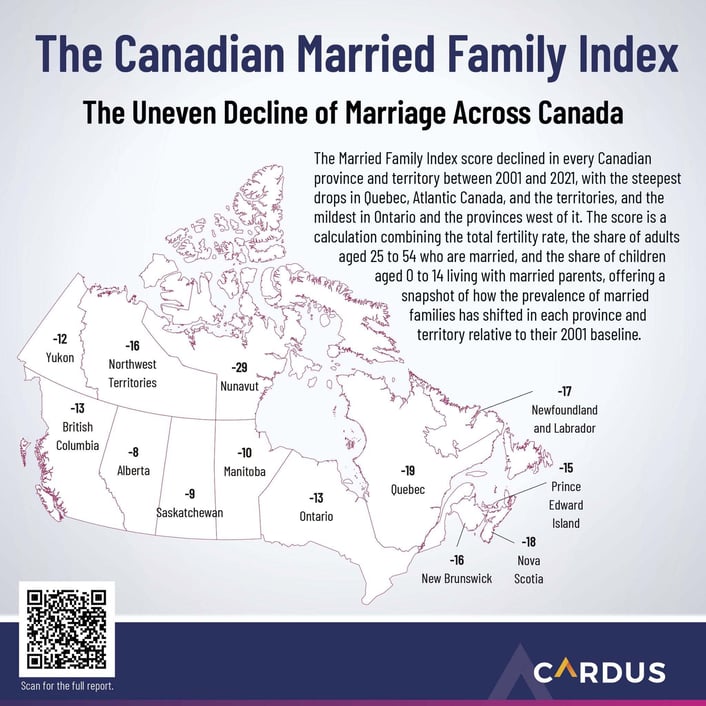
Measurable Marriage Decline
Healthy marriages don’t just affect the quality of life of those directly involved; they also affect families, communities, and society in significant ways.
Building off their previous work with the Canadian Marriage Map, my colleagues in our Family Program have developed the Canadian Married Family Index, a score that helps track three key family variables by province and by territory. It is notable that every province and territory has a negative sign in front of the number, meaning the prevalence of marriage has declined when measured against a 2001 baseline. So we’re left comparing rates of decline, with Alberta and Saskatchewan ranking the most positive (at -8) while Nunavut and Quebec have the most negative (at -29 and -19).
TAKE IT TO-GO
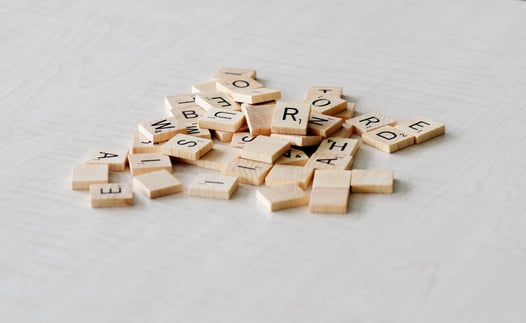
A Man of Letters
The label “man of letters” has seventeenth-century French origins coinciding with the identity of a public intellectual as a vocation. I mistakenly thought the roots had to do with academic credentials and the letters one gets to add as a suffix to your signature but a check of the Oxford Dictionary (generally a reliable source in figuring out the meaning of the combination of letters that are more commonly known as words) corrected my assumption.
What brought me there was a social media chart that crossed my feed, in which letters were remixed to form totally different words with surprisingly related meanings. I’m not endorsing the implicit messages that some of them carry (my mother-in-law was quite the opposite and although ready to defend my Reformed/Presbyterian sympathies, I’m certainly not going to claim prayer accomplishments). Still, I found myself admiring the unknown author of these letters and certainly not about to challenge them to a game of Scrabble.
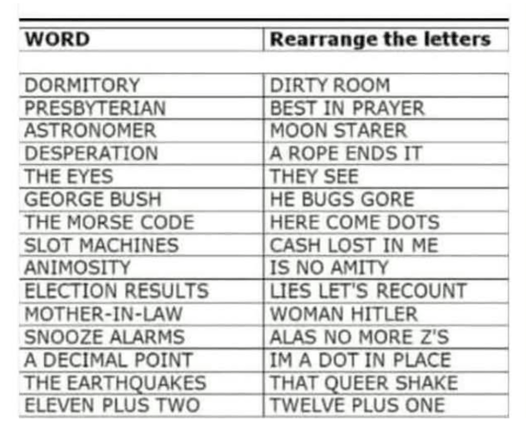
As they say, if you can’t beat ‘em, join ‘em. So this week, it’s letter play rather than wordplay. Hope your week is a good one, and looking forward to being back in your inbox next Saturday morning.
Reply to Ray