

October 3, 2026
Click “Listen Now” to hear the audio version of Insights.
HERE'S MY TAKE
The term “social license” made a comeback this week. It had been frequently referenced a decade ago, but I hadn’t noticed it much until this week, when it showed up in three very different media stories.
The first was last weekend’s multiple interviews with former Canadian General Wayne Eyre promoting his soon-to-be-released book. He repeated the warning that the Carney government would lose its present social license for increased defence spending if it did not clearly articulate the threats it had in mind to justify that spending.
Following this, a leaked Alberta cabinet document outlined a strategy to “help strengthen social license” as the basis for measures addressing community concerns around building data centres.
The next day, I read William Watson in the Financial Post explaining Canada’s inability to build pipelines with reference to the social licence debate.
The term came to prominence in the context of resource development. The argument was always that something more than official government approval was required to advance resource projects—broader public concerns regarding environmental and indigenous issues needed to be addressed before there was a moral legitimacy in proceeding.
The phrase sounds wonderfully democratic and, in itself, is not objectionable. But, as I argued in a piece published a decade or so back, the term’s usage is often intended to reframe the meaning of both license and democracy. Receiving a licence means receiving permission from someone authorized to grant that permission. Self-appointed advocates citing favourable opinion polls don’t quite make the cut. Democracy in this context requires that everyone have a chance to have their say, not that everyone gets their way.
I hear someone objecting. “Last week you used this space to argue the distinction between power and authority, noting that just because a government has the power to act in certain situations, that does not mean it has moral legitimacy in acting. Are you not now hypocritically arguing against the concept, suggesting government should act against popular opinion?”
No. But explaining why requires some important distinctions that seem increasingly muddled in our politics.
At least since the Magna Carta, developing democracies have established limits on political power. Kings were not above the law. Over the following centuries, as Parliament and constitutional government developed, another principle became increasingly important: legitimate government required the consent of the governed. The American Declaration of Independence put it memorably: governments derive “their just powers from the consent of the governed.”
But notice what happened as constitutional democracy developed. We did not leave “consent” as an abstraction, available for anyone to claim. We built institutions to give it expression. As Howard Anglin commented on the Alberta referendum, referenda are “antithetical to Canada’s constitutional system.” He went on to say “(p)lebiscites are not only unnecessary, they implicitly undermine the legitimate authority of the legislature and the government.”
We vote. Legislatures deliberate and pass laws. Governments are accountable to elected assemblies. Constitutions limit what majorities may do. Courts interpret and enforce those limits. Regulatory bodies operate according to delegated authority. Governments consult. Citizens petition, protest, organize, and argue. And at regular intervals we vote again.
The genius of constitutional democracy is not that it discovers what “the people” want and then does it. “The people” almost never want one thing. We disagree. The genius of democracy is institutions through which those disagreements can be peacefully adjudicated and decisions legitimately made.
Which brings us to why the term “social license”—as enlightened as it sounds—can be so problematic. It subtly changes the question from whether governments are exercising legitimate authority through accountable institutions to whether an undefined public mood approves of what they are doing.
Sure, one can argue that a referendum is defining, but in the present Alberta case, it is a referendum on whether to hold a binding referendum and muddles the process rather than clarifying it. Many acknowledge that the motive for voting pro-separation is to leverage Alberta’s negotiating position vis-à-vis the federal government, with a yes vote raising more questions about what a future Alberta might look like than it settles.
Social license goes way beyond referendums and, at its core, takes the legitimate idea of consent of the governed and divorces it from the institutions designed to give that consent meaning.
Who grants a social license? How do we know when one has been issued? Fifty-one percent in a poll? A majority in the neighbourhood where a project is being built? Ten thousand people at a protest? A million signatures on an online petition? What if a majority nationally supports something but most people locally oppose it? What if public opinion changes six months after an election? How deep into the details do those granting a social licence need to approve to maintain moral legitimacy? What happens if the poll question used to measure consent is worded and interpreted differently by those who translate that licence into practice?
There is no issuing office for social license. The concept becomes a polite term for what is essentially populism. Populism comes in many varieties, left and right, and the term itself is frequently abused. But one characteristic common to much populist politics is an appeal over the heads of institutions to an allegedly authentic voice of “the people.” The institutions say one thing, but supposedly people say another. And the person making that claim somehow knows better than institutional leaders what the people really think.
The language came into popular usage from the political left. A pipeline might have received regulatory approval and governmental authorization, but opponents argued that it nevertheless lacked “social license.” The implication was that somewhere beyond the cumbersome machinery of elections, legislatures, environmental assessments, and regulatory hearings existed another democratic authority capable of overriding them all.
These days, distrust of institutions is as much a feature of the right as it is of the left. Referendums, online movements, rallies, opinion polls, and social media sentiment can all be presented as more authentic expressions of democracy than legislatures, courts, regulatory processes, or representative government.
Different causes; same temptation.
None of this makes public opinion irrelevant. Quite the opposite. General Eyre's underlying point is surely sound: if governments want Canadians to support dramatically higher defence expenditures over many years, they need to explain the threats those expenditures are intended to address. Governments that cannot persuade citizens of the wisdom of their policies eventually discover the consequences at the ballot box.
But why call that “social license”? We already have perfectly good words for it: public support, political mandates, persuasion, trust, accountability, and consent. We have institutions and processes designed to balance different perspectives and competing interests. Our problems aren’t solved by bypassing them; we're better off renewing and reforming them to make them more effective.
Good governments listen. They explain. They accommodate legitimate objections. Sometimes they change course. And citizens remain free to organize politically to replace governments whose decisions they oppose. Bad governments deserve to lose elections.
That is democratic politics.
The left was playing with fire when it popularized that argument against projects it disliked. The right should resist the temptation to pick up the same torch now that populist winds are blowing in its direction.
Legitimate democratic authority depends upon the consent of the governed. Constitutional democracy embeds that consent in institutions precisely because “the people” are plural, disagreement is permanent, and today's majority can become tomorrow's minority. By all means, let’s demand that those institutions remain responsive to the people they serve. We should reform them when they fail. We should insist that governments persuade rather than merely impose.
But we should be wary of inventing an imaginary licensing authority called “society” and then letting whichever politician, activist, or pollster who happens to have the microphone announce whether the licence remains valid. Which is why I am allergic to the term social licence.
Who issues the social license?
Nobody does. As flawed as some of our institutions are, freedom is enhanced through order. Focusing energy on improving institutions, rather than inventing populist authorities issuing ill-defined licenses, is a better path forward for democratic improvement and flourishing.
WHAT I’M READING
Is AI Getting Religion?
The New York Times reported on meetings between Anthropic executives and religious leaders, apparently making the case that a future version of Claude “could be conscious” and seeking advice on how to infuse it with a morality. The article raised many more questions than clear answers, but I share the concern about tech leaders proposing “that Claude had what philosophers call “moral status” on par with a person — that it was a being with similar inherent rights to dignity or respect.” This isn’t happening in a vacuum: Pope Leo XIV’s recent encyclical Magnifica Humanitas addresses precisely this temptation, warning against equating artificial with human intelligence and insisting that AI does not experience, suffer, love, or relate as embodied human persons do. In other words, we certainly need to think seriously about the morality we build into our machines; we should be considerably more cautious about building a moral case that the machines themselves are persons.
Executive Prime Ministership
It’s an opinion piece, so the conclusions need to be read with appropriate caution, but Jesse Ling’s Toronto Star analysis of the inner workings of the Prime Minister’s office is a fascinating read at various levels. There is obviously lots of fodder for political junkies who follow the minutiae of the relationship between a leader, caucus, and the bureaucracy in seeing public policy move through the political process, but this piece could also qualify as an organizational development piece, analyzing how best to organize a complex organization, as well as a leadership primer, especially as the methods of Prime Minister Carney and Prime Minister Trudeau are contrasted.
Liberal Arts After Hours
The University of Toronto is offering an “after dark philosophy series” that gives students who prefer not to focus on STEM themes a chance to engage with deeper philosophical ideas. A standing-room crowd filled a lecture hall for three hours to listen to a debate on the ethics of capitalism, reflecting a trend in several universities where students are seeking education beyond the technical. “Philosophy endures as a popular second choice for students majoring in hard-edged subjects such as economics, physics, and math,” is the claim, despite almost all new funding universities receive being spent on technical courses.
MEANINGFUL METRICS
Turkey Time
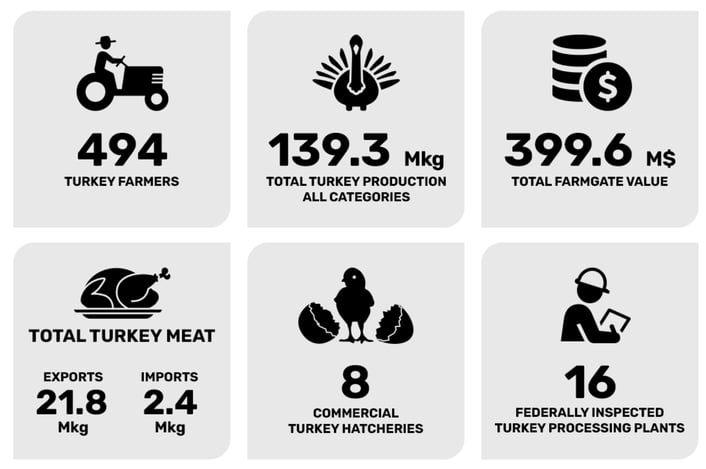
With Canadians ready to celebrate Thanksgiving next Monday, I found myself musing about Canada’s turkey industry. The Turkey Farmers of Canada website contains a helpful infographic with plenty to chew on: Canadians gobbled 129 million kilograms of turkey last year, or 3.1 kilograms per person.
But perhaps the most striking number is how seasonal our appetite is: 37 percent of all whole turkeys purchased in Canada are bought for Thanksgiving and another 45 percent for Christmas. Apparently, when it comes to turkey, Canadians don't just have a preferred meat—we have a preferred calendar.
TAKE IT TO-GO

Word Work
Regular readers know I’m partial to wordplay. But having just written an editorial quibbling about language and its implications, it seems fair to observe that wordwork might be a better choice to describe what this final paragraph is doing.
We all realize that words have a job to do. Some do the heavy lifting. Some are overworked. Some don’t pull their weight. We employ them, deploy them, put them to work and occasionally give them a well-earned rest. A carefully chosen word can do the work of a sentence, while the wrong one can create a whole lot of extra work.
Of course, getting words to work doesn’t mean we can’t have a little fun on the job.
So consider this less a cancellation of wordplay than a shift change. The wordplayers have already headed home and now the wordworkers have punched the clock, rolled up their sleeves and reported for duty. When their task is done, we will consider this edition of Insights complete.
Next weekend is Thanksgiving Day in Canada meaning we will reup the content we have previously provided you in case you missed it, aiming to provide the next edition of Insights on October 17. On behalf of Phil Gaudreau and Dayna Hillier who edit, post, and promote my musings each week (a hearty thanks to both for their diligence and expertise), the Insights team wishes all of our readers a most blessed Thanksgiving celebration.
Until next time.
Reply to Ray