

August 8, 2026
Click “Listen Now” to hear the audio version of Insights.
HERE'S MY TAKE
Who loves Canada more? It is the sort of question that produces considerably more heat than light, which may explain why it has occupied so much space online and in newspapers over the past few weeks.
The immediate spark was a July 24th Globe and Mail column in which Andrew Coyne asked whether Canadian Conservatives have a patriotism problem. His argument was about loyalty, not flag waving.
At a moment when US President Donald Trump is applying economic pressure against Canada and repeatedly challenging its right to act as an independent country, Coyne sees evidence that some Canadian Conservatives instinctively side with Trump against their own government. Their ideological affinity with the American right, he suggested, may have become stronger than their solidarity with their Canadian compatriots. You could also consider the sympathy some on the right express for Alberta separatism.
Coyne believes there is reason to ask whether party and ideology have displaced country in the conservative hierarchy of loyalties. The column prompted an extensive reaction, especially online. Coyne’s critics argued that he had quietly equated patriotism with support for Prime Minister Mark Carney and the Liberal government’s negotiating strategy. Questioning whether Carney is handling Trump effectively, they insisted, is not the same as taking Trump’s side.
Nor were Conservatives inclined to accept lectures on patriotism from Liberals who, only a few years ago, seemed more comfortable apologizing for Canada, keeping its flag at half-mast, and rewriting its history than celebrating the country. Now that large Canadian flags are politically useful, Conservatives contend the Liberals have wrapped themselves in the maple leaf and declared disagreement disloyal. Both sides land some blows.
Coyne identifies something real and troubling. Partisanship can distort loyalties so that we begin to cheer developments harmful to our own country simply because they embarrass the party in power. But his critics identify an equal danger: the governing party's attempt to claim ownership of the national interest and treat criticism of its choices, the very work of the official opposition, as disloyalty to Canada itself.
The dispute, therefore, revealed something more important than which party can claim to be most patriotic. It exposed a conceptual confusion. We speak as though solidarity, patriotism, and sovereignty are interchangeable, but they’re not. They’re related, certainly, but each describes a different kind of political attitude.
Solidarity rests on a deeper moral insight: Augustine’s account of rightly ordered love. Developed in On Christian Doctrine and distilled in The City of God, this account holds that “virtue is the order of love.”
We owe something to every human being. Yet our obligations are also ordered. We bear special responsibilities to those with whom we share a common life. Political solidarity is that particular set of reciprocal duties among citizens grounded in that ordered moral universe.
Patriotism is different. If solidarity names the duties we owe one another, patriotism is the love of country that animates those duties and finds expression in loyalty to our shared polity. Loyalty is patriotism in action, a steady commitment to the common good through disagreement and change. Emotions attend that love—gratitude, pride, sorrow, hope—but they express rather than constitute the commitment.
Sovereignty, finally, is not a feeling or a duty, but a status: the authority of a people to govern itself. More than the right to choose, it is the responsibility to bear the consequences of choosing. A sovereign nation accepts that self-government may require sacrifices that don't maximize immediate comfort, because preserving the capacity to decide is itself a good.
That's why our present debate matters beyond any single negotiation or news cycle. Before we argue about strategy, we have to recover a shared grammar. Solidarity as the moral foundation, patriotism as the loyal affection that sustains it, and sovereignty as the political freedom they serve. The measure of our common life won't be found in any single deal. It will show in our willingness to accept the burdens and the freedoms together.
WHAT I’M READING
In search of a normal politician
Sean Speer at The Hub makes the case for a doctrine of "normalism". He advocates for a more managerial, centrist government—one not concerned with "identity" or "transcendence" but rather "safe streets, functioning services, and a growing economy."
How to build a nation
Mark Pupo in Macleans argues that Donald Trump’s trade threats and annexation rhetoric have exposed Canada’s deep dependence on the United States and jolted the country out of decades of economic complacency. Renewed patriotism may supply momentum, but rebuilding the economy will require sustained spending, faster decisions and patience—the benefits are many years away.
Understanding young adult journeys to faith
New research commissioned by the Church of England and conducted by our friends at Theos explores how Gen Z is engaging with Christianity in new ways amongst a changing cultural context. A key finding from their interviews: "Now more than ever, the Church could be more assured in its identity, recognising its heritage and traditions as something to be valued, preserved, and shared."
MEANINGFUL METRICS
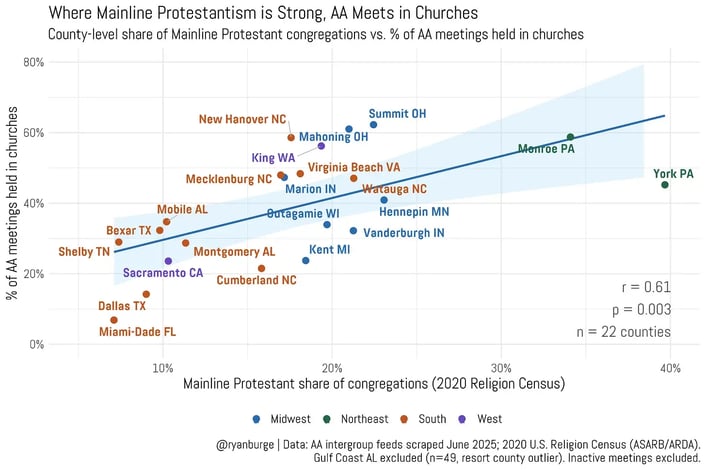
Where does Alcoholics Anonymous go when the churches close?
Ryan Burge of the blog Graphics about Religion took on the monumental task of trying to determine how many Alcoholics Anonymous (AA) meetings in the States take place within churches. While his data set is incomplete and many more hours of work would be needed for a full picture, his initial findings confirmed that AA meetings frequently rely on mainline Protestant church buildings as meeting places.
Left unanswered is the question at the heart of his investigation: where does AA go when the churches close?
TAKE IT TO-GO
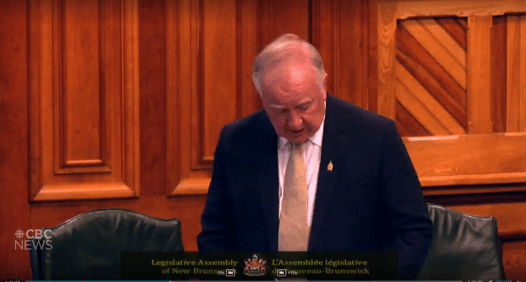
ChatMLA?
On June 9, New Brunswick MLA Bill Oliver delivered a 40-minute speech that recently went viral for all the wrong reasons. Mr. Oliver left in three obvious signs that the speech had been written, or at least altered, by an artificial intelligence writing assistant. But let's take a step back.
It wasn't just the prompts being in the script—it was the fact Mr. Oliver read them aloud. It was a pivotal moment for AI in Canada. Think of it like the invention of the printing press, except Gutenberg pauses halfway through the Bible and says, “Would you like me to make this passage more concise, persuasive, or conversational?"
Ultimately, Mr. Oliver's mistake was deeply human. He trusted the script. He kept reading. He discovered, in front of an audience, that artificial intelligence still requires actual intelligence at the final stage. This incident should serve as a wake-up call.
Let me know if you'd like a more natural, flowing version of your write-up with more puns. (Just kidding)
Look for the next edition of Insights in your inbox on Saturday, August 15th.
A personal note
My thanks go out to my colleagues Michael Van Pelt and Brian Dijkema for contributing the last two Insights columns, and to Dayna Hillier and Phil Gaudreau for their assistance in preparing Cardus Insights. I have been recovering from some medical issues and am now getting back into the saddle, fully resuming all duties—including this newsletter. See you in the next one!
Reply to Ray