


June 13, 2026
July 4, 2026
Click “Listen Now” to hear the audio version of Insights.
HERE'S MY TAKE
Two hundred and fifty years ago today, the United States Congress approved the final wording of the Declaration of Independence, largely drafted by Thomas Jefferson. It was but one step in a complicated process, but it has proven to be one of the most influential political statements of the past two and a half centuries. Its impact has extended far beyond the United States, shaping democratic aspirations and political movements around the world.
The Canadian in me takes a certain delight in gently observing, alongside King Charles III in his recent speech to Congress, that for those of us who remained loyal to the British Crown, the American Revolution was really only "the other day." But when one measures history in centuries, that is merely a quibble. Given that Canada's own constitutional arrangements are only 159 years old, we should approach this celebration with humility. Canada has more than its share of problems and is hardly in a position to lecture others; it would be especially un-Canadian to do so at a birthday party.
The current strain in Canada-U.S. relations has understandably left many Canadians viewing our southern neighbours with greater skepticism than at any point in recent memory. Recent polling suggests roughly two-thirds of Canadians now hold an unfavourable view of the United States, a dramatic reversal from the goodwill that characterized much of the past half-century.
Still, let's not allow the present moment to cloud our judgment. The story of America's first two hundred and fifty years is, on balance, one of a remarkable force for good in the world. It has been an imperfect democracy, certainly, but also an extraordinarily successful one. There is much in the American experiment from which the rest of us can still learn.
At least three reasons come to mind.
First, the idea of America remains a noble one.
The central claim of the Declaration of Independence remains among the most profound political statements ever written:
"We hold these truths to be self-evident, that all men are created equal, that they are endowed by their Creator with certain unalienable Rights."
The aspiration expressed in those words is universal, not uniquely American. The founders did not invent human dignity, liberty, or equality. Rather, they recognized them as gifts belonging to all people as image-bearers of God. Their understanding of government, however imperfectly lived out, reflected the conviction that political authority should be limited because every human being possesses inherent dignity and because concentrated power is always susceptible to abuse.
These are not uniquely American values. They are rooted in the broader Christian and Western tradition. Yet America institutionalized them in a distinctive way, and the idea of America continues to inspire, especially on those days when it is able to look upward rather than inward.
Second, the example of America has generally been a positive one.
Ideas matter, but what ultimately matters is whether they become embodied in institutions and habits.
America has often fallen short of its founding ideals. Slavery, racial injustice, exclusion, and political excess are all part of its story. Yet what remains remarkable is not merely that America failed, but that it repeatedly developed the moral resources to recognize those failures and seek correction.
As a politically minded Canadian trying to understand my southern neighbours, I continue to value the insights of Alexis de Tocqueville. Writing in 1835, he observed that many tasks European democrats expected governments to perform were instead carried out by churches, charities, neighbourhood groups, and voluntary associations in America. A vibrant civil society had been developed to mediate between the individual and the state.
This mattered politically, but also morally. Citizens learned cooperation, responsibility, compromise, leadership, and trust. They became accustomed to solving problems together rather than immediately looking to the government. The result was a richer moral vocabulary, one that spoke not only of rights and
entitlements but also of duty, virtue, reconciliation, forgiveness, and service.
America's civil society has long been one of its greatest strengths.
Less than a century after the Declaration came the Civil War. It remains one of America's darkest chapters, but also one of its defining moments.
Abraham Lincoln inherited a nation divided by a profound moral disagreement. Yet in his Second Inaugural Address, he acknowledged that both sides believed God was on their side and cautioned against simplistic moral certainty: "The prayers of both could not be answered; that of neither has been answered fully."
That humility did not weaken his commitment to justice. Quite the opposite.
"With malice toward none; with charity for all; with firmness in the right, as God gives us to see the right..."
Standing firm while affirming the humanity of those who differ. Pursuing justice without abandoning charity. Seeking reconciliation rather than conquest. These are moral achievements before they are political ones.
Without such a moral vocabulary, democracy eventually becomes little more than procedures. Measured against other nations rather than against perfection, America's example over most of its history remains admirable.
Third, the hope of America is enduring.
As a Canadian policy analyst, my focus is on ideas, institutions, and policies rather than personalities. Admittedly, maintaining that posture has been difficult during the past decade of American politics, where merely mentioning the current president can provoke intense reactions.
But a nation with a two-hundred-and-fifty-year history and forty-seven presidents is bigger than any one administration, movement, or personality. Americans have endured civil war, economic depression, social upheaval, world wars, and constitutional crises before. Again and again, their institutions have proved more durable than many observers expected.
A Birthday Worth Celebrating
So today, July 4th, 2026, is a day to congratulate our American colleagues, neighbours, and friends. You have every right to take pride in what your country has accomplished over the past two and a half centuries. You have built one of the most prosperous, innovative, and influential societies in human history. Stand tall. Sing your anthem with vigour. While celebrating your achievements, remember what made them possible.
America's greatness has never rested primarily in wealth or military power. It has rested in a set of convictions about the dignity of the human person, the limits of political authority, and the responsibilities that accompany freedom.
Those values do not belong exclusively to America. They are gifts rooted in truths endowed by our Creator and available to every nation willing to cultivate them. They need not be wrapped in stars and stripes in order to remain true. In fact, the Stars and Stripes will fly more strongly when it flies alongside other flags that uphold these same truths.
Healthy national pride has its place. (I still look forward to the day Canada regains Olympic hockey gold!) But the competition between nations is healthiest when it serves a larger pursuit of human flourishing. To borrow the language of the Declaration, the true measure of success is whether free people organize themselves in ways that maximize life, liberty, and the pursuit of happiness.
My birthday wish is that America's next two hundred and fifty years prove even more exemplary than its first. May it continue to bless the wider world, not simply through power, but through its witness that human beings flourish best when freedom is joined to responsibility, liberty to virtue, and rights to the dignity bestowed by our Creator, respected in a just manner for all.
Happy Independence Day.
WHAT I’M READING
Who are We, Canada?
In celebration of Canada Day, my colleague Brian Dijkema penned this thoughtful column that invites us to reflect on the elements of Canadian persona identity and how we might work towards a stable, positive identity of Canadian nationalism. His list: shared space and geography, history, language, symbols, sense of continuity and predictability, and a means of transferring these elements to the next generation.
When Parliament Gets It Right
Dr. Ramona Coelho has been one of Canada's most thoughtful voices on euthanasia policy, and her Globe and Mail op-ed this week is well worth reading. As Parliament prepares new MAID legislation this fall, she argues that the law must more clearly define "reasonably foreseeable natural death," "grievous and irremediable," and "intolerable suffering," restore minimum waiting periods under Track 1, and establish real-time safeguards when families or clinicians raise concerns.
The Politics of Transgression
Sean Speer argues in The Hub that our politics increasingly asks government to answer questions it was never designed to resolve. Rather than responding with an opposing politics of transgression, he calls for "a politics of normalcy" that protects the conditions for a good life while leaving deeper questions of meaning and belonging to the institutions better suited to carry them.
MEANINGFUL METRICS
Measuring Religious Polarization
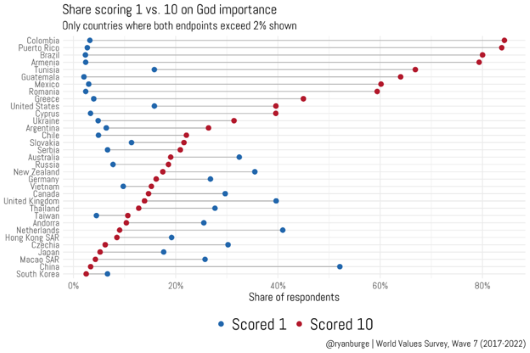
Since this Canadian is looking beyond our borders this week, Ryan Burge's analysis of religious polarization across 54 countries makes an appropriate metrics feature. His graph compares those who rate God as "very important" with those who say God is "not important at all," providing a simple picture of religious polarization within each country.
Canada sits near the global middle, with roughly 16% saying God is very important and about 30% saying not important at all, leaving a large majority somewhere between those extremes. The United States is almost the mirror image, with approximately 40% placing God at the highest level of importance and only about 16% at the lowest. China, by contrast, stands apart, with roughly fifteen non-religious respondents for every deeply religious one. Burge's broader essay explores how these patterns relate to beliefs about heaven and hell, religious exclusivity, and national prosperity, offering a nuanced reminder that headlines rarely capture the full complexity of religious life.
TAKE IT TO-GO

Orange You Glad Canada's Still In?
Truth be told, I expected Canada's World Cup run to end with a respectful nod, leaving me free by the Round of 16 to cheer for the Netherlands of my forebears. But as a friend noted, the Dutch were rocking until they were Moroccan. So the transfer window is closed. Oranje is out. The Maple Leaf lives. And this Saturday, the underdogs get extra time.
Next week's Insights will arrive as usual. Since I'm spending the week at the cottage with my wife's extended family, I pre-wrote it during my week in Istanbul. "Who let the cats out?" is a question every visitor to Türkiye eventually asks, but I'll use it as a segue to reflect on what makes civilizations flourish, and what North America may be forgetting. Enjoy your week.


Reply to Ray