


May 3, 2025
December 13, 2025
Click “Listen Now” to hear the audio version of Insights.
HERE'S MY TAKE
A year ago, the end-of-year insights I offered on the Canadian political situation started with the words “Chaos, crazy town, crisis.” Chrystia Freeland had just resigned as federal finance minister. Elected but not yet installed as president, Donald Trump was in his peak public musings about Canada as a 51st state. A federal election was scheduled for October 2025 at the latest, which most pundits anticipated would make Conservative Party leader Pierre Poilievre prime minister. In fairness, most predictions came with caveats about uncertainty and unpredictability.
Twelve months later, we can shift from prediction to reflection. Tariffs came, although in a somewhat different and less predictable form than promised. We had an election, and Mr. Poilievre did not become the prime minister. (Not only did he not become head of government, but he also saw two caucus members cross to the Liberals and one announce an early exit from politics in the intervening months.) It seems “avoiding doomsday” is an apt overarching motif for the Canadian political year that was. In keeping with that motif, the spring federal election pivoted on the ballot question of who was best able to deal with the challenge that US President Donald Trump presents to Canada. Since hockey analogies seem to be in vogue after Mark Carney’s successful “elbows up” election campaign, you could say we recruited a penalty killer for prime minister. 2025 was not about scoring goals or winning games; it was about surviving. Getting out of the corner without getting injured and surviving to face a future period without falling too far behind seemed to be the extent of our collective ambitions this year.
As we enter 2026, I wonder if we need a collective mindset change. It’s not that the issues we face are very different from a year ago. Trade with the United States remains challenging, if not problematic. Our need to build infrastructure to deliver our energy to foreign markets is as urgent as ever. Separation talk persists in both Alberta and Quebec. And we’ve yet to see any real solutions to Canada’s productivity and affordability challenges. Crime and safety remain an everyday concern. But, even if the issues haven’t changed, I still wonder if both our leaders and citizens took a different approach to these challenges, we might see better results.
Take our relationship with the United States, for example. The challenges are obvious: tariffs, ongoing trade disputes, foreign policy, and border issues. But the Canada-US relationship is more than a government-to-government issue. We still have the world’s longest undefended border, family and friends on both sides of the border, shared cultural connections, and good business relationships between Canadians and Americans. These all run far deeper than the political controversies of the day. What would happen if we broadened the conversation instead of focusing on settling the specific trade issues as they impact a given sector? The Macdonald Laurier Institute (MLI) has proposed a “Grand Bargain” approach:
“... a more ambitious, comprehensive negotiation that incorporates many unresolved bilateral issues and shared opportunities. Such an agreement could include areas like critical minerals and energy, border and continental security, defense spending, softwood lumber, food and water security, cross-border infrastructure, and regulatory alignment.”
One doesn’t need to buy into all of the specifics MLI suggests, but the impulse to think more broadly in terms of strengthening the overall relationship and solving the tension points within a more comprehensive agreement seems to be wise.
What if we took a similar approach to national unity? Regardless of how Alberta and Quebec politics unfold, we cannot ignore the real possibilities of separation referendums, given the particular histories of each jurisdiction. I am personally skeptical that there is adequate support in either province for such a referendum to succeed, though, personal predictions don’t really matter. However, the process can be more troubling than the result, and as a podcast episode of “The Bridge with Peter Mansbridge” properly highlighted this week. It’s quite likely foreign players will take advantage of these referendum processes to destabilize Canada in a manner that advances their competing global interests. Many nations would love to get their hands on Canada’s far north, given its strategic importance and the mineral riches it contains.
Instead of seeing this as a problem, we could approach the issue more aggressively as an opportunity. Canadians’ most top-of-mind natural resources are typically oil and gas. (As I discussed last week in reviewing the Alberta-Canada Memorandum of Understanding, energy is very significant.) But there is also increasing demand for a range of minerals, including graphite, nickel, lithium, and other rare earths, of which Canada, in general, and Quebec, in particular, have significant supplies. The exploitation of these resources, often in hard-to-reach places, is more than an engineering challenge. Does it not have the potential to build Canadian identity and nationhood, just as the Canadian Pacific Railway, the Trans-Canada Highway, and the St. Lawrence Seaway did? What if, instead of adding various projects to the Major Projects Office's list for consideration, becoming a mining and energy superpower became a national identity project? Rather than reciting our productivity challenges, interprovincial trade issues, and sectoral hang-ups as a checklist of problems, we might overcome some of these if we saw them within a larger framework.
While the application of hockey analogies to public affairs has its limits, Canadians know well that it isn’t just the skill on the team that matters. Camaraderie, identity, and confidence on the ice often make the difference between success and victory. Canadians played the 2025 political relationship game with a doomsday mindset, playing defensively to avoid losing. 2026 is a time to go on the offensive for a win.
I anticipate some will object that Canadians don’t have a strong enough national identity to achieve this. And there’s something to that objection, though Canada has multiple identities rather than a single one. Our history has included multiple nations living within a single polity with “peace, order, and good government.” One can go back to the Quebec Act of 1774, which recognized the religious freedom of French Catholics and upheld French civil law as beginning a legacy in which Canada is a “peace treaty” between French Catholics and English Protestants. While our history with Indigenous peoples is more fraught, Canada today is a country in which multiple nations live together. Although the term “community of communities” carries historical baggage, Canada is a shared civic project for people of diverse backgrounds. The land we inhabit requires cooperation to overcome its harsh climates and vast distances. The Canadian identity was built less through government documents or patriotic phrases than through the reality of neighbours relying on each other—regardless of ethnic, linguistic, or religious differences—to homestead the prairies, build towns around mines, or build fishing villages.
Of course, we must not translate this into an identity of mere proceduralism, as if being Canadian is just about getting along and actually standing for nothing. Canadian values include a deep-rooted respect for the dignity of every human being (that has its origins in recognizing we’re all made in the image of God), a toleration of difference within the boundaries of mutual respect, protection of the order that guards for others the rights that I seek to enjoy myself, and a sense of the “common good” that implicitly requires some shared sense of what is good. To be sure, some voices challenge these values in our day, posing very real and important identity questions. But culture is inherited, not imposed. I argued in this space a few weeks ago that the government cannot create identity and culture, and that vibrant institutions beyond the government must build a healthy culture. Most Canadians born today are not direct descendants of British, French, or Indigenous peoples, but are born in or have immigrated to a country in which all three national identities have become part of a single Canadian polity. Living peaceably with my fellow Canadians from various backgrounds is part of my Canadian identity. Subsidiarity and solidarity bring me to celebrate these communities as part of being Canadian.
That is not to minimize the real identity questions that challenge us. Romanticized stories about our history won’t solve the tensions that diaspora politics and polarized tribalism have brought us. But again, a doomsday approach that stares only at the problem and responds defensively won’t solve it. Instead, it’s better to start with our common humanity and the respect and dignity every one of our neighbours deserves and to focus on what we can do together.
Our elected MPs have headed home for their Christmas break, away from the place where they parle on behalf of their constituents to the ridings in which they will hear their constituents speak. While the drama is less intense than it was a year ago, the general mood is rightly one of concern and even despondency among some, as the effects of our economic and political tensions bring real-world challenges to Canadians' homes. It will take actions, rather than words, to solve these matters, but good actions come after imagination of what might be possible. The commitment of Canadians to respect their neighbours and work alongside them, despite what could be significant differences, is a legacy we can all celebrate and build on.
WHAT I’M READING
Religious Freedom Debate
Parliament’s justice committee passed a Bloc Québécois amendment to Bill C-9 this week, which removes the religious exemption from Canada’s hate-speech laws. My colleague Andrew Bennett highlighted in his Hub essay that “not only is this ill-informed it also threatens religious freedom in Canada. Just as importantly, it would also reveal a completely flawed understanding of hate, of reasonable limits on freedom of expression, and even of personal responsibility.” National Post columnist John Ivison observed that “the government made a Faustian bargain to gain passage of their bill” with a result “that stripping the religious defence was more likely to criminalize faith than combat hate.”.
Banning Social Media for Kids
This BBC article (thanks to the reader who brought it to my attention) highlights Australia’s ban on social media for those under the age of 16, which is scheduled to take effect this week and is backed by substantial fines to social media companies who do not take the necessary steps to comply. The BBC calls it “the most radical” of steps many governments have taken around the world to limit children’s use of social media. The havoc that social media is wreaking on young people seems to be an accepted fact, and some think that steps like Australia’s may “become a proof of concept that gains traction around the world.”
Why the How Matters
Phil Klay’s essay parsing the debate about American military strikes against narcotics traffickers and drug boats helpfully takes the discussion beyond the intricate arguments about legality. He wonders how the “celebration of death” in the current public debate compares with the cruel gladiatorial games of Roman times, citing Augustine who said, “The real evils in war are love of violence, revengeful cruelty, fierce and implacable enmity, wild resistance and the lust of power.” Perhaps the bigger question than one of process is what is being exposed about the soul of America through both the actions and the debates regarding them—something that implicates not just the politicians and military, but every American.
Choosing Educational Pluralism
Debates about how education is best delivered often pit public-sector teachers’ unions, which loudly argue that only public schools can provide education for the common good, against libertarians, who argue that giving parents money with no strings attached will serve the public good. Ashley Berner, a Cardus senior fellow, argues in the New York Law Democracy Project that 171 out of 204 countries rely on non-state actors to deliver education in a “choice plus accountability” model. That’s different than simple school choice because it involves the state funding, regulating, and holding independent schools to account.
MEANINGFUL METRICS
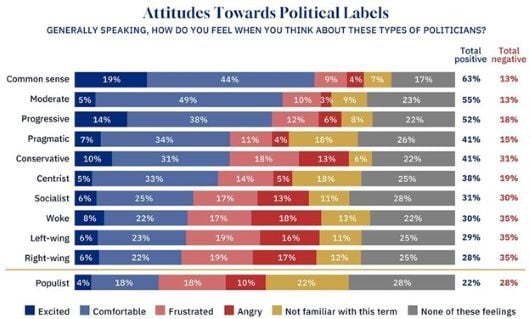
Labelling the Labels
Despite their regular use, political labels are hard to define and therefore can communicate very different things to different people. I’m fascinated by pollster and Carleton University professor André Turcotte’s essay this week on a Pollara survey conducted in October. Turcotte focused on the comparatively low emotional response (both positive and negative) that the label “populist” evokes. He suggests this is because of “disengagement and uncertainty” regarding the term. However, when Pollara tested commonly assumed “populist positions” on specific issues, the responses were much more polarized. Not surprisingly, the survey also found that 55 percent of Canadians had a positive view of the label “progressive” compared with 41 percent who had a positive view of “conservative.” “Woke,” “left-wing,” and “right-wing” are the labels that evoke the most negative responses (with “conservative” only slightly behind). “Common sense” tests as the most positive label, although I am not certain it is that meaningful except to indicate that there is a substantial group of “moderate” (55 percent) or “centrist” (38 percent) Canadians who seem to view themselves and their approach to politics in non-ideological terms.
.
TAKE IT TO-GO

Milking My Dutch Heritage
Both of my parents immigrated to Canada as teenagers, so while I bleed maple leaf red, news from Holland naturally clogs my inbox. A social media post this week drew my attention to a 2018 story about a Dutch cow. Hermein escaped from her farm and sparked a national wave of sympathy—proving once again that the Dutch are capable of organizing anything, even a crowdfunding campaign for an animal with better exit strategies than most consultants. Authorities tried to steer her home, but like a stubborn Dutchman, she refused to budge until negotiations were fully concluded.
Here’s hoping your weekend is equally well-negotiated, your next week is udderly productive, and any workplace hurdles are as navigable as a flat Dutch landscape. Tot volgende week — keep things moo-ving.


Reply to Ray