


February 24, 2024
December 20, 2025
Click “Listen Now” to hear the audio version of Insights.
HERE'S MY TAKE
I winced a little when I read the headline, “The Architects of AI Are TIME’s 2025 Person of the Year.” The article starts off with a focus on computer chipmaker Nvidia. Of course, I don’t dispute the reality that Nvidia, as the global leader in artificial intelligence investments, is now the company with the highest valuation in the world. It wasn’t that long ago when I would not have recognized the company’s name. Regardless, they have clearly been a significant story in 2025.
Whatever we may say about Nvidia, year-end newsmaker lists remain arbitrary and subjective. Someone else might have chosen Taylor Swift based on her 108 million monthly Spotify listeners, which jumped by 1.85 million when she endorsed Kamala Harris in the 2024 Presidential election, or the 14 million likes she received on Instagram within an hour of announcing her engagement to NFL star Travis Kelce. Someone else might have opted for US President Donald Trump because of his 108.6 million X account followers. Or maybe you’d choose Trump because, love him or hate him, he has been part of almost every major political story, not just in the United States but around the globe. By social media following, both are dwarfed by Portuguese footballer (or soccer player for North Americans) Cristiano Ronaldo, who has over a billion social media followers worldwide, giving him arguably unmatched global cultural, commercial, and agenda-setting influence.
Social media presence notwithstanding, Time's editor-in-chief stressed that 2025 was the year when the potential of AI to change our lives inevitably became clear to all. “For delivering the age of thinking machines, for wowing and worrying humanity, for transforming the present and transcending the possible, the Architects of AI are TIME’s 2025 Person of the Year,” he wrote. AI is not only changing the economy and the types of jobs available to the next generation, but it is also influencing almost every aspect of our day-to-day lives. Personally, I no longer use search engines like Google, whose algorithms were providing less than complete data and required my conscious resistance to overcome. Instead, I’ve turned to AI tools like ChatGPT, though I am experimenting with a couple of others for comparison purposes. These much more powerful tools are now part of my everyday life. AI is transforming how many tasks in society people perform, which is arguably of far greater importance than social media followers.
Choosing newsmakers of the year started as a media marketing strategy. The holidays were typically slow news days, but audiences also had more time for media consumption. What started as marketing has morphed into a reflective focus that implicitly tells media consumers what members of the news media think matters most. This year’s choice suggests that they feel technology matters more than any political, religious, economic, or cultural movement. Naming newsmakers has become a ritual of meaning-making. Historical lists provide a first cut of history, highlighting what matters and, by implication when it is left off the list, what is of lesser importance.
I read Time’s article this week after spending two days with the Comment editorial team. Comment’s manifesto is explicit about promoting Christian humanism, and this week’s meeting discussed competing “anti-human” trends that threaten a flourishing humanity. We explored numerous subjects, including technology, institutional structures, the thinness of our social networks, dehumanizing politics, and the elevation of animals, machines, and rivers to having human-like rights. Some people (not on the Comment team) advocate for a post-human world in which the environment might be preserved, unspoiled by human activities. The most extreme among them argue it is immoral for us to have children. Others advocate for a trans-human world, where the test tube replaces the womb, artificial intelligence guides human intelligence, and the human morphs into some sort of engineered machine.
As we turn the calendar (for those of us still using physical calendars), I wonder whether the defining question for our public life these days might be “What place are we providing in our public life for our humanity?” And without being persnickety, I also wonder if we need to take more care not to be reductionistic when discussing public issues. Credit to Time—they consciously honoured the people behind AI rather than the technology itself. They reflected on the impact of that technology, including both what people do and who people are. Their work has revolutionized both the nature and pace of innovation, forcing all of us to rethink how we will think, create, and even protect privacy in the future.
This isn’t the place for a detailed elaboration on how our body, soul, mind, and spirit interact, or on how the image of God in every human being gives us dignity and worth, making us distinct from the rest of creation. So, let me just finish with a series of observations about questions worth asking. These questions can help evaluate the significance of AI and how it will change our lives, but also relate to considering every other public square topic that sets the weekly agenda for this newsletter.
- Beware the constant temptation to reduce every subject to a narrow discipline in order to understand and make decisions. We must value expertise and respect disciplines. We must, at the same time, not absolutize them. Everything in its place. Whether the question we face concerns technology, poverty, or family, we should keep the human in mind and understand that any solution we find for one part of our lives inevitably affects other parts.
- Being human isn’t a matter of control—it remains a gift. Our understanding of biology and reproductive technology notwithstanding, the creation of life is not a project within our control, nor an accident of history, but a gift of God. We can parse the distinctions between mind and emotion and even tie them to biology. While we understand that the levels of serotonin, adrenaline, oxytocin, and dopamine within our bodies change as we experience spiritual emotions, whether towards God or another human, are these experiences not better termed trust, contentment, love, and awe? When our public debate loses the capacity to discuss these aspects of being human, reducing everything to a single discipline or category, we are heading towards difficult situations.
- Public life is about shared life with others, and valuing humanity means prioritizing being humane. You only value your own humanity to the extent you see the humanity of others. Ours is a troubled time in which not only machines, but also the way we view our neighbours (and especially the ones we disagree with) contribute to dehumanization. The right tends to see emotional detachment as realism or toughness—prioritizing order, markets, or national interest while dismissing compassion as weakness or sentimentality. The left tends to selectively suspend empathy in the name of justice, reducing opponents to symbols of harm whose suffering is either deserved or irrelevant. In both cases, the moral imagination narrows: people are sorted into categories rather than encountered as neighbours. Consequently, we trade the capacity to see the full humanity of those who disagree for ideological clarity and performative righteousness.
The celebration of the architects of AI as newsmakers of the year reminds us to be doubly attentive to the importance of understanding and respecting humanity in our public life. That is an appeal I can make to all based on a vision of flourishing and prosperity. However, it is one I especially make to Christians whose faith is focused, as we are reminded at this time of year, on God himself taking on human flesh. This season is one in which we are particularly reminded of the hope that comes from the fact that the Son took on human flesh—being born, living, dying, rising again, ascending to heaven, and promising to return, all with a body just like mine, the decay and effects of sin excepted.
We can debate whether the makers of AI, Taylor Swift, Cristiano Ronaldo, or Donald Trump deserve the newsmaker of the year headlines. They all affect us in one or another way, as do many others for whom you might make the case. Much of that is beyond my control, and truthfully, much of it seems scary. However, there is an incarnated reality that transcends and gives us hope and meaning today and into the future. I live out of that truth not only when it informs my mind in understanding the world in which we live, but also when I understand my own and my neighbour’s humanity in light of that truth.
On behalf of the entire Insights and Cardus team, let me wish you a most blessed celebration of the Saviour’s birth and a most prosperous 2026.
WHAT I’M READING
Measure More than Government Cuts
This Globe and Mail op-ed makes several important points about the federal government and Canada’s productivity challenge. It rightly notes that the government is “better at drafting press releases than digging holes” and that the various announced projects lack a clear path to execution because they’re constrained by overlapping jurisdictional interests. Although announcements to “cut” the size of the civil service are significant, the author writes, “Markets recognize that Canada’s productivity problems require competent state capacity alongside fiscal discipline, not merely the absence of government.”
Technology Is Not a Binary
I found this essay by Drake Osborn (which draws on Andy Crouch’s book, The Life We're Looking For: Reclaiming Relationship in a Technological World) extremely useful for developing categories to understand the proper use and potential misuse of technology. Osborn suggests that technology, like the seatbelt or X-ray machine, is “an inherent good when it is tied to the preservation or protection of life, beauty, and culture.” When it comes to production, however, technology can be a mixed blessing. It gives us both the shovels to work the garden as Adam was commanded, as well as the temptation to make an idol of efficiency, which can fill us with despair. He warns against the use of technology in formation in which the technology becomes a master to be followed, preventing us from better understanding the true, good, and beautiful.
‘Tis Betting Season
The Globe and Mail ran a feature on the particular danger that sports betting presents to Gen Z, a generation that is increasingly unable “to grasp the difference between gambling and investing to build long-term wealth.” The article notes that, similar to investing in the stock market, betting can “deliver that hit of excitement when things go your way and both can trigger learning patterns driven by brain chemistry that keep us coming back for more and more.” With the NFL playoffs, the World Junior Hockey Championship, and other holiday sporting events adding to the already busy sports calendar, I fear betting advertising will be even more prominent than usual. Cardus has documented the dangers associated with sports betting.
MEANINGFUL METRICS
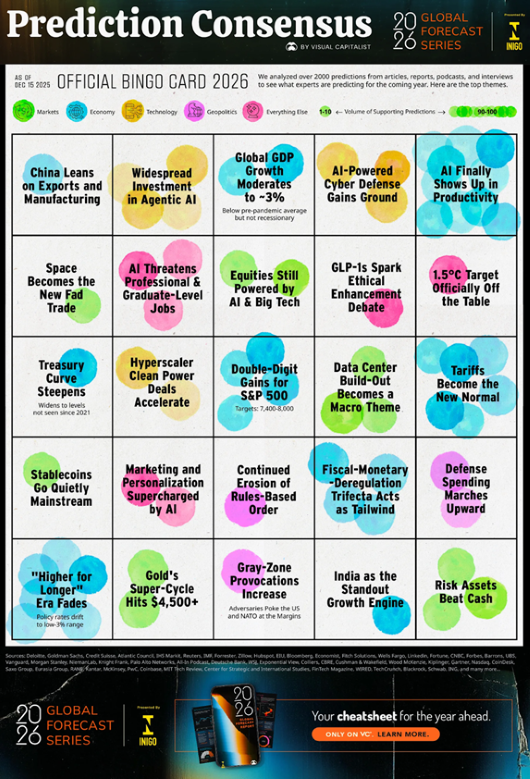
The Prediction Bingo Card
Regular readers know that Visual Capitalist (VC) is one of my go-to sources for overviews, and this week’s prediction consensus—a bingo card summarizing more than 2,000 predictions of 2026—seems worthwhile. The VC commentary notes that AI headlines the predictions for the third consecutive year. However, “(w)here 2024 forecasts centered on whether AI hype was justified and 2025 focused on deployment at scale, the 2026 conversation is about integration and consequences.” I was a bit surprised by the economic optimism that many of the predictions imply. For many, this is a qualified optimism. “The IMF projects global growth at 3.2% in 2025 and 3.1% in 2026—below the pre-pandemic average of 3.7% but not recessionary,” according to VC. “Morgan Stanley expects similar numbers: 3.0% global growth in 2025, 3.2% in 2026 and 2027. Advanced economies are expected to grow around 1.5-1.6%, while emerging markets hold above 4%. The consensus is a soft landing: growth moderates, inflation continues its gradual descent, and central banks ease policy—but not aggressively.”
TAKE IT TO-GO

Wrapping Things Up
The out-of-office replies are multiplying as we enter Christmas week. It’s a time for celebrating and remembering, when the rigours of work are no longer expected to reign, and dear family time takes priority on our schedules. It would be too obvious to present a complete flight of puns, and I know yule all prefer me just to sign off so that you can get on with the celebration, so I will do just that.
Have a blessed Christmas. Insights will be in your inbox the next two Saturdays—next week with a Christmas reflection and the subsequent week with an “In case you missed it” edition so that those of you for whom reading Insights is a Saturday morning ritual are not deprived. A new edition in the usual format will be back in your inbox on January 10th.


Reply to Ray