


November 22, 2025
February 7, 2026
Click “Listen Now” to hear the audio version of Insights.
HERE'S MY TAKE
February 15 is Flag Day in Canada. Canadians don’t exactly get amped about it, and for many, the symbolism of the red-and-white maple leaf is not well-defined. There will be far more enthusiastic flag-waving a week later if our Olympic men’s hockey team reaches the gold-medal game. Still, that doesn’t mean the flag is only a prop for rah-rah emotion.
Patriotism and loyalty are matters of the heart, which makes it healthy to root for your country enthusiastically. But they are also matters of reason. Our self-interest and strategy must take into account how to live alongside others who are appropriately loyal to different flags. As the political temperature heats up in North America, we need to think carefully about flag-waving that goes beyond celebrating Olympic wins.
Amid all the talk of patriotism, calls for provinces to break away from Canada persist. Notably, Canada is one of the few democracies with an explicit legal “exit clause.” The Clarity Act sets out a process by which any province can try to leave Confederation. Provisions akin to divorce law set out a process for negotiating separation terms and a fair division of assets, and possibly redrawing borders. As a related aside, former foreign affairs minister Stéphane Dion noted this week that much of the current discussion ignores both constitutional realities and basic facts. Alberta separatists often correctly point out that natural resources fall under provincial jurisdiction in Canada, and their resentment is rooted in a sense that they aren’t getting a fair deal economically or politically. What they usually don’t explain is how that is solved by joining the United States, where natural resources are under federal control, and from which no state or region is allowed to secede.
Separation dynamics were on my mind following conversations at a reception ahead of a speech by former prime minister Stephen Harper on Wednesday. More than a thousand invitees from across the country were in Ottawa to mark the twentieth anniversary of his taking office, creating the opportunity to meet many folks with a wide range of views on these and other matters. While listening to his speech, I noted that Mr. Harper’s tone in addressing both the U.S. and separation issues was more direct than that of our present politicians across the spectrum. Mr. Harper has the luxury of not needing to campaign. So, he can speak more freely. However, I think his speech could’ve worked in a campaign, likely improving the standing of any current political leader who had delivered it. I even think this template would attract support from some whose federalist frustrations have them now at least considering separatism, even if they insist they’re just copying Quebec’s negotiating tactics to improve their position within the federation.
Amidst all the separation talk, there’s another political reality. The dominant posture on Canada’s political left is an “elbows-up” nationalism that treats US President Donald Trump as the singular cause of every rupture and assumes Canada’s task is simply to resist, endure, and wait for a return to normal. That stance mistakes grievance for strategy and nostalgia for policy. On the right, a mirror-image problem appears. Reluctant to alienate Trump-sympathetic voters, conservative voices often default to the claim that the problem lies almost entirely at home. They blame almost everything on a decade of Trudeau government, rather than grappling seriously with the structural shifts underway in American policy and geopolitics. They seem to forget that, although Mr. Trump may give it a cruder rhetorical edge, “Buy American” was not his invention. It was also an Obama administration policy, underscoring that Canada faces a structural and enduring challenge going beyond the partisan or personal. It’s naïve to think that if we just clean up our own act (which this space has often and specifically argued we must) and outwait the current American administration, we can return to the Canada–US relationship of the past half-century. As Mr. Harper outlined this week, getting our house in order is a prerequisite for an effective solution, but not a solution in itself.
“The moment in history we now face can do one of two things,” Harper said. “It can lead us to blame Donald Trump for all our ills and make excuses for the failures of the last decade. Or it can lead us to finally do what is necessary to attain our full potential as a country—to become more competitive at home, better connected in the world, and to leave Canada the most secure, wealthiest, and freest country on the planet.”
Mr. Harper compared our present moment to the 1860s, when voices south of the border advocated annexing Canada and cancelled a free trade agreement with Canada. Canadians responded by affirming their sovereignty through confederation at considerable risk and cost. It was rational rather than chest-thumping nationalism, but it was confident flag-waving (at that time, the Red Ensign rather than the maple leaf, but that is a whole other debate). “We live in an age of nationalism,” Harper said, arguing that Canada must be united. “We Canadians have no less reason to be nationalist than any other country.”
Mr. Harper’s time in office was marked by an emphasis on flags and symbols. He wrote a book on Canada’s flags, and his official parliamentary portrait features multiple flags arranged to symbolize what mattered to him. One of the most powerful moments in his speech this week came when he spoke of the price paid to defend the Canadian flag: resisting separatism and defeatism at home while standing for our principles abroad, which meant sending young Canadians into battle, some of whom returned in flag-draped coffins. Contrary to President Trump’s demeaning rhetoric, Canada has historically played an outsized role in global military missions, including responding to requests from our American neighbours over time. So, Mr. Harper convincingly argues that we should be confident in asserting our pride and identity, even as we invest to address current military shortcomings.
This message—also voiced by other Harper-era figures, including Cardus Senior Fellow Jason Kenney—differs from the recent political discourse. This is not to dismiss the real grievances of frustrated federalists, nor the importance of honest conversations about Canada’s failures. And that includes the sincere view of some people that things have deteriorated badly enough to merit discussions of separation. Take your pick of villains: political elites pandering rather than leading; economic elites praising free markets while relying on protectionism and resisting competition; cultural elites chasing fads instead of strengthening culture-making institutions. But Canada is not unique in this. We need to engage these arguments and genuinely consider alternatives, not sidestep them.
Quebec and Alberta separatists differ in emphasis: language and culture for the former, economic and political fairness for the latter. However, I don’t hear compelling explanations in either case of how separation would actually solve their concerns. The same is true of discussions about our future relationship with the United States, which are often narrowly focused on a new trade deal. We’re discussing the process of negotiations, but not the substance of what follows a hypothetical new arrangement.
I’m hardly the first to raise this concern. Proposals such as the MLI’s The Grand Bargain and the University of Calgary School of Public Policy’s New North America Initiative similarly argue for thinking big and for getting beyond the constraints of the immediate negotiations. They call on Canada to build on deepening continental integration grounded in robust sovereignty and self-confidence. Partnership with the United States need not mean surrendering sovereignty or acquiescing to bullying. A constructive Canadian strategy would start from the premise that shared security, energy abundance, and economic competitiveness are not zero-sum. A durable North American partnership requires ambition, not nostalgia. It views ourselves and our neighbours not in the context of the short-term interests of current office holders—on either side of the border—nor in the interests of our most immediate tribe, but in the longer-term structural interests and the continuation of the values on which our respective histories have been built.
It’s a conversation not only for our politicians but also for our business and civil society leaders with their cross-border counterparts. The choice is between shaping a renewed continental project among unequal but self-respecting partners or drifting into win-lose arrangements of the sort Mr. Trump seems to prefer. A genuine win-win is possible, but only if Canada is prepared to stand up for itself.
Part of that standing up needs to come from Canadians rising above partisanship and polarization. Mr. Harper’s audience this week was understandably mostly partisan, though I attended his speech as a patriot. And I give due praise to many opposition MPs, former prime minister Jean Chretien, and Prime Minister Mark Carney, whose words regarding Mr. Harper matched the moment and rose above partisanship this week. And at the unveiling of his official portrait, Mr. Harper captured the essence of the moment when he said, “I sincerely hope that mine is just one of many portraits of prime ministers from both parties that will continue to be hung in the Parliament of Canada for decades and centuries to come […] but that will require that in these perilous times, both parties, whatever their differences, come together to preserve the independence and unity of this blessed land.”
Whether the challenge is American-driven economic pressure, internal separatist movements, or a broader loss of confidence in our capacity to solve problems, Flag Day 2026 feels like an especially important time to raise the flag. Patriotism is not mindless nationalism that pretends all is well. But it does carry a quiet conviction—yes, this is worth fighting for—that gets us to the starting line, even when the cost is real and the journey long.
I’m running out of space, so I won’t revisit the deeper questions of identity and survival that I’ve addressed here before. The point today is simple. By July 1, Canada will have been one of the world’s most stable democracies for 159 years. We’ve punched above our weight internationally, offering hope and dignity and providing a future to millions of immigrants, including my grandparents. Our present challenges don’t diminish that legacy. And that legacy is precisely what makes this country, and its democratic inheritance, worthy of a stirring defence and a deep renewal.
God keep our land glorious and free.
Happy Flag Day 2026.
WHAT I’M READING
Palliative Care or MAID
The story of Kiano Vafaeian made headlines this week. The 26-year-old whose diabetes was leading to vision loss went doctor shopping until he found one willing to administer MAID. The case is another in which the lack of appropriate and timely health care options, mixed with mental health issues, is motivating some to seek euthanasia. That issue came to the fore in a Policy Options piece this week by my colleague Dr. Rebecca Vachon, together with two Cardus senior fellows. Together, they argue that the lack of adequate palliative care data “raises questions about how meaningful the choice of MAID really is for many people.” They also note that Health Canada acknowledged its data does not speak to “the adequacy or quality of the palliative care services that were available or provided.”
Word Nerd
Leah Eichler, “a self-proclaimed word nerd,” opined in the Globe and Mail that “the F-bomb was taking over politics.” She argues that profanity transgresses norms, contributing to an overall desensitization to an increase of violence. She notes that profanity is coming from both sides of the political spectrum in the context of ICE raids in Minneapolis since “anyone can swear with impunity now—and maybe, for those who stand up and push back against 'daddy,' that’s a silver lining.” Various articles have reflected on changing public language norms over the past year, including the argument that it reflects emotive authenticity (which can be healthy but also can lead to hateful speech).
Servant Leadership
I generally avoid shilling Cardus material in this space, presuming that those Insights readers who want it already subscribe to other available Cardus newsletters. But this week’s Comment offering, an essay called “The Dark Side of Servant Leadership,” is especially worth noting. It not only does a good job at exposing the dangers that occur when a good concept becomes so popular that it is no longer pursued because of its virtue but rather its popularity, but it also speaks to the authenticity that can only come through relationships and organizations that are scaled in a manner that makes such things possible. There is plenty to chew on in the article with no easy obvious answers, but I consider it worth promoting for those not subscribed to the other threads. (That, by the way, is something you can easily remedy by clicking this link 😊).
Tolle Lege
Tolle lege, which is Latin for “take up and read,” is often emblazoned on library walls. This week, The Atlantic ran an interesting essay on the vicious cycle of a decline in reading, which also comes with a decline in published book reviews. The essay rightly noted that, beyond the particulars that affect readers, the trend needs to be understood in the context of “disaggregation” and distrust, in which the conveners of social conversation and consensus—the “gatekeepers,” as their critics derogatorily described them—are disappearing. I continue to find book-length arguments essential to building a nuanced understanding and have managed, for a few decades, to average a book a week. It sounds more ambitious than it really is; reading at 40-50 pages an hour means that my five or so hours for book reading each week gets me through at least one book. I consciously divide my reading time between my narrow interests, the expertise on which my career relies, and broader reading. I also balance current and historical works, aiming that at least one-third of what I read has stood the test of time and is more than a century old. I have little doubt that our society would function better if more of us took the time to read. And there undoubtedly would also be a larger market for published book reviews, which contribute in so many ways beyond ensuring that you get good bang for your book-buying buck.
MEANINGFUL METRICS
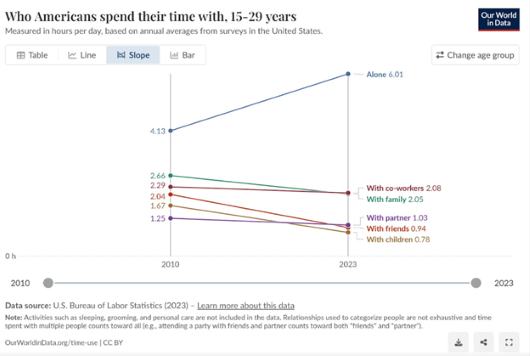
Alone with Your Phone
Data shared on Jonathan Haidt’s Substack highlights how our devices bring many benefits, including “freeing time, saving money and reducing drudgery,” but also make us less present even when with others and increase our loneliness. The trends of the last 15 years show a dramatic increase in “alone time” for 15-29 year-olds, which comes especially at the expense of family time. “(T)echnologies…also disentangled us from one another—eliminating norms and shared experiences that, however effortful, also provided connection. As we grew accustomed to privacy, efficiency, and ease, maintaining our social lives and communities increasingly became a hassle. Independence replaced interdependence.”
Not all the news is bad. The authors report on various initiatives encouraging conscious unplugging. However, “Unplugging isn’t enough on its own,” they write. “The time and energy we reclaim has to go toward building social connections: hosting the dinner party despite the hassle, staying for coffee after church when you’d rather go home, sitting through the awkward silence, offering or asking for help….What’s required is a change of culture, grounded in a basic fact of human nature: that authentic connection requires action and effort, and that this action and effort is part of what makes connection fulfilling in the first place.”
TAKE IT TO-GO

Over Easy
CTV Vancouver told the quirky story of an Easter egg as “its Sawatsky sign-off story” on Monday. The egg–since named Eggbert–was painted by six-year-old David Jenvey at Easter 1966 and, no yoke, it has been stored in a fridge ever since. David and his wife came out of their shell a bit as they told the story to the TV news reporter, with a seriousness that didn't crack me up, but when a colleague brought the story to my attention, I knew it would be an eggs-cellent take-it-to-go for this week’s newsletter. I’m not too chicken to borrow other people’s stuff as a serious newsletter like Insights does need an over-easy way to segue from this week to next. Speaking of next week, it’s Family Day weekend, so we will scramble things up a bit and serve up a menu of recent Insight offerings that you can sample in case you missed them.
Looking forward to being back with a fresh serving of insights on the 21st.


Reply to Ray