


March 28, 2026
April 18, 2026
Click “Listen Now” to hear the audio version of Insights.
HERE'S MY TAKE
On Monday, the Liberal government crossed into majority status in the House of Commons after five floor-crossings and three by-election wins. On Tuesday, Prime Minister Carney announced a temporary suspension of the federal excise tax on fuel, potentially reducing prices by ten cents per litre between April 20th and September 7th, 2026. This responsiveness to affordability challenges was framed as providing “tangible relief” and “positioning Canadians for long-term success.”
Predictably, these created media musings about which leaders were in touch with the grassroots, whether these moves reflect efficiency or cynicism, and what implications they might have for democratic legitimacy. Last week, I used this space to reflect on the fact that, while floor crossings are technically permissible, the current circumstances raise deeper questions about moral legitimacy. It highlights institutions and processes that have morphed beyond their original structure and intent, and hence are being (mis)used in ways that might get things done but at great social cost. When citizens conclude that the process is rigged against them—that engagement is performative and outcomes are predetermined—democracy loses the social trust that makes it work. Gas prices matter. So does the oil gauge.
These issues include both regional (especially evident in the Alberta separation debate, which is an important topic for another day) and demographic dimensions. There is a growing perception that current arrangements favour the boomer generation, widely seen as anchoring the Liberal majority. Social media seized on a Globe and Mail story this week about a retired couple who trimmed a winter vacation from six weeks to four, flew off-peak, and used points to manage fuel costs. It fed a broader narrative: “the system” exists to preserve the comfort of those already in control. The “backroom deal” narrative, reinforced by crossing MP rationalizations that ridings with government caucus MPs were more likely to receive government investments for their constituencies, only reinforces that view.
The data is complex, but the pattern is clear: younger voters leaned Conservative based on affordability and everyday concerns, while older voters focused on protecting what they had and on perceived external threats, particularly from President Trump. Turnout among older Canadians is typically 20-35 percent higher than among younger cohorts, with similar gaps in party membership and engagement. "Team Establishment" is winning; the younger tribe needs to wait their turn. On the one hand, this isn’t new. There is a stage-of-life dimension to this. Younger Canadians have always been less politically engaged and felt less political agency. Whether disengagement leads to diminished influence, or the reverse is true—if you were more engaged, you’d get better results—remains an oft-debated question.
But there’s more to this than politics. Today’s younger Canadians face a level of precarity unlike previous generations. Those under 35 have home ownership rates 8-14 percent lower than their parents at the same age. Buying the same home at 28 instead of 38 typically makes a difference of over three hundred thousand dollars in additional lifetime wealth. Marriage comes later, fertility has declined sharply, and far more young adults are living with their parents well into their thirties. The realistic “flourishing dream” for most younger Canadians has been significantly redefined.
Cardus’s work with the Angus Reid Institute underscores this divide. Those over 55 tend to view the baby boomers’ legacy positively; nearly 70 percent of those under 40 do not. Disillusionment runs deep: almost 60 percent of younger respondents said they would look abroad for opportunity rather than rely on attachment to Canada. Many see the future not in building on the past, but in starting over.
Those poll results came to mind as I listened to the public conversations this week. Beneath the surface conversations about politics and gas prices—especially among younger Canadians—there is growing cynicism about agency: When the government we get doesn’t reflect the choices we made, what’s the point? Is Canadian democracy just an imperial Prime Minister’s office, with everything else as window dressing? Why even bother when our votes don’t really determine the outcome?
The immediate concern may be political, but the underlying issue is broader: how Canadians experience agency across all institutions. Isn’t the prime argument about separation in Alberta the extent to which the institutions listen and reflect regional voices? There is a growing sense that society is subject to the whims of leadership that does not really respect those affected by its decisions. We can quibble about whether this is a consequence of the decisions themselves, the process used to make these decisions, or the manner in which they are communicated (the media usually gets a fair bit of blame here), but it’s hard to argue with the reality of the result.
From where I sit, most leaders are not acting in bad faith. They take their tasks seriously, trying to exercise their positions of responsibility in ways that get things done. Leaders sometimes view institutional constraints as obstacles, so they rationalize taking shortcuts as long as no laws are broken. That may be pragmatic. It may even be familiar. But there comes a point when, just because something can be done—even efficiently—it is not wise. Process shapes trust, and trust is an underappreciated social asset: slow to build, quick to erode.
If what we pay at the fuel pump is a proxy for the everyday experience of the affordability challenge—most of us can’t get to work or live day-to-day without our vehicles—then it might be helpful to extend the analogy and look at the other lights on the dashboard. The cynicism prompted by current events has prompted the oil light to flash its caution.
Like the oil in my vehicle, trust is rarely thought about but remains the essential lubricant of social life. We can address trade, productivity, and security. But even if we solved every technical issue, our society will only flourish to the extent that people believe in its identity, values, and opportunities—and in their ability to share in them. It’s about trusting that the system is not rigged and, although imperfect, will ultimately work and is therefore worth participating in.
The Prime Minister’s leadership faces a new test—how he uses his majority. Ideally, he will not utilize the majority advantage to bypass the meaningful role that the legislative branch is intended to have in our system. There is a choice between embracing debate and accountability and consolidating control by limiting scrutiny. Now that an election is not imminent, the test for all of our MPs is whether they can resist using the House of Commons primarily as a stage for their performative social media messaging and instead focus on achieving some of the ideals of accountability that the legislative branch of government is intended to uphold. As one pundit noted, “it might be prudent now that he has a majority for Prime Minister Carney to give Parliament the respect as if it were a minority.”
The fact of our constitutional divisions between the federal government and the provinces; the accountability provisions between the legislature and the executive branches; the lack of clarity regarding the role of the Senate with the potential for its powers to be significantly abused; and the reduction of political parties to marketing machines for their leader to become the Prime Minister and using the office to govern imperially—all of our political institutions have swerved from their paths and it feels our democracy is veering from ditch to ditch (and I haven’t even mentioned the confusing role of the courts in all of this). Our democratic vehicle needs more than just an oil change; it needs a total tune-up. Achieving a majority government in the manner we saw this week might have made sense for reaching a short-term political destination, but it was achieved despite, not because of, effective political institutional arrangements.
Most leaders I meet are idealists. I differ with many regarding the content of those ideals, but respect that they are doing what they can to contribute to a better society as they are able. But we are at a time in which motives matter less than perceptions. There is a growing belief that those with wealth, position, or influence are focused on protecting what they have rather than creating opportunities for others. Those in leadership need to focus not only on outcomes but also on respecting the process and agency of those they lead. Social trust requires a broad-based sense that one’s voice matters.
People understand that decisions will be made by others that impact them. Many even welcome it. But something shifts when the opportunities to engage are seen as irrelevant or disregarded.
The unusual path to this majority reinforces a narrative that engagement and agency do not matter. It will shape political careers, but its deeper consequence may be the strain it places on the generational compact—the expectation that each generation inherits something to build upon.
Trust, legitimacy, and agency may sound abstract. There is no checklist for building them. But just as a vehicle cannot run without oil—even when we pay more attention to the fuel gauge—we cannot ignore these as the essential emollients of our social fabric. Focusing only on how we might afford the fuel while ignoring the dashboard warnings that our social lubricant levels are getting dangerously low is not a good long-term strategy. Here’s hoping that the leaders of all of our institutions and those on all sides of the Parliamentary House are attentive to the importance of building democratic trust. Even those of us less mechanically inclined know that ignoring those warnings is a costly proposition.
WHAT I’M READING
Questions about Ontario MAID Scrutiny
Thursday’s Globe and Mail carried an editorial regarding changes to the size and parameters of the committee tasked with reviewing complex cases of medically assisted death. The Globe worries that “a shift in emphasis from oversight to providing guidance to MAID practitioners” amounts to avoiding the scrutiny that has come as a result of disturbing cases of patients being offered euthanasia in place of social or medical services that were not available. Speaking of the safeguards which the Supreme Court suggested needed to accompany euthanasia, The Globe wrote: “Ensuring there is vigilant scrutiny of those safeguards is the proper – and critical – role for the coroner’s office and its committee, not a misguided move toward a ‘solution-oriented dialogue.’”
Measuring Identity Politics
My colleague Étienne-Alexandre Beauregard tackled the perennial debate on the political right regarding the wisdom of avoiding (or not) divisive cultural issues to focus on “bread and butter issues.” Borrowing a formula proposed by Sean Speer in thehub.ca, Beauregard argues against conventional wisdom in suggesting that the right’s avoidance of cultural themes “is largely responsible for their loss of popularity among a substantial portion of the electorate, all over the world.”
Last Branch Standing
New York Times columnist Ross Douthat hosted Sarah Isgur, author of a new book, Last Branch Standing, on his podcast to talk about the courts's various rulings relating to presidential powers. Isgur notes that very little of the conflict is original to Trump, and that what has changed is the volume and intensity, rather than the character, of the longstanding tug-of-war between the branches of government. Citing President Obama’s quote, “I’ve got a pen and I’ve got a phone. And I can use that pen to sign executive orders and take executive actions and administrative actions that move the ball forward,” noting that the only difference is that President Trump is “using a much bigger pen and a much bigger phone.” For those preferring to read rather than listen, a transcript is available. In either form, the hour-long podcast provides a helpful perspective on the past, present, and future of the United States Supreme Court.
Remember Michael Kovring?
He was one of the “two Michaels,” Canadians detained for 1,020 days by the Chinese government. He was a victim in a diplomatic dispute in which China used less-than-diplomatic methods to register its dissatisfaction with the Canadian government. He penned a Substack piece this week reflecting on recent developments and concluding that “The Carney government's economics-first approach to Beijing shows worrying signs of downplaying human rights abuses—including forced labour in EV supply chains.”
Common Sense Justice
Usually, newspaper columns commenting on judicial decisions highlight things that may be rationalized legally but don’t pass the common-sense test. The story usually provokes incredulity and outrage among non-lawyers. This week’s National Post column on Judge Antonio Skarica’s decision is of the opposite genre. Skarica sentenced a criminal with no immigration status to 28 months in jail, greater than the two years less a day that the crown requested for threatening a woman. Explaining his decision in the context of recent court decisions that lessened sentences for those in immigration proceedings, Skarica wrote: “In my opinion, the Canadian justice system is at an inflexion point. Who should get priority: Should it be a foreign-born individual with no current immigration status, who was granted the privilege of attending one of our educational institutions, and used that opportunity to abuse a law-abiding, honest, hardworking but vulnerable Canadian citizen? Asking that question provides the obvious answer.”
MEANINGFUL METRICS
Switching Religions
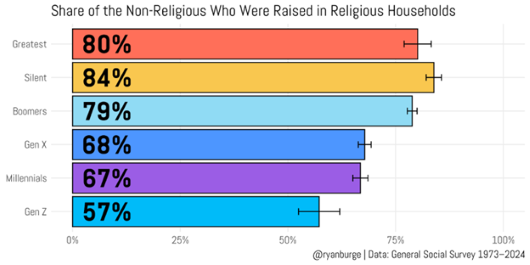
Ryan Burge is one of the leading sociologists of religion in the United States, and his data pages are filled with valuable insights. A few weeks back, in an article titled “Inertia Still Rules American Religion,” Burge highlights that 74 percent of those who are religious today are affiliated with the religion they were born into. While that is down from 89 percent in the early seventies, it is still higher than most imagine. This obviously has an impact on the data for non-religious folk; however, that group is increasingly composed less of those who have abandoned religion than of those who were raised non-religious. This chart shows a clear trend by demographics, with older “nones” having been raised and rejecting religion, whereas younger “nones” are more likely simply to reflect the non-religion in which they were raised.
TAKE IT TO-GO

Zoom, Zoom, Zoom
A few decades back, I drove a late-nineties Mazda Protege whose manual transmission I could occasionally coax to match the “zoom, zoom, zoom” in the legendary commercials. This week, I came across coverage of Japanese office chair races, which prompted my Mazda memory, though I’m not sure the 90 kilograms of rice prize would be enough to convince me to zoom my desk chair around a track for two hours.
I won't Slack on office programs, but I’ve spent many more than two hours Zooming in a more conventional office setting. As best I can tell, there is no follow-up meeting booked, although if the schedulers are using Teams, the possibility is real that it has been booked but just hasn’t yet registered to impact my Outlook. Before I try to Excel in wordplay metrics over other important deliverables, we will just leave this as the final Word on the matter.
I can confirm, though, that next week’s Insights is in the calendar and scheduled to arrive in your inbox next Saturday morning. Until then, whether you’re on Zoom or getting a bit more zoom-zoom, have a good week.


Reply to Ray