


June 1, 2024
May 2, 2026
Click “Listen Now” to hear the audio version of Insights.
HERE'S MY TAKE
Trade and tariffs have made headlines for most of the year since Prime Minister Carney and President Trump assumed office, with every note of rhetoric, actions and reactions analyzed for what it might imply about the future. The upcoming July 1 deadline–the date by which Canada, the United States, and Mexico must complete their joint review of the USMCA trade deal and decide whether to extend it–is about to make things real in a different way. Deadlines clarify and the agreements made (or not made) will have implications in a way that parsing exactly what was meant by a “rupture in the relationship” phrase in a speech does not.
As we move toward the deadline, the significance of this is coming into focus. The Prime Minister has appointed a new ambassador, a new advisory committee, and a new chief negotiator. The partisan barbs have increased in intensity with Opposition Leader Poilievre questioning Mr. Carney’s economic credentials and suggesting that to date, the Prime Minister has “squandered our leverage” and is “showboating.” Carney has dismissed Poilievre’s critique by asking, “What’s he ever negotiated?”
Stateside, Commerce Secretary Howard Lutnick was challenged in a recent Senate committee meeting hearing by New Hampshire Senator Jeanne Shaheen. Referring to Lutnick’s earlier quote that Canada’s negotiating strategy “sucks,” Shaheen asked bluntly: How does insulting America’s closest ally help businesses in her state that depend on Canadian tourism and trade? Lutnick doubled down, emphasizing that Canada’s economy depends on the United States and that it was “insulting” to Americans that Canadians responded to the Trump tariffs by removing American alcohol from their shelves.
I suspect we are in for another few months of intensified rhetoric between and within both countries. Given that the implications of what is being discussed impact so many jobs and even entire industries, understandably, these make news, which in turn attracts follow-up and an ever-polarizing vocabulary. It is especially important when hearing such commentary that they are really a side show to the real negotiations that are happening. Beneath the noise lies a more stable and enduring reality, shaped by the precise mechanics of the agreement and the enduring facts of geography.
It’s easy to misunderstand what is happening. The USMCA (it is also sometimes referenced as CUSMA) is a trade agreement between the United States, Canada, and Mexico that came into force on July 1, 2020 and officially runs until June 30, 2036 (a sixteen-year agreement). It has its roots in the 1989 Free Trade Agreement between Canada and the United States, which Mexico joined in 1994 during the NAFTA era. And while the tariff policy of President Trump has been the most significant challenge to that agreement in the past forty years, a total reframe of the agreement does not necessarily follow. It’s important to separate the media noise (which is part of the politics and persuasion pieces that are significant in the public policy process) from the precise policy levers that need to be pulled on July 1.
Bear with me for a paragraph of technical detail that is actually important and seems largely misunderstood. Under Article 34.6, any of the countries may provide six months' notice and withdraw from the agreement. That can happen at any time, and the fact that President Trump has not exercised this clause suggests–his rhetoric notwithstanding–that he understands the American economy is better off with a healthy trade agreement with Canada. If ripping up the agreement were in America’s best interest, they would presumably have done so already. If that were to happen, in six months, North American trade would revert back to the global World Trade Organization rules and whatever bilateral agreements the countries might improvise, which most agree would end up fragmenting crucial supply chains, significantly increasing costs on both sides of the border, and causing economic adjustment on both sides of the border. Canada might be hurt more severely than the United States (given that US trade is a larger proportion of Canadian trade than vice versa), but the hurt would be significant in both countries.
But Trump hasn’t done that. Under the terms of CUSMA, which remains in force, we have a July 1, 2026 deadline, which, under the terms of Article 34.7, requires an official “joint review” of the agreement. The terms are quite straightforward. Each of the three countries officially submits proposals for changes they would like to see to the agreement. If everyone agrees, the agreement is extended 2042 with similar built-in reviews every six years.
But what happens if all countries don’t agree? It only takes one of the countries to disagree (Canada, Mexico, and the United States may come to these discussions with different degrees of leverage given their size, but they each remain sovereign states), and then the ten-year clock towards the agreement’s expiry starts ticking. Again, no one has to wait ten years–the six-month exit option under Article 34.6 always remains available. But assuming that since that hasn’t happened yet, it is unlikely to happen immediately (and the changing dynamics between the president and the Congress may make that even more difficult for the US administration in the future than it has been to date), effectively the failure to reach agreement on July 1 results in a continuation of the status quo formal trade agreement that officially persists while disputes, tariffs and counter-tariffs, and carve-outs multiply in practice.
There are many who say that is where we are already at and that, as the US agreements with Great Britain, the European Union, and others indicate, there is no agreement that can be reached which is reliable with the present American administration.
I was taught the concept of BATNA early in my negotiation career. It requires articulating for yourself “What will the other side do if they are unable to reach an agreement with me?” as well as answering that same question as to what you would do if no agreement is reached. It is those alternatives that are the true negotiating position of the other side–not the position that they advocate in the negotiations process (or in the case of national negotiations with a political dimension, through the media).
The punditry noise and media coverage of the negotiations focus on the messages the parties want their constituencies–and the other side–to hear, but rarely reflect what is really happening in the negotiations. Both the 1988 and the 2018 settlements occurred with hours to spare before the deadlines, with messages of pessimism about a likely agreement sent by both sides until a deal was actually reached.
Does that mean a deal is inevitable at the last minute again? Hardly. President Trump fancies himself a dealmaker. He’s even written a book on it. He also values symbolism and how he is perceived, and the views of Canadians and Canadian leaders toward him don’t seem to incline him to be overly friendly towards us. He is certainly not very popular in Canada, and he knows it. But he also admires strength. Standing up for your own interests and being firm isn’t necessarily deal-breaking behaviour. Insiders who deal with this administration tell me that, more than any that preceded it, the president himself is more of a decision-maker on files like this than his advisors. Whatever you think of the president, predictable isn’t a word that you probably use to describe him.
I use the policy-persuasion-politics triad to analyze every public decision that is coming down. The policy matter is quite straightforward. Either Canada, Mexico, and the United States reach an agreement on July 1 extending it for a decade, or we enter a decade (or until we find reason for an agreement, perhaps after internal US political dynamics have changed) of managed deterioration of the existing USMCA. This is not preferable from a Canadian perspective, but neither is it something to be avoided at all costs either, especially since the president’s history of the past year of unilaterally reinterpreting the existing rules means we are essentially in that spot presently.
So what arguments might persuade? The Canada-US relationship has historically been shaped by geography (we are natural trading partners regardless of what we think about each other), history, and shared values. While the economic realities that can be measured in terms of trade, jobs, and inflation numbers easily dominate, the real question is whether we see the North American project as a combined force for good in the world, in which citizens on both sides of the border view the other as an ally. (See the data in Meaningful Metrics below–Americans across the spectrum seem more favourable towards Canada than does the rhetoric of the present administration.) Will the framework for finding an eventual deal focus on finding stability for both sides, or on securing an economic victory for our side? Keep in mind that perfect free trade doesn’t really require an agreement–there are no rules to negotiate if all trade is free. The fact that the present USMCA runs over 1,000 pages (just the core agreement, excluding its extensive annexes and tariff schedules) indicates it's not free trade but rather the careful management of sector-specific understandings, organized into 34 chapters. There is lots to persuade each other about, but at the core, it will come down to whether Canadians and Americans want to view themselves as friendly neighbours working together for a peaceful neighbourhood and good in the world, or whether we are competitors in some economic battle in which being first is all that matters.
All of which brings us to the politics of the situation, into which almost all of the current coverage fits. Here, the tone matters as much as the substance. Right now, the trade fur is flying, to borrow a phrase from our fur trade past. That may have belonged to the era, but it wasn't the fur that could be traded.
When the trade fur finally settles on or after July 1, what will matter most is not who won the exchange–be it the rhetorical or the precise numbers in the agreement–but whether we preserved something worth trading within.
The rhetoric is noisy, not always comfortable–but just like a hockey fight, an important component of the game. So if we must pay attention to headlines, I prefer this week’s headlines about Buffalo Sabres fans stepping in to support a singer whose microphone failed while singing the Canadian national anthem at a hockey game in the United States, with only American teams. I remain hopeful even as the rhetoric escalates, the barbs sharpen, and the theatre intensifies, that these do not change the underlying reality: Canada and the United States are bound together by more than the latest negotiating posture.
WHAT I’M READING
The King’s Speech
As someone who values the institution of the monarchy and its function in Canadian constitutional democracy, it was amusing to observe the reactions to King Charles’s address to the United States Congress this week. The Wall Street Journal headline, “What brings feuding Americans together? A king, it turns out,” highlighted how the King used some light-hearted humour and careful wording to raise important themes in a manner that avoided controversial specifics but still made some important points. The coverage was a bit more pointed in the French newspaper Le Monde, which was more explicit than the speech itself in interpreting the warnings about nationalism, isolationism, and the challenges facing democratic processes and the rule of law. The British Guardian chose to highlight the contradictions and absurdities and was unable to resist quoting the king: “Charles ribbed Trump over his demolition of the East Wing of the White House to make way for a $400m gilded ballroom. ‘I’m sorry to say that we British made our own small attempt at real estate redevelopment of the White House in 1814,’ he joked, referring to the burning of the first White House by British forces in the War of 1812.”
Economic Strategy
Finance Minister François-Philippe Champagne presented the government’s spring economic update on Tuesday. Partisan reaction is predictable, but I find it interesting to scan sectoral reactions to it. The Globe and Mail editorialized with cynicism: “In the upside-down land of the Liberals, a spending spree is a spending cut, blowing a windfall of billions of dollars is prudent and failing to prepare for a fiscal storm is, well, just good management.” The banking analysis was only slightly more favourable, with the Royal Bank describing the release as “more of the same strategy.” The Canadian Labour Congress expressed impatience: “Workers need real results now”. It got virtually no coverage, and I’m not exactly sure what it means, but the paragraph regarding potential changes for the charitable sector did catch my eye. (I reproduce the paragraph verbatim in the next entry.)
Modernizing the Charitable Framework
From the Spring Economic Statement: “Modern Tax Rules for Charities: The Government of Canada’s tax incentives for charitable giving aim to mobilize private capital for public needs, creating an attractive environment for donors while supporting affordability, social security and our communities across the country. The government recognizes that the charitable sector, and non-governmental organisations, are an important driver for the Canadian economy, create well-paying jobs and supplement the social safety net. With advances in technology and digitization, the government will undertake an exercise to modernize the framework for the charitable sector in 2026-27. As a first step, the government will undertake a consultation with key stakeholders and relevant agencies for them to provide feedback and align with best practices adopted by other G7 countries.”
Evidence and Conspiracies
Jonathan VanMaren makes important distinctions between requiring reliable evidence before being convinced of something on the one hand, and either buying into conspiracy theories or blindly following experts on the other. He rightly points out that this is an issue on both the left and the right, but writing as he is for a conservative-oriented audience, he focuses on the current debates regarding the Epstein files and Candace Owens’s take on Charlie Kirk’s assassination. He helpfully concludes: “If truth matters, we should pursue it. If evidence matters, then we should consider it – and the lack of it. If we are being led to conclusions through skillful narrative creation rather than proof, we should stop and consider where we are being led and why – because many influencers who identify as Christian have done more to confuse and corrupt their audiences than progressives ever could.”
MEANINGFUL METRICS
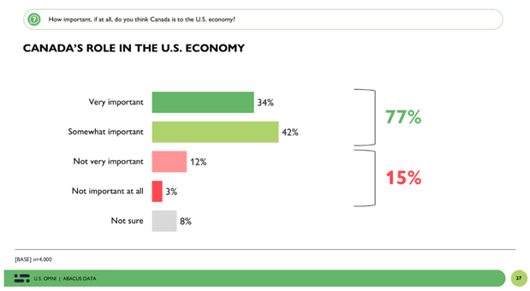
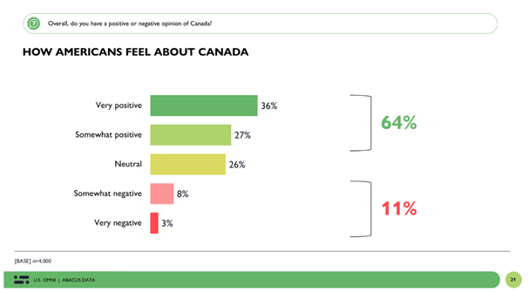
A poll of 4,000 Americans conducted in February suggests that Americans remain very positive about the importance of Canada to their economy and continue to have a favourable impression of their neighbours to the north. I expected to see a significant partisan divide within the US on these questions. Those divides are evident in questions about tariffs, but when it came to perceptions of Canada and the renegotiation of the USMCA, I was surprised to see the consistency across the political spectrum. “Views are similar in border and non-border states. Close to half in both groups of states think USMCA should be kept largely as it is or kept, but with some changes. By past vote, 54% of Trump voters support keeping the agreement largely as it is or with some changes, compared with 50% of Harris. Among MAGA Americans, 59% support keeping the agreement, while 19% want to see major changes or it be scrapped entirely. Just 12% of Americans overall want to see USMCA scrapped entirely.”
TAKE IT TO-GO

Cowtown
I drafted this week’s Insights working from a Calgary hotel room, shortly after leaving a restaurant serving Alberta beef that had two cow statues grazing at its entrance and welcoming guests. No bull–it immediately came to me as to what this week’s takeaway should be. After all, isn’t this paragraph about chewing on some wordplay cud after the main course has been served? I’d be steering you in the wrong direction if I didn’t do cow puns from Cowtown.
Calgary came to be a city after the Canadian Pacific Railway came through in 1883 and it served as the key shipping point for the cattle raised on the vast Alberta grasslands. The “Cowtown” moniker came early and stuck. It’s not just the annual Stampede but the Ranchman’s Club, Cowboys Music Festival, and Lammle’s are among the ever-present reminders that you are in Cowtown. It is not even udderly ridiculous to argue that of all the Canadian city monikers that have a century-old-plus history, Cowtown remains the most authentic and embedded in the city today, even though the vast majority of the city’s 1.6 million residents would be as uncomfortable dealing face-to-face with a cow as are the politicians who awkwardly wear cowboy hats, big belt buckles, and uncomfortable boots during Stampede.
But it’s time to mooove on as I’ve milked this one for about all it’s worth. I’m off to Edmonton and Vancouver before heading back to Ottawa, from where I hope to draft next week’s Insights, which should provide some reflections on the media coverage I will graze on over the coming week. Look for it in your inbox next Saturday morning.
Have a great week.


Reply to Ray